
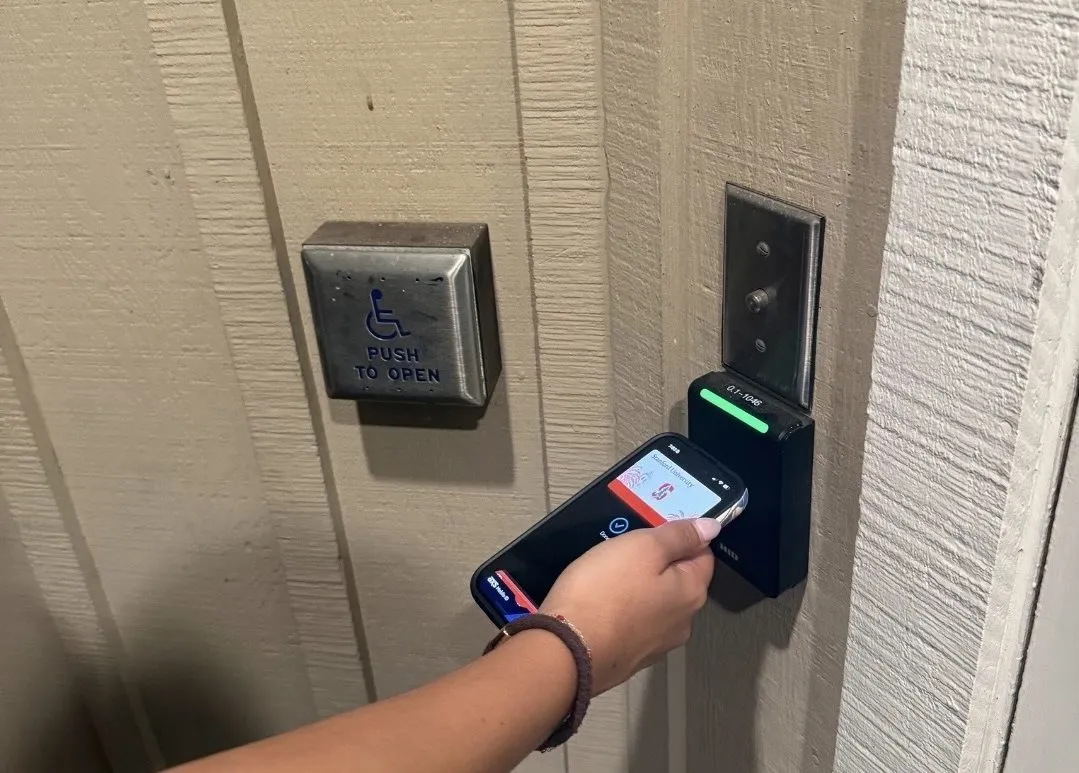
By simply tapping their mobile device to a card reader, students can now use their phones to get into their dorms. The new feature, Stanford Unlock, launched Oct. 5 and expands on Mobile Key, the tap-to-enter system University Information Technology (UIT) introduced in 2022, which previously allowed students to access gyms, libraries and academic buildings.
An Oct. 1 email to students from Residential & Dining Enterprises (R&DE) Student Housing Operations detailed the conditions of the new feature, including that Stanford Unlock lets students scan for Cardinal Dollars and Cardinal Print stations. Physical University ID cards will continue to work as before, but for dorm access specifically, students will need to choose between their ID card and Stanford Unlock for entry.
Jocelyn Breeland, chief communications and marketing officer at R&DE, explained that the new feature addresses a security gap that kept Mobile Key from working on residence halls for years.
“Mobile Key did not open residence doors because at that time there was not a solution for the unique security concern with having two access credentials — a phone and an ID card. Since then, we are aware that students have wanted the convenience of using mobile devices to enter their residences,” Breeland wrote in an email to The Daily.
Breeland explained that R&DE worked with UIT over the summer to pilot Stanford Unlock in select graduate residences.
“Our pilots were successful, with positive student response, and we are now happy to offer this option for all students living in residence,” she wrote.
According to the Oct. 1 email to students, the physical ID card is the default access method for housing unless a student switches to Stanford Unlock. Students have an initial 30-day grace period to switch between the two, after which they can change their access method only once every 30 days. The email also clarified that Stanford Unlock does not replace the Mobile ID within the Stanford app as the University’s digital identification card.
The email also noted that Stanford Unlock will not unlock doors to facilities at Stanford Medicine, where community members will continue to need a hospital badge to access the School of Medicine, Clark Center and Stanford hospitals.
Breeland explained the security reason behind the 30-day policy, adding that system administrators can help students who lose their phones.
“The 30-day policy is in place to ensure the security of a system meant to protect all individuals in community living facilities. System administrators can assist with lost mobile phones as needed,” she wrote.
Students can use Stanford Unlock to open exterior residential doors; however, they will still need their physical ID card to open interior doors to apartments and bedrooms. According to Breeland, R&DE plans to incorporate those interior doors into Stanford Unlock in the future.
Jacqueline Martinez ’27 said she hadn’t heard about Stanford Unlock before being asked about it.
“I didn’t hear anything about it, and I didn’t know about it,” she said. “I’ve just gotten used to the ID, so I just carry my ID around everywhere. I think if I wasn’t in the habit, the phone is definitely easier because you always have your phone.”
Martinez, who serves as a Resident Assistant (RA) in Soto, where students can use ID cards to enter their rooms, explained that an RA’s ID card acts as a masterkey for the dorm. She said that with Stanford Unlock, there’s no risk of losing her ID card, potentially giving someone access to the entire dorm.
“The phone in that case would be more convenient,” said Martinez.
Luke Kosner ’30 has used the Mobile Key since arriving on campus in September, and said he’s found it convenient. On Oct. 5, Stanford Unlock’s launch day, he tried using the new feature for his dorm.
“I use it every day getting into buildings except for my dorm,” he said. “One, I have [my phone] on me more often than my wallet, and so I’ve resorted to having this little mobile wallet thing that I don’t really want to use. Second, I have Find My iPhone on my phone, so if I were to lose it, I’d have a higher chance of recovering it.”
Kosner said that only his physical ID card, not Stanford Unlock, works to enter his dorm as of now.
Other students reported similar issues on Fizz, an anonymous campus social media app. One student posted, “Tried to move my housing access to my phone and now I have no access. Someone at Stanford IT missed the CS ethics lecture on not shipping vibesh—ed software to prod.”
Another student posted, “BEWARE DO NOT SWITCH HOUSING ACCESS, because of Stanford’s s—ty IT I can’t even get into my dorm now.”
Kosner suggested that all dorm rooms should have digital access instead of physical keys because then students would only need their phones to access any building on campus. He also suggested that the University improve communications on Stanford Unlock’s features.
“I bet a lot of the reason that people are still using their physical keycard is because they don’t know about Unlock,” he said.
Kosner also recognized that the decision is ultimately up to students.
“I think that we’re able to make an informed choice,” he said.