
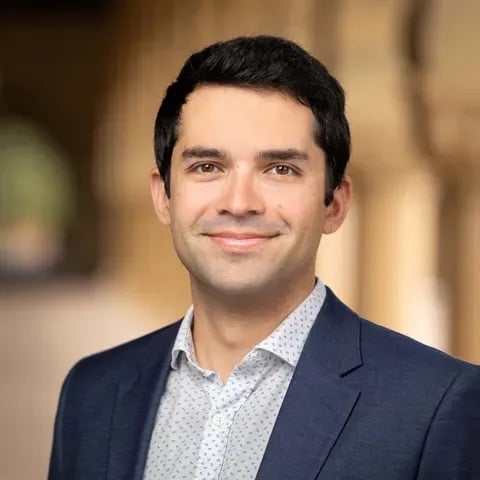
Assistant economics professor Adrien Bilal was selected to join the TIME100 Next 2026 last Wednesday for his work on long-term economic consequences of the climate crisis. Next 2026 is a list of the world’s most influential rising stars in various fields, from business and entertainment to the arts and scientific research.
Bilal’s most well-known work advocates for the efficiency of introducing decarbonization strategies such as domestic carbon pricing and overhauling electricity generation. He received French newspaper “Le Monde”’s Best Young Economist Prize last March for work in shifting the climate policy debate away from the local scale and towards the global supply chain.
He also won the prestigious Frisch Medal for his joint development of a model that quantified the misallocation cost of labor friction, which is the gap in skill, cost, or time that prevents viable workers from instantly matching with employers.
His views and findings on policy are best summarized by Bill McKibben, environmentalist and author of his TIME bio. McKibben wryly wrote of one line in Bilal’s most popular study, which featured his calculation of GDP risk, that “[the line] is econospeak for ‘what on earth are you doing propping up coal plants and shutting down wind farms?’”
With his Time100 Next recognition, Bilal joins Katherine Dafforn (Biology, the University of Massachusetts Boston) and Yu Deng (Mathematics, the University of Chicago) as one of only three professors honored on the list.
Bilal is also a fellow at the Stanford Institute of Economic Policy Research, where he focuses on climate change and its relation to spatial and labor economics.
According to Bilal, the news came as a surprise. His initial reaction was, “So surprised, but very pleasantly surprised,” he said. “You see some academics on the list, but not that many.” He hopes that the selection will bring greater public awareness to the research and its implications.
While Bilal’s work mainly warns that neglecting the global economics of environmental degradation can have unprecedented consequences, such as a 50% drop in the world’s GDP by the end of the century, he also emphasizes that climate policy’s benefits can extend beyond the environmental.
“If we can bend the temperature curve,” he said, “then you would be in a situation where as economic growth accelerates, living standards improve faster than what we‘ve been used to and global health also improves faster.”
Pete Klenow — Bilal’s colleague, a professor of economics policy and Senior Gordon Fellow at the Stanford Institute of Economic Policy Research — said the honor was “well deserved.”
“Just as striking is how quickly he has done it,” Klenow told The Daily. “[Bilal] finished his Ph.D. in 2020 and already has a record… that compares favorably with tenured faculty at the best departments in the world. We are lucky to have him as a colleague, and I expect he will be one of the leaders of the field for a long time.”