
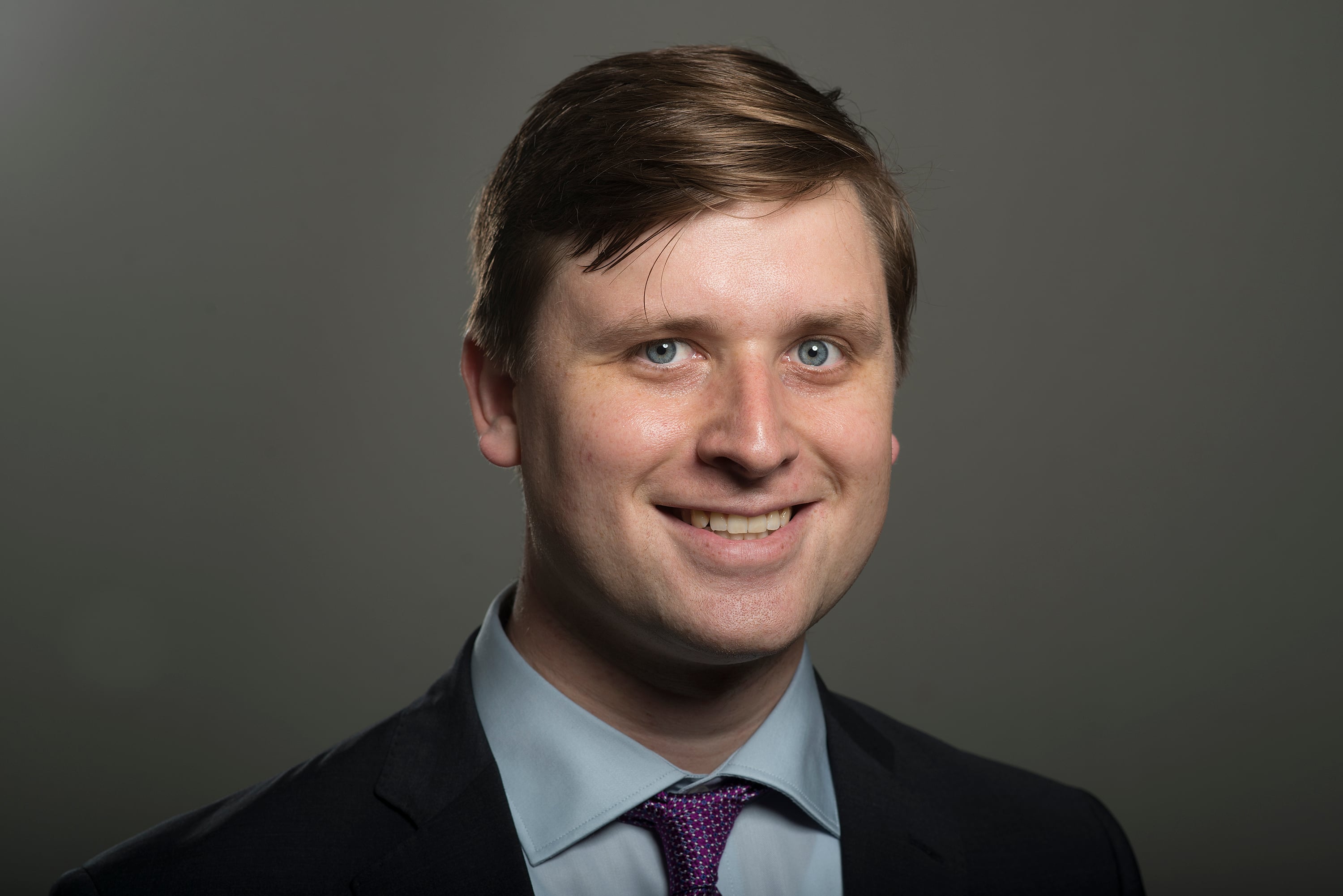
The Washington Post’s Deputy Opinion Editor James Hohmann ’09 told Stanford students in a Tuesday talk that American institutions should still be trusted, and that they could come back stronger after facing pressure.
The event, titled “The Guardrails Are Holding: A Case For Confidence in American Institutions,” was hosted at Green Library.
Hohmann illustrated the role of institutions by recounting his experiences as a Stanford undergraduate. A former editor-in-chief of The Stanford Daily, Hohmann said he spent time as an undergraduate studying, and sometimes procrastinating, in Green Library.
The building, he said, contained examples of the important role that American institutions have historically played. A first edition copy of Galileo’s “Sidereus Nuncius” (“Starry Messenger”) — the 1610 work in which the astronomer first published observations made with a telescope — is held in Green Library, for example. Preserving and carrying on knowledge like this, Hohmann said, is what American institutions do.
While current political institutions such as the judicial system are “not perfect,” Hohmann nonetheless believes that the American system stays accountable because of multiple checks and balances. He pointed to the Justice Department’s criminal investigation into Federal Reserve Chair Jerome Powell, which was dropped this spring, as an example.
The investigation centered on accusations of corruption regarding Powell’s handling of renovations at the Fed’s headquarters. After being closed in April, it was referred to the Fed’s inspector general. The case ended after Chief Judge of the U.S. District Court for D.C. James Boasberg found that the government had produced “essentially zero evidence” of a crime.
Hohmann also commended the resilience of the press, which has been targeted by the Trump administration in recent months. Most recently, the president wrote on Truth Social that The New York Times “and many other artificial media outlets, should be arrested for their dishonesty and disservice to our country,” after the Times reported empty seats at his Saturday rally in Ohio.
“The other half remains,” Hohmann said, referring to the important role of mass media as the “fourth estate,” a branch essential to democracy that runs parallel to the executive, legislative and judicial branches.
He pointed to the Washington Post’s exclusive reporting on Trump secretly switching planes in Turkey in July ovdr concerns regarding a possible Iranian attack, as well as the Post’s reporting last month that a U.S. intelligence assessment found Saudi Arabia has not ruled out developing nuclear weapons. These examples, Hohmann said, suggest the American press is still doing its job despite immense pressures from the administration and low public trust.
According to Hohmann, as a former history major, the United States’ current moment could be another episode of the historical instances in which American institutions improved after challenges. He pointed to past episodes that exposed weaknesses in American institutions — Franklin D. Roosevelt’s attempt to pack the Supreme Court, Harry Truman’s seizure of the steel industry and Richard Nixon’s Watergate scandal. In each case, he said, the system ultimately corrected itself and “institutions [came] back stronger through reform.”
To “study the weaknesses” of the system and repair them, Hohmann said, is the proper way to preserve and strengthen institutions.
Hohmann’s employer, The Washington Post, is one such institution that has faced headwinds in recent years. Jeff Bezos purchased the publication in 2013 for $250 million, and made the decision to stop making presidential endorsements in 2024.
This year, the Post’s publisher made the “hard decision” to close its Middle East bureaus over budgetary concerns, Hohmann said. The cuts, announced in February, eliminated roughly one third of the Post’s staff, including its entire team of Middle East correspondents and editors.
“The bureau system is expensive, but [the Post is still] covering extensively on the Middle East,” Hohmann said.
Vice Provost of University Libraries Micheal Keller, who hosted the event, had his own comments regarding American democracy. The country must “rescind [the Citizen United decision] in the years to come,” he said. That decision allowed unlimited political spending by corporations and unions.