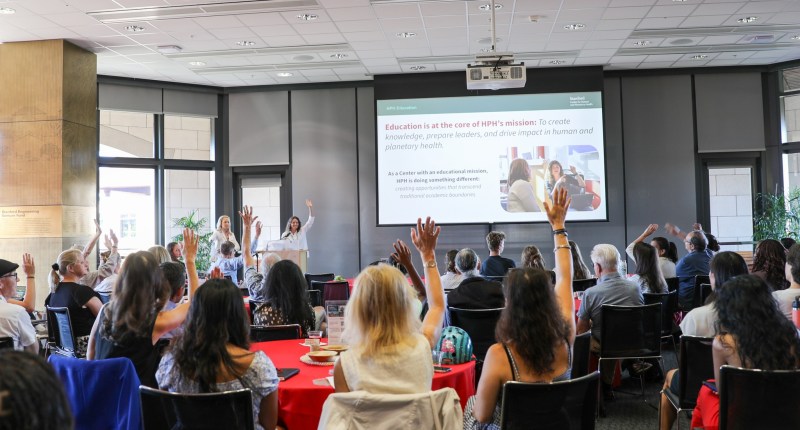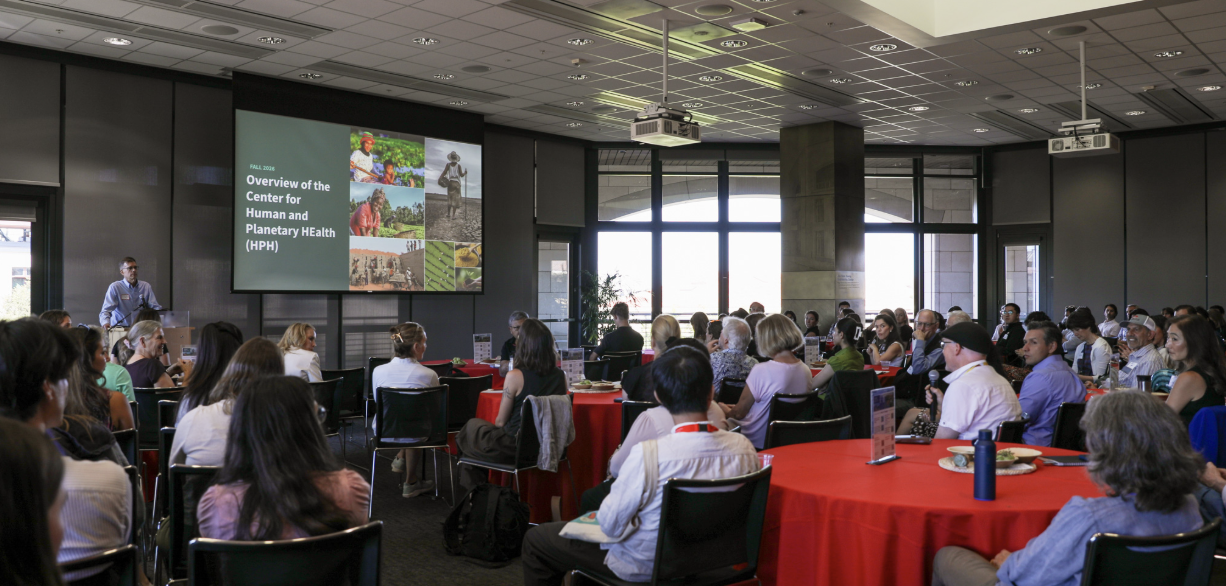
Stanford’s Center for Human and Planetary Health (HPH) celebrated its second anniversary at an event centered around research and action to combat climate change and protect human health on Tuesday afternoon.
The gathering, titled “Celebrating Human and Planetary Health at Stanford,” was standing room only, with more than 150 students, faculty, researchers, staff and external partners in attendance. HPH aims to transform research on climate change into measurable impact.
The event featured remarks from HPH Faculty Director Steve Luby, the School of Medicine Dean Lloyd Minor and Doerr School of Sustainability Dean Arun Majumdar. Luby also gave a presentation highlighting HPH’s core objectives to drive solutions-oriented research, prepare future leaders in the field and accelerate impact while building community at Stanford.
“I was excited to see so many dedicated professionals who care about human and planetary health across the entire world, not just locally,” wrote Allie Colman ’29, a student in the Human and Planetary Health course, in an email to The Daily. “The center’s global perspective gives me hope that we can begin implementing effective, solutions-oriented policy that is based on real facts.”
The event also included updates from HPH programs, with focuses such as the health implications of childhood exposure to gas kitchen appliances, the negative impacts of lead contamination and disease ecology in a changing world. Attendees heard from the HPH Plastics & Health Working Group and Food Systems, Health and the Environment Working Group about their work from the past year, as well as HPH Education and the HPH Action Labs.
“[HPH Director of Electrification for Health] Brady Seals delivered an excellent presentation that uncovered the dangers of gas stoves. I was surprised to learn that gas stoves are a major source of indoor pollution that can cause serious health risks,” Colman wrote. “I had never heard people talking about this danger, nor have I seen our government take action. I am now motivated to consider which appliances in my own home might be putting my health at risk.”
Partners from both inside and outside Stanford had the opportunity to present as well, with topics ranging from the impact of climate change on West Nile virus transmission to the work of the Stanford Toxins & Health Lab.
“We want our community to represent how big the issue is,” said Sara Damore, HPH program manager and course instructor for the Human and Planetary Health class. “The breadth of the issue goes from the decisions that people make in their daily life, to people who have a big influence on policy, to people who are working in the private sector. And so the more touch points we can have, the more we can help people realize how much of an influence they have in the system.”
Attendees mingled and connected at the reception following the event’s conclusion, taking advantage of the wealth of passion and expertise that had convened in support of HPH. “Universities have superpowers,” Luby said in his opening remarks. “We have the personnel, an approach and institutions that can generate a sound understanding of the world.”