
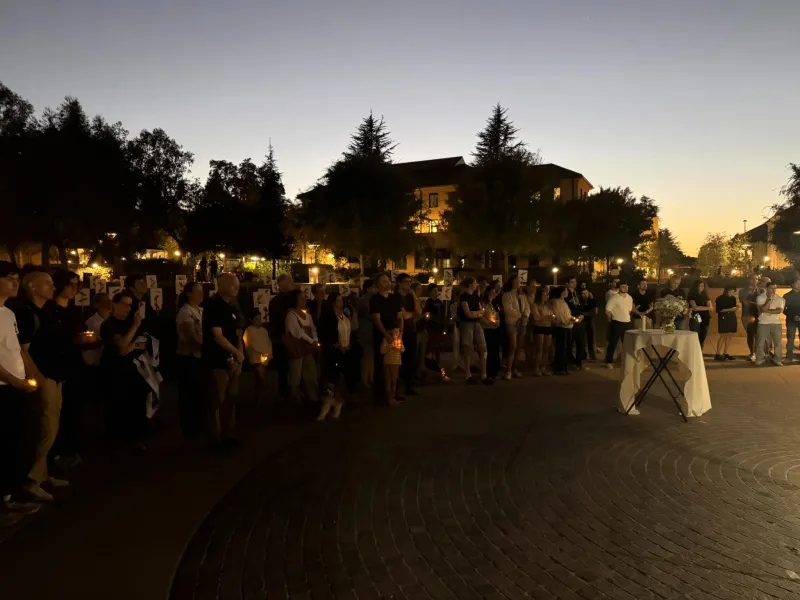
Dozens of students, staff and community members held candles on Meyer Green on Wednesday night to mourn the roughly 1,200 people killed on Oct. 7, 2023, marking the first anniversary of the attack since every hostage came home.
Hillel at Stanford, the Jewish Student Association (JSA), the Stanford Israel Association (SIA) and Chabad at Stanford hosted the day of remembrance. Hamas freed the last 20 living hostages on Oct. 13, 2025, and Israel recovered the remains of the final one, police officer Ran Gvili, on Jan. 26. Hamas militants took 251 hostages during the Oct. 7 attacks.
According to Tal Shasha, Hillel’s Israeli fellow, the gathering was to “remember those who were taken hostage and came back home, and to remember those who were taken hostage and did not come home alive.”
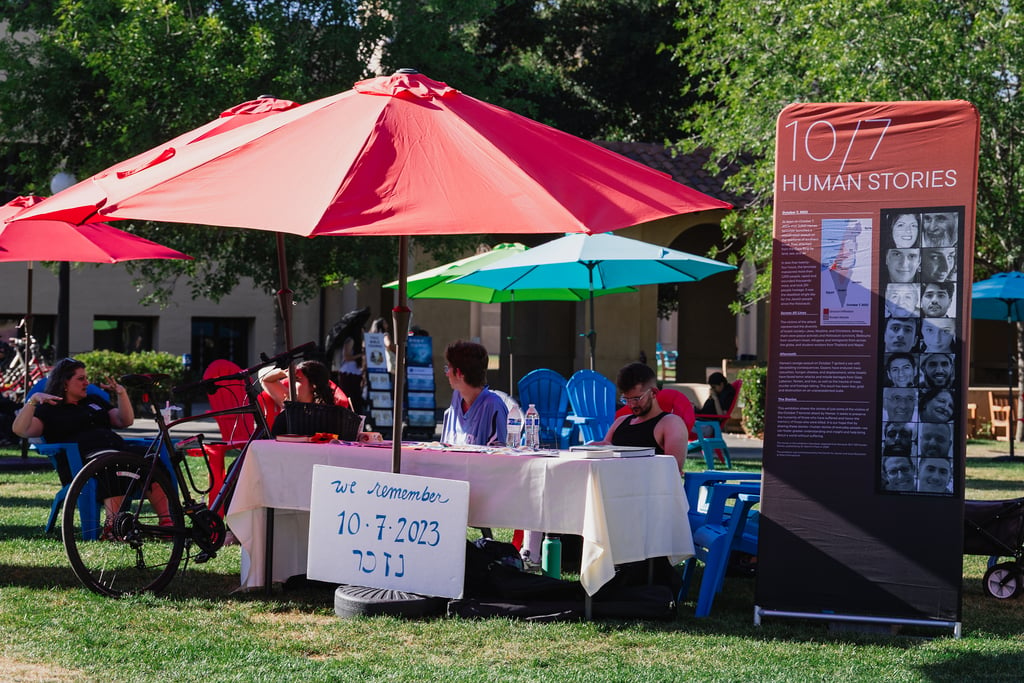
The memorial on Meyer Green stood from 10 a.m. to 8 p.m. At 11:15 a.m., Hillel screened the Israeli national memorial ceremony live from Israel. In White Plaza, students staffed tables marked “We remember 10.7.2023” beneath banners titled “10/7 Human Stories.”
The evening ceremony began beside a display of red flowers, which Shasha, said was inspired by a project that placed red clay flowers across Israel. “They also speak of resilience, standing bright against devastation,” Shasha said.
Students for Justice in Palestine (SJP) and Jewish Voices for Peace (JVP) held a separate vigil in White Plaza the same day “for the living, the martyrs and the land.”
“Our intention for having this all-day vigil is to call attention to our vision of a liberated future that encompasses justice and belonging for all people,” said lauryn chew ’30, an SJP organizer and the event’s MC, who spells her name in lowercase.
Rabbi Dov Greenberg, executive director of Chabad at Stanford, told the crowd the question was not whether to remember, but how. “We have come here to mourn, to remember, 100%. But the deeper question is, how are we going to remember?” he said. “But the destroyers and the haters do not get to decide the next chapter of Jewish history.”
Greenberg said Jews answered Oct. 7 by resolving on Oct. 8. “Because haters want me to cower in fear, I will stand with courage and dignity for my people, for Israel, for human beings, for freedom around the world,” he said.
Esther Luvishis ’29 read a poem she wrote built around the names of the dead. In it, she said she was “tired of counting and miscounting on bitten fingers the names of his brother, her husband, their grandma, our people.”
Attendees were invited to set their candles in the center of Meyer Green, and the ceremony closed with “Hatikvah,” Israel’s national anthem.
For one Stanford student, who requested anonymity for fear of retaliation, the anniversary held personal ties.
“Three friends of mine, two of whom I knew for a long time, were kidnapped,” the student said. “One was held in Gaza for a few months, the other for a few years. They returned eventually, thankfully.”
To Rabbi Jessica Kirschner, Hillel’s executive director and senior rabbi, the day belongs to the people who were killed and taken hostage.
“October 7 remains a day of mourning specifically for the victims of the Hamas attack on October 7, 2023,” Kirschner wrote in a statement to The Daily. “Attempts to make it something different, and especially to excuse or glorify terrorists and murderers as ‘martyrs’ on this day of all days is gross and cruel.”
“We deserve a day to mourn our losses without caveats or competing narratives. Palestinians deserve a day like that too, to hold the immense sadness they carry,” Kirschner wrote. “Their pain is also so real. But pick another date. There are plenty to choose from.”
Daanish Noor ’27, an SJP organizer, said the organization’s broader goal was “Stanford’s divestment from the genocide.” In Zeng’s view, the University “has institutional ties and reasons for partnering with corporations that contribute to genocide.”
The Graduate School of Business’s Jewish Business Student Association said the return of the hostages brings “a profound sense of relief,” while Oct. 7 “remains a day of immense loss and pain.” SIA said its ceremony and memorial “is not a political statement” and “stands as a visual and interactive space for students to process the events that unfolded.”
“In Judaism, memory asks something of us: to comfort those who suffer, strengthen one another, and build a future worthy of the lives we remember,” Greenberg wrote in a statement to The Daily.