
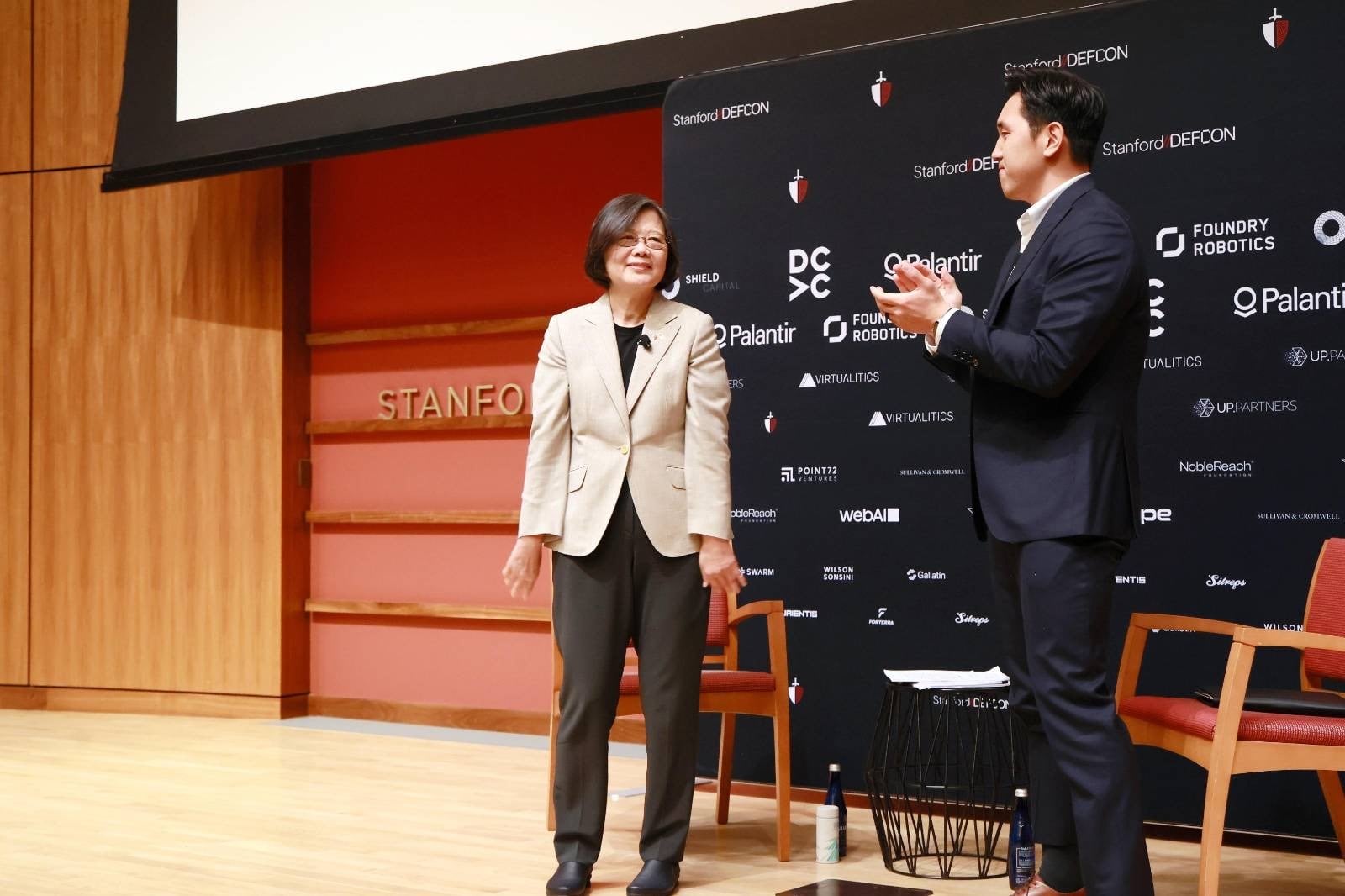
Former president of Taiwan Tsai Ing Wen stressed the importance of democratic resilience and maintaining U.S.-Taiwan relations while speaking at the Hoover Institution on Thursday.
She highlighted Taiwan’s importance because of its persistent protection of democracy and keeping institutions open. “We do not offer a perfect model but the challenges we have overcome now face other democracies,” Tsai said.
Her address to Hauck Auditorium was co-hosted by the Hoover Institution Project on Taiwan in the Indo-Pacific and Stanford in Government (SIG). Tsai, who served as Taiwan’s first female head of state from 2016 to 2024, emphasized the important role Taiwan plays in geopolitics. Taiwan accounts for over 60% of the world’s foundry revenue and over 90% of leading-edge chip manufacturing. This infrastructure serves as the base of modern defense systems, critical infrastructure and advanced technologies like AI, radar and missiles.
Tsai also gave the opening keynote at Stanford’s fourth annual DEFCON conference on technology and national security on Oct. 7. She met with a small group of around 30 students from SIG, the Taiwanese Students Association and students who have taken courses about Taiwan for lunch as well.
Condoleezza Rice, direcotr of the Hoover Institution, emphasized Tsai’s important role during a crucial time for the Indo-Pacific during her introduction of Tsai at the Oct. 8 event. Tsai’s presidency coincided with rising Chinese military pressure on Taiwan and growing concern about a standoff with China in the Taiwan Strait, which would have impacts on regional security and global technology supply chains.
“She stands at the center of these questions,” said Rice.
Taiwan understands how to be resilient, something Tsai said develops gradually as societies overcome individual challenges and adapt to change. “Democracies are sometimes noisy or chaotic,” Tsai said, but emphasized Taiwan’s ability to approach challenges.
This is especially true given the persistent pressure Taiwan faces from China. Understanding how to handle an authoritarian regime makes Taiwan a valuable asset to the rest of the democratic world, Tsai noted.
She framed collaboration with Taiwan as a means to spread democracy through collaboration and “shared” interests, stressing Taiwan’s eagerness to work with other democracies. Tsai said that the U.S. can be assured that the country will remain its loyal friend in the politically important region of the Indo-Pacific.
“Without democracy, it’s not Taiwan,” she added.
U.S.-Taiwan relations are important beyond economic and technology security and industrial resilience, Senior Fellow of the Freeman Spogli Institution Larry Diamond, a moderator of the event, told The Daily. If the U.S. values democracy and freedom, partnership with other democracies is extremely important, he said.
“Every authentic and quality democracy…[is] something we should value, partner with, and seek to preserve,” he said. “Taiwan is arguably the highest quality, most vibrant democracy in Asia. I think it’s pretty important that it survive, independent of what it’s providing for the world in semiconductors.”
The former president warned the audience of imminent issues in politics and global affairs: the polarization of politics, authoritarian influence and internal populism, which she explained makes it more difficult for countries to respond to external threats. Democratic institutions must prove their resilience by maintaining a sense of community and proving that they can actually improve lives, she told the crowd.
In a time of polarized politics, being “boring” is useful, Tsai said, jokingly referring to how people tend to label her.
Beyond democracy, Tsai touched on her role as Taiwan’s first female president. It was “the people in Taiwan who elected me” who broke the glass ceiling, she said. Tsai not only became the first female president in a landslide victory, but also became Asia’s first female leader not born into a political family legacy.
In the subsequent discussion with Diamond, she explained that Taiwan is drawing lessons from the war in Ukraine, such as the need to innovate quickly during war.
Tsai represents the democratic ideals she champions and embodies a pragmatic and patient leader, not one who is “boring,” Diamond told The Daily. “She reflects and personifies the aspiration and resilience of a very democratic society, and Taiwan really has become that,” he said. “A country that emerged from a period of pretty serious authoritarianism, and through a lot of courageous struggles, civil society mobilization, principled action.”
Gordon Kim MBA ’27, who organized Tsai’s appearance at DEFCON, emphasized the important model of diplomacy that Tsai embodies.
“War is the last resort. Deterrence and peacekeeping should always be the priority—this is done not only by having a strong military, but even more so by having strong diplomacy,” he wrote to The Daily.
One reason why Hoover asked SIG to co-sponsor the event was because of Tsai’s relatable career path, Diamond said, as students could likely imagine themselves as career officers or political advisors. He hoped this would encourage students to not be afraid of entering the world of politics.
Tsai ended with a word for students, encouraging them to study abroad in Taiwan if presented with the opportunity and to see the country’s democracy in action. Diamond, who is leading a Bing Overseas Study Program (BOSP) Global Seminar there this upcoming summer, hopes that Stanford will expand opportunities for students to study in Taiwan.
Student attendee and co-president of Stanford Democrats Robert Liu ’28 said the U.S. has much to learn from Taiwan, given its advancements in championing female leadership. “Even we’re not there. We have a lot to learn from her as a leading former president of a democracy, a very vibrant democracy, in many cases, more vibrant than America,” he said to The Daily.
Tsai imparted more advice to students, telling them that they should consider curiosity, adventure and their ability to work with others when making important decisions about their lives. She added that, should you fail, you should just “do more to get it,” pointing to her failed presidential run in 2012 as an example.
“Perhaps it makes me a bit boring, but this is exactly what leadership requires,” she said.