
To call “Alaav (Hearth & Home)” (2024) a blend of documentary and fiction would severely undersell the film. It’s a heartwrenching slice of life; a voyeuristic view into the complexities of care. Filmed over the course of 20 days, it’s two hours and two minutes of what it means to be alive through the lens of mortality.
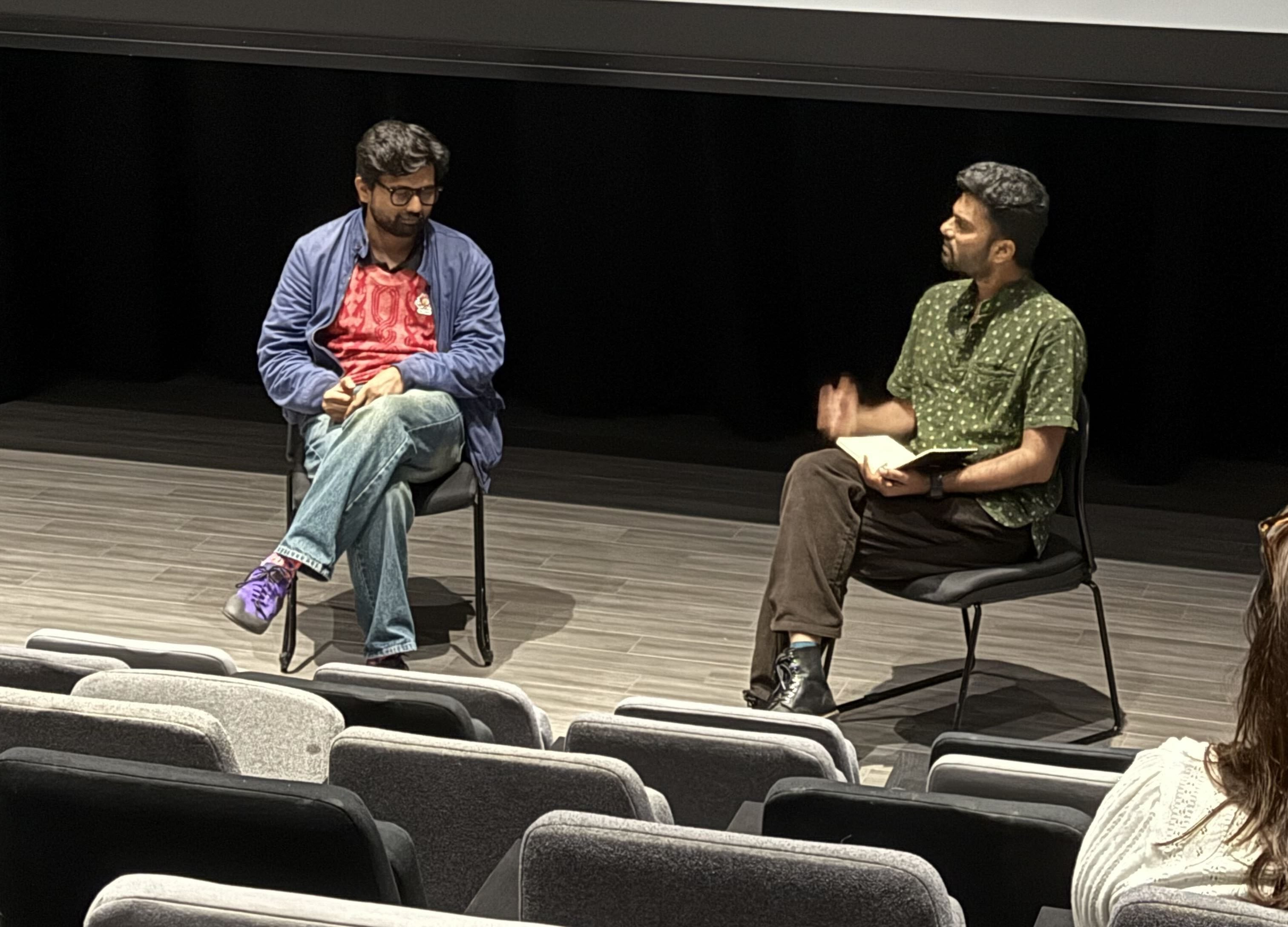
Directed by Prabhash Chandra, “Alaav” tells the intimate, moving story of Bhaveen Gossain, a man caring for his 95-year-old mother, Savitri. On Thursday, the Center for South Asia and the Art & Art History department screened “Alaav,” kicking off their South Asian film series.
While “Alaav” is officially categorized as fiction, both Gossains are real. The partially-scripted film “intentionally blurs the line between reality and poetry,” Chandra said in a Q&A following the screening. When asked to conclusively identify the film’s genre, Chandra said, “I wanted to make a real film about real people. I don’t know if it’s a documentary or fiction, but it doesn’t matter, I’m just telling a story. Consider it a docufiction.”
Despite being a musician by trade, Bhaveen’s whole life now revolves around his mother — feeding her, bathing her, talking to her, even so much as helping her relieve herself in the washroom. Even in scenes where she is not physically present — such as when he’s teaching music or cleaning the house — her presence remains pervasive, whether it be the sound of her coughing in the background or Bhaveen talking about her.
The film is uncomfortable in perhaps the best way, as it requires the viewer to sit with its stillness. There are no sudden movements or sounds, and the set is entirely contained within the walls of Bhaveen and Savitri’s real home in New Delhi, adding to the film’s documentary-like feel. One hears the occasional aircraft, prayer conch or child, as a reminder of the outside world, but even these sounds are so repetitive that they eventually blend into the background.
While I felt a tightness in my chest at multiple points throughout the film — notably the scene when Bhaveen has a meltdown when his mother refuses to eat her dinner, shouting “Khoon pee lo mera (Drink my blood!),” a common Hindi idiom used to express intense exasperation, before sobbing in defeat — it wasn’t until the penultimate scene of the movie, Diwali (the Indian festival of lights), that I finally broke down. Throughout the entire film, Bhaveen speaks to his mother as if she’s a baby, using phrases such as “Aa karo” (“Open wide”) or “Ninni aaye” (“Are you sleepy?”). In the Diwali scene, he kneels down to her, asking if she remembers the words to the shlokas (prayers, often recited in musical form), reciting them along with her.
I was reminded of my father having me recite my shlokas on drives to the temple and found myself thinking of a future where I would do that for him. Bhaveen’s gentle patience with his mother despite their tiffs, his careful brushing of her hair … everything put me in his shoes.
I’ve always found it difficult to reconcile with the ever-present “eldest daughter guilt” that consumes me. How does my need for independence, to build a life for myself, clash with my filial piety? My parents often call me their “budhape ki lathi (the stick of old age),” an idiom used to describe one who will take care of them in their old age. “Alaav” was a glimpse into the painful yet intimate fragility of that future, especially since time stops for no one.
The post-film Q&A revealed more about the man behind the movie. Chandra holds a postgraduate degree in physics yet somehow found himself in the world of filmmaking and theatre. As a physicist myself, I found Chandra’s unorthodox background coupled with the critical acclaim he’s received for his filmography exceptionally compelling.
Chandra spoke at length about his obsession with temporality, the notion of time. In a story fundamentally grounded in reality, he noted the importance of capturing “real time in cinematic time.” To my physicist ears, this sounded like Chandra was implementing a locally flat reference frame. In layman terms: by confining Bhaveen and Savitri to their home while allowing everyone else free mobility, he showcased a life that was being lived on pause.
During the talk, Chandra also delved into his creative process. First, he based the film on a known beginning and ending. Then, he established a set number of long static shots based on his observations of Bhaveen and Savitri’s everyday life. Finally, he wrote in the in-betweens, allowing his cast creative liberties and encouraging them to “forget there’s a camera.” He shared that some of the most delicate moments, like Savitri recalling her childhood friends and the name of her high school, were unscripted. That raised a question for me: Does this approach toe the line of invasive filmmaking? Even after much thought, my decision remains unclear.
“Alaav” ends on an indefinite, mournful note. While Chandra revealed his intended ending during the Q&A, I much prefer the ambiguity of the scene as written. Guess you’ll have to watch the film to figure out what I’m talking about. Now, if you’ll excuse me, I must call my mother, lest I start sobbing again.