
The first seven weeks of my summer were spent on Yokohama Bay, in an opulent sailboat-inspired building called the Pacifico Yokohama; out of this boat, Stanford runs its Inter-University Center for Japanese Language Studies (IUC). From the window right outside my classroom, I could see two bridges running over the canal and the giant ferris wheel of the Cosmoworld Amusement Park, the centerpiece of Yokohama’s Minato Mirai district and an icon of the city itself. When I wasn’t in my small class of six, summarizing news articles aloud or listening to one of my brilliant classmates give presentations on philosophy, religion and art, entirely in Japanese, and when I wasn’t sitting on my bed in my apartment trying to make sense of absurdly long strings of kanji and kana, I was up and down the escalators of the many malls and department stores around the Bay.
I was on the hunt for the kind of cute clothes I knew I could only get in Japan: maxi skirts that wouldn’t make me look frumpy, shirts with fun and interesting details, dresses so cute and princessy they made your eyes water just looking at them. And I found all those things.
Except they were several times smaller than I was.
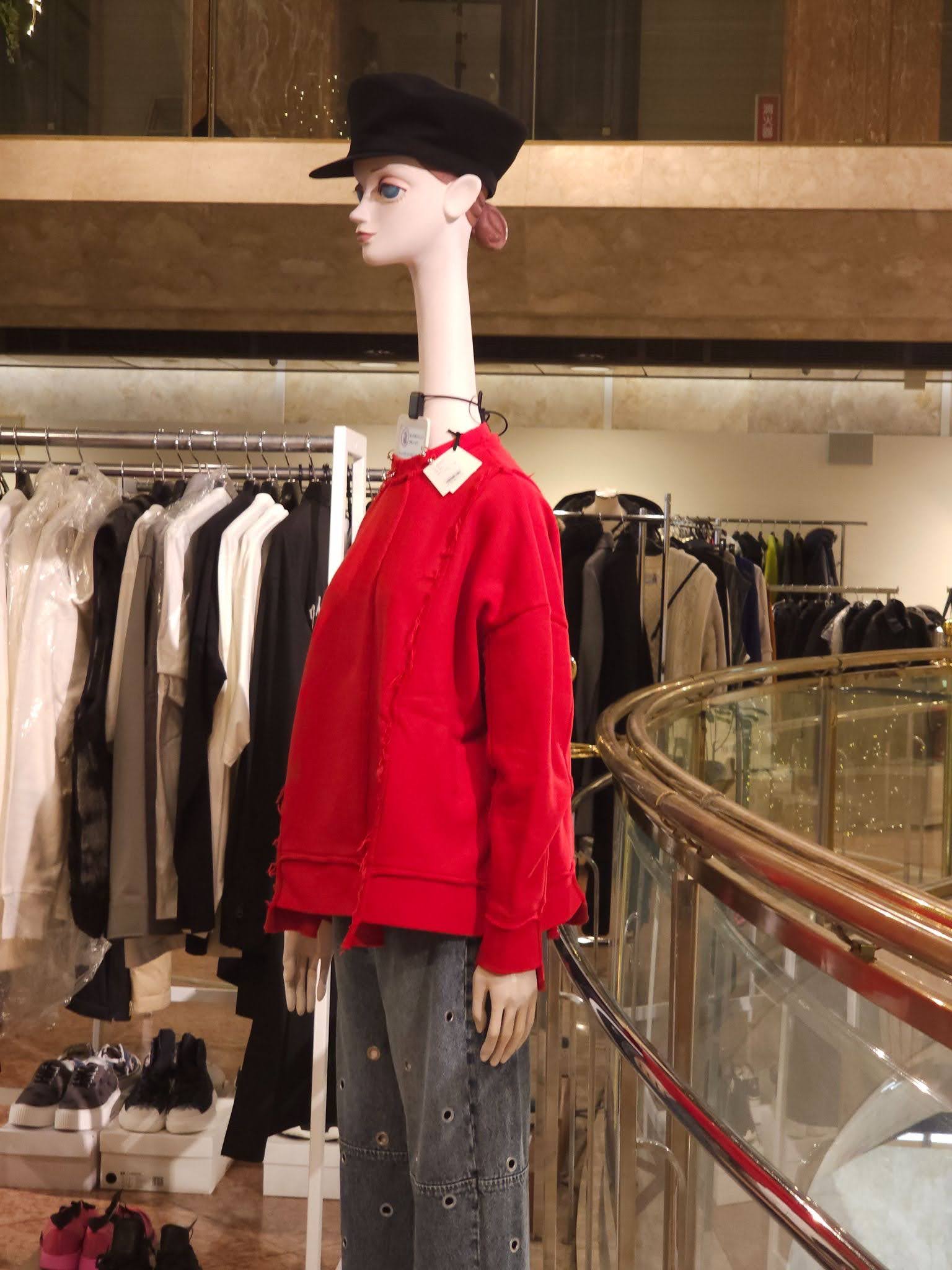
I gazed at a mannequin wearing a toddler-size shirt and marveled. There was no world in which I would be able to fit into something so small. How was it that there were women who could?
These women, the ones I scooted around and bumped shoulders with, were the ones in paradise: anything they laid their eyes on, they could have. They weren’t restricted to the free-size skirts and dresses, which still only stretched so far, or the plus-sized stores with scantier options. I squandered precious hours after my Japanese classes going from store to store to store, only to walk out empty-handed. Things were too short, or too tight, or just sat weirdly on me, refusing to accommodate my curves. Had I ever felt bigger and uglier than I did then, beneath the harsh lights of the dressing room?
Before Yokohama, I had lived in Japan for two years straight, and before that South Korea. I wasn’t new to the mental and physical exhaustion of trying to hold on to your dignity in a society that, through its many subliminal messages, tries to snatch it away. I should’ve been used to the pain of having to put back on the rack the cutest-thing-I-ever-saw because it didn’t fit.
But I wasn’t.
The clothes were maddeningly beautiful, and walking through Queen’s Square to and from the Pacifico, I would see men and women all decked out and I too wanted to be so well put-together.
One day, while wandering around after yet another unsatisfying trip, my spirit was particularly sore. What must it be like to grow up even a little bigger in a place like this, forced to wear not what you really liked but what fit, while the smaller girls your age expressed themselves as freely as they liked in all the beautiful clothing being spun out just for them and no one else? Passing thousands if not tens of thousands of stores, and their armies and armies of mannequins, all enforcing a dictatorship of skinniness.
Who then will be able to shrug off the impulse? — that of wanting to whittle yourself down just so you can fit into some fabric. There are plenty of plus-sized stores that stock hip and cute clothing as well, but isn’t it telling that in all ten floors of Shibuya 109, a women’s fashion mecca of Tokyo, there is only a single plus-sized retailer?
That is ten floors and twenty escalators of some of the most envied clothing in Tokyo, and almost all of it off-limits for a girl of bigger proportions.
It may be surprising, then, to hear that in spite of all this, I was not inclined to diet.
How could I be? For seven weeks, I had access to some of the best food in the whole world — tonkotsu ramen, Japanese curry, pork cutlets and pastas galore. No way was I going to pass those up when I knew I would soon have to return to the culinary drudgery of rural Maine.
Besides that, IUC’s classes were putting me through the wringer. Whole essays and presentations and dense readings in Japanese. Sleepless nights and emotional lows so low they made me afraid for myself. Flares of anxiety that made it hard for me to pick myself up and go to classes, and hard to fully appreciate the Yokohama outside the walls of my apartment, all its glittering, dark-watered beauty. Food was one of my only sources of joy in that otherwise exhausting summer. Unlike clothes that fit, food was reliable and could always be found. So many of those fruitless shopping trips ended with me plopping down at the table of one restaurant or another.
And yet, though the me sitting in front of my buffalo mozzarella pizza at Saizeriya was heavier, more exhausted and perhaps more anxious than I’d ever been in my life, I ate my pizza with relish and without guilt.
Somewhere along the way, I had realized that if I stopped eating just for clothes it would never last. That really, at the end of the day, I couldn’t muster up enough love for those skirts and dresses I’d wanted to put myself through some torturous, unhealthy diet.
Biting into a crunchy golden slice of tonkatsu, I knew that if eating was how I eased my worries and anxieties, then I would first have to find another way to work through them, or else I’d constantly undo any progress I made towards the body I wanted.
More importantly, if I was going to cut back on my favorite foods, it could not be for the vague goal of “being skinny,” nor because of the tastes of the people around me. There would have to be some deeper, more meaningful reason of my own, some internal driving force that would set me on a real fitness journey and make any changes I made to my lifestyle permanent.