
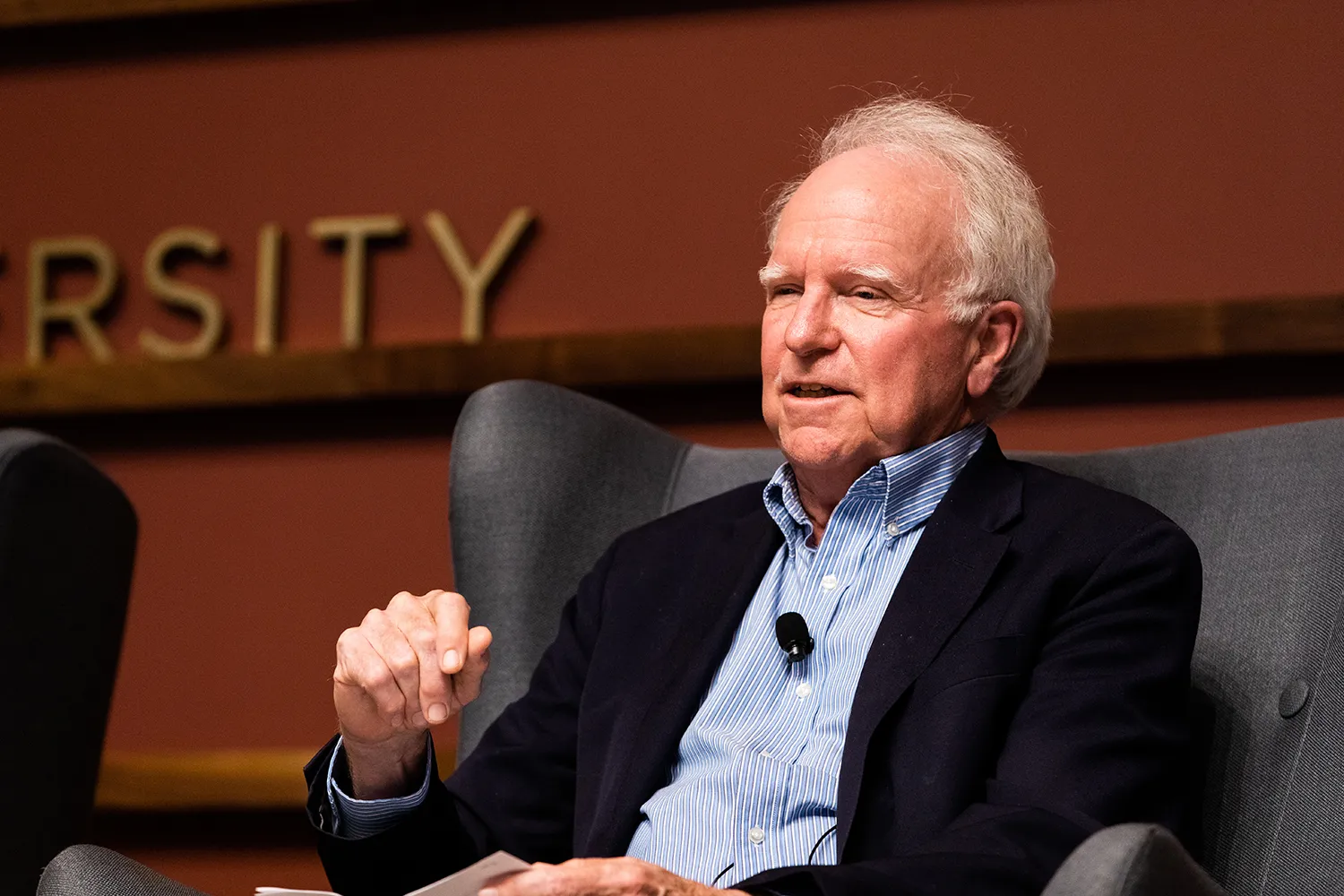
In 1978, the year he joined Stanford and the Hoover Institution, economist Robert Hall published a short paper with a simple test of how households decide what to spend their money on. Nearly 50 years later, its core equation sits inside the models central banks use to set interest rates.
On Monday, that work earned Hall, 83, the 2026 Nobel Memorial Prize in Economic Sciences. He shares the prize with Columbia University economist Michael Woodford. The Royal Swedish Academy of Sciences recognized the pair “for microeconomic foundations of macroeconomic stabilization,” and the two will split 12 million Swedish kronor, or around $1.2 million.
“This is a wonderful surprise,” Hall said in a statement provided by the Hoover Institution. “Stanford’s economics department and the Hoover Institution gave me a dream job: the freedom and time to do the research I wanted to do.”
Hall also thanked his wife and coauthor, economist Susan Woodward, and congratulated Woodford, whose work has taught him “a great deal.”
Hall, a macroeconomist, studied households because two-thirds of gross domestic product (GDP) is consumption, said Valerie Ramey Ph.D. ’87, the Thomas Sowell Senior Fellow at Hoover.
“What happens to consumption is a big factor in what happens to overall GDP,” she said in an interview with The Daily.
Ramey took classes from Hall at Stanford in 1982 and worked as his research assistant from 1983 to 1987. Hall also sat on her dissertation committee.
The older Keynesian view held that a household looks at its current take-home pay and spends a fixed share of it, Ramey said, such as 80 cents on the dollar. Milton Friedman and Franco Modigliani, both later Nobel laureates, challenged that view.
“Consumers aren’t as simple as Keynes believed,” Ramey said. “They don’t just look at their current income.” Instead, she said, people weigh what they expect to earn later and try to smooth their spending over time.
Hall found a way to test that idea.
“He took an idea from finance, but nobody had ever thought to apply it to macroeconomics before,” Ramey said. If households already weigh everything they know, past income should not predict how their spending changes from one day to the next – only news should. Hall’s tests on national data, Ramey said, showed that the theory held up remarkably well.
His equation became a building block of the New Keynesian model, which Woodford extended into the framework central banks and governments rely on today. When inflation runs high, Ramey said, the model shows how raising interest rates cool household and business spending. Ramey’s own recent papers find that households save most of a temporary tax rebate, in line with the theory Hall tested.
Hall’s approach is “the cornerstone of all subsequent macroeconomics,” Hoover senior fellow John Cochrane wrote in the Hoover Daily Report on Monday.
“He always had the big picture,” Ramey said. “With him, he always wanted to simplify so that he could focus on the essence.”
Colleagues admire how Hall kept pushing new research long after his landmark papers, according to Ramey. “We would joke. We said, ‘We want to grow up to be Bob Hall,’” she said. The goal, she explained, was to still be working at the frontier of research in their 70s and 80s.
Some Hoover senior fellows, including Friedman, have won the Nobel, but Friedman did most of his work before he came to Hoover. Yet, “Bob Hall was at Hoover all along,” Ramey said.
Hall also chaired the National Bureau of Economic Research’s Business Cycle Dating Committee, which keeps the semiofficial chronology of U.S. recessions and expansions, from its launch in 1978 until 2024.
Hall joins recent Stanford economics laureates Paul Milgron and Robert Wilson, who shared the 2020 prize, and Guido Imbens, who won in 2021.
Born in Palo Alto, Hall earned his bachelor’s degree at University of California, Berkeley and his Ph.D. at MIT, and he taught at both before coming to Stanford. With Hoover colleague Alvin Rabushka, he proposed the flat tax in a 1981 Wall Street Journal article. He served as president of the American Economic Association in 2010.
Hall is a Robert and Carole McNeil Endowed Professor of Economics and Senior Fellow at the Hoover Institution, Emeritus.
He attended a small celebration on Monday, Ramey said, where he spoke about the value of public funding for education. In his statement, he credited California taxpayers for his public and state schooling, and the federal government for paying for his graduate education at MIT.
“I hope they will regard this as a satisfactory return on their investment,” he said.