
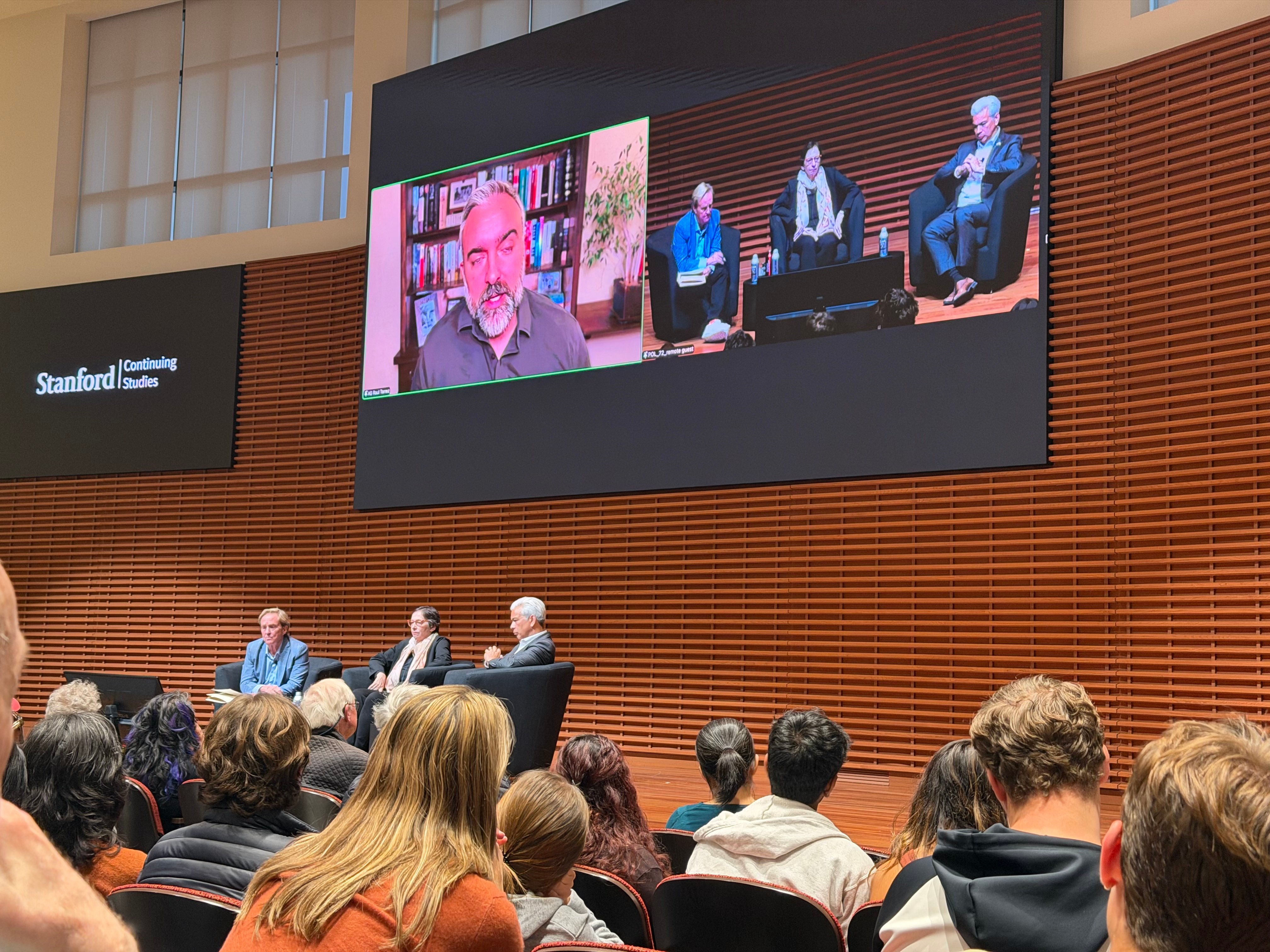
Two Attorneys General and an award-winning Stanford constitutional lawyer raised concerns on Monday about deference to the executive in the current legal landscape and the Supreme Court.
They spoke as part of education professor Jim Steyer’s ’78 J.D. ’83 speaker series, “Will America Fail the Midterms?”
Steyer told The Daily that he partly intended the class to inspire Stanford students to vote in the upcoming midterm elections and “be completely active in any way [they] can to get people out to vote.”
The discussion repeatedly stressed the notion of active participation. “We need to be active and engaged and firm,” said California Attorney General Rob Bonta said, “democracy is not self-executing.”
The panelists specifically feared that the federal government was becoming increasingly complacent about executive overreach. Pamela Karlan, co-director of Stanford’s Supreme Court Litigation Clinic, noted that the U.S. was founded on the assumption that “ambition will check ambition,” which she said “has failed.”
“I think it’s fair to say at the national level [that] Congress is not checking the president in any way,” Karlan added.
New Mexico Attorney General Raúl Torrez J.D ’05., present via Zoom, added that when institutions such as the Supreme Court afford President Trump a new executive privilege, he likely feels “empowered to push further and to push further.”
The attorneys general outlined how actors at the state level were moving to check the executive branch.
“We deserve a president who will follow the law, follow the Constitution,” Bonta said. “The rule of law is certainly being tested. We’re resisting that test, but it is because we are fighting back and pushing back.” Bonta has issued nearly 100 lawsuits against the Trump administration to date.
Steyer turned to the Roberts Court and what he called its “historic disregard for precedence, bending over backwards…to the executive branch.” Karlan further described the notion of a “unitary executive,” as “a long term project of the conservative legal movement” facilitated by the Court.
Karlan warned that under unitary executive doctrine, the government would act as if “[executive] power has to be directly in the President.” Under this doctrine, the executive “can’t be limited by Congress, and can’t be checked…by the courts,” according to Karlan.
More optimistically, Torrez said that despite federal circumstances, he could still help his state from his place in office. The Attorney General recounted facilitating a sting against child-rapists through Instagram, saying that Meta willfully enabled the predatory men on their platform.
By taking Meta to trial, Torrez won two verdicts totaling $975 million. His office is currently pursuing further settlement up to $220 billion dollars.
“I’m not waiting for anyone in D.C. to get off their ass and do their job,” Torrez finished. “I’m gonna take these guys to court and do it.”
Steyer lauded that Bonta and Torrez had both “fundamentally transformed the landscape.” After an hour of detailed descriptions of unchecked power in D.C., Steyer finished his class on an upbeat note. “The best is yet to come,” said the professor, telling the audience that they were “going to see fundamental changes.”
Karlan invited the audience to be a part of those changes, and made a call to action for Stanford students interested in law to “find something that fits you.”
She ended the panel telling the attendees to “find what your passion is and where you can contribute and where you can do your best work.”
“That’s a pretty good lesson for people of all ages,” Karlan added just before Steyer brought the session to a close.
Speaking to The Daily after the class, Steyer expressed appreciation for Bonta and Torrez in the current landscape, describing them as “heroes.”
He went on to affirm protest among students, saying, “don’t be afraid to stage major demonstrations on campus to challenge the status quo.” A student group should “take on the United States Supreme Court” and their actions over the past decade, he added.
“I think young people have the chance to change the world,” he said, “That’s why I keep teaching.”