
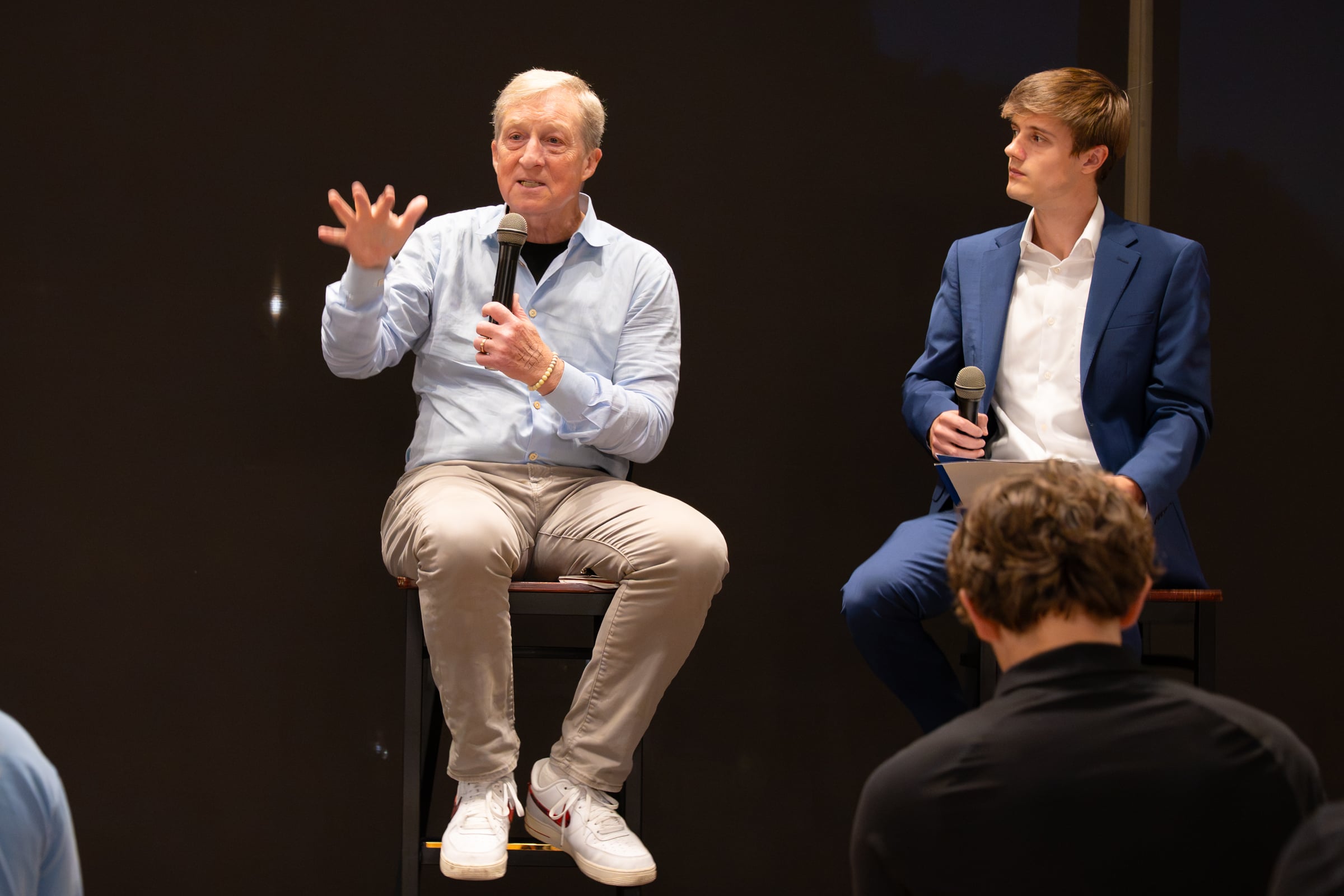
Tom Steyer MBA ’83, who placed third in the California gubernatorial primary, addressed around 60 students at a Stanford in Government event on Oct. 8 about healthcare, wealth inequality and his climate-related philanthropic efforts.
Steyer argued that California should switch to a state-run health care system to replace private and employer-based insurance. This switch would reduce the overall health care costs in California, freeing up funds for education and other programs, he said.
“If you look at the California budget, which I’ve had the misfortune to do, [healthcare costs] eat everything,” Steyer said.
This has not always been his belief. In his 2020 presidential run, Steyer supported a public option that would preserve private health care. “I really believed in my heart of hearts, having gone to [the Graduate School of Business], that business could solve this problem,” he told The Daily in an interview after the event.
But he has since changed his mind: “the way our healthcare system works, there isn’t good competition,” causing costs to “continue to spiral until we get rid of this system,” he said.
Steyer, a billionaire, also spoke to the perils of wealth inequality. “This level of inequality, it’s not only unjust, it’s absolutely antithetical to democracy,” he said. Taxes on the rich were justified because their wealth was not created in a vacuum, he added, but enabled by the systems and societies they lived in.
“Of all the people who were running for governor, the only person who said he or she would vote for the Billionaire Tax Act was me,” he said. Proposition 40, also known as the Billionaire Tax Act, is a proposed 5% wealth tax on billionaires that would fund California health care.
While Steyer said he supports it, he criticized the tax for being only a one-time measure, and not allocating enough money to education. He also expressed concern over California’s drop in education rankings.
After spending over $200 million on his own gubernatorial campaign, Steyer acknowledged to The Daily that losing a personally funded political campaign was “obviously not the best outcome.”
“What is true is in my campaign I did not take any money from any special interests, and lo and behold, I was representing the people of California, not the special interests,” he said. Special interests give money to politicians because they expect to make a return on their investment, he said.
Not everyone believes Steyer’s stances are coherent. “A lot of people consider the descriptor of billionaire and climate activist as contradictory,” said Sophie Kim ’30 during the event’s Q&A.
Steyer, however, argued that his various philanthropic efforts benefit sustainability. He and his wife Kat Taylor run the TomKat ranch in Pescadero to raise animals and grow healthy produce in a sustainable way, he said. They have been working with scientists and taking measurements, with the stated goal of influencing the practices of 14 million acres of other ranches by showing ranchers how regenerative agriculture can be done, according to Steyer.
The TomKat Center, which Steyer established at Stanford with Taylor in 2009, also distrivutes funding to Stanford students to commercialize their ideas on how to combat climate change. The organization’s grants have nurtured multiple successful companies.
Steyer also cited the Steyer–Taylor Center, which he formed with Taylor in 2011 to explore energy policy at Stanford. He said that policies like taxing pollution can be effective in accelerating the transition toward clean technologies. The Steyer–Taylor recently closed because it was set up for a specific period of time and its endowment ran out of money, he said.
To conclude the event, Steyer encouraged students to forge values and uphold them. “If you’re not willing to stand up and take a punch for the things you deeply believe in, then you don’t deeply believe in them,” he said.
Steyer received strong student engagement. “When he opened the discussion for questions from the audience, nearly every hand shot up,” said Jack Norman ‘27, who moderated the interview. “I was very happy that Tom even stayed after to continue individual discussions with students, and there is strong demand to bring him back.”