
Editor’s Note: This article is a review and includes subjective thoughts, opinions and critiques.
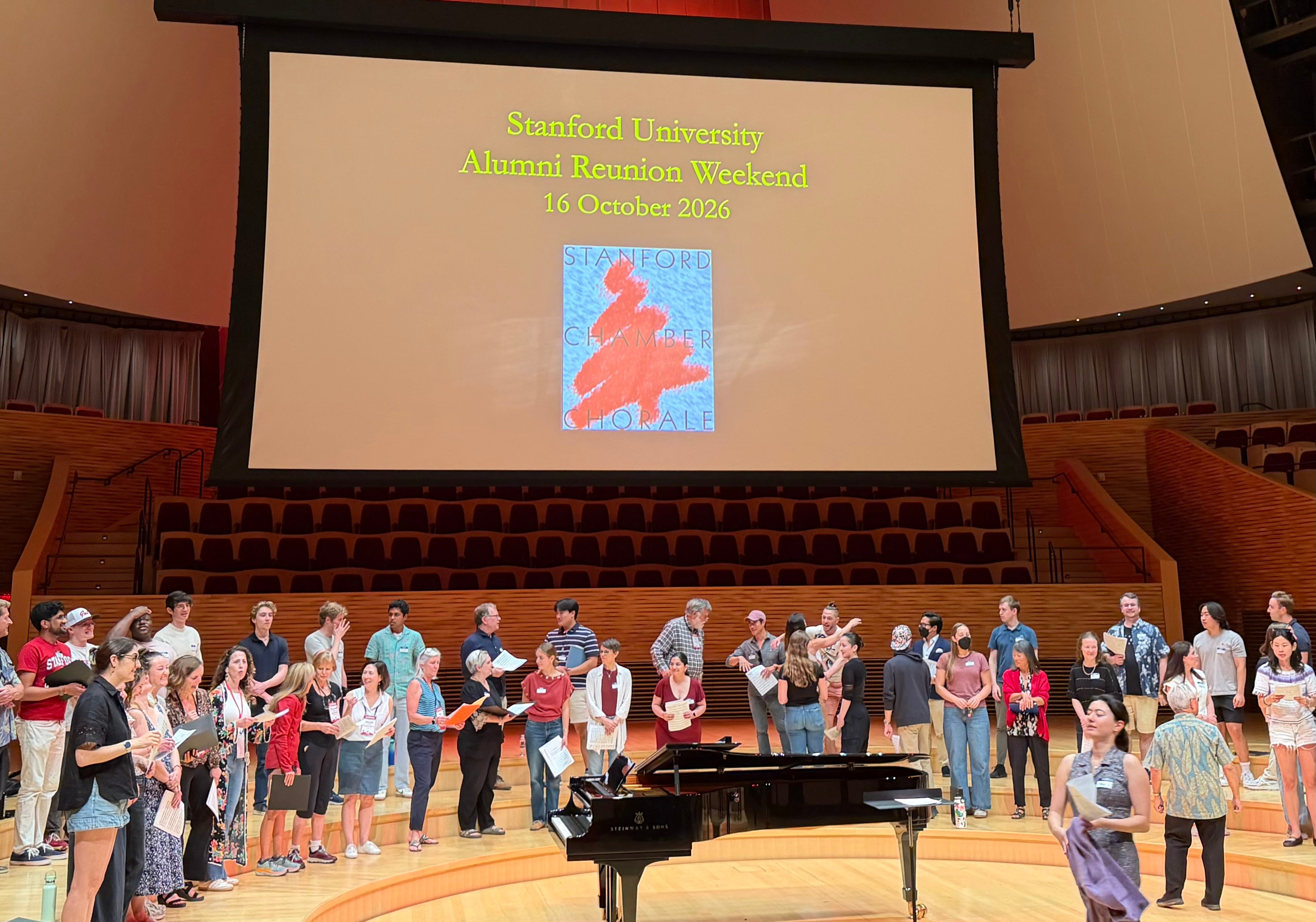
In the intimate setting of Bing Concert Hall, Stanford Chamber Chorale alumni gathered alongside current members for a performance that united singers across generations. Friday’s Chamber Chorale Reunion Weekend Mini-Sing, held during Reunion Homecoming Weekend, invited former members to be choristers once again.
This was the first time the reunion took place at Bing. In prior years, Chorale alumni reunited in the familiar setting of Memorial Church, where the group typically hosts concerts. The Mini-Sing was a private performance for alumni and their families after the church closed for the day. This year, however, the Mini-Sing was open to the public.
“Bing offers a new experience for those who graduated before it existed, so singing in a place like this is special.” said Stephen Sano, music professor and current director of the Chamber Chorale.
Sano began the Mini-Sing by celebrating the space, describing Bing Concert Hall as “one of the best places to perform choral music.” He explained that the stage floor, made of Alaskan yellow cedar, is designed to vibrate and resonate with the music, much like the soundboard of a piano. He demonstrated this with a jump on the stage — drawing attention to the floor’s responsiveness and to how the space itself became part of the music.
Straying from the structure of a conventional concert, the Mini-Sing followed an “open rehearsal” format. First, Sano led the chorale through a classic vocal warm-up, emphasizing vowel placement and a unified sound across voice parts. Then he ran through each song on the program, breaking them down to highlight dynamics, vocal blend and what he called the melodic “shape,” just as he would in a regular rehearsal. As he guided the group, he also instructed the audience to keep an ear out for these artistic elements. Listeners followed along with printed scores.
This particular collection of alumni had never sung together before, and there was no rehearsal ahead of the event. Some alumni even came to the Mini-Sing straight from another Reunion Weekend panel.
To make the music work, Sano chose pieces that returning alumni may have sung with the Chorale before, along with repertoire that is widely known across the choral community. The program included two versions of the alma mater, “Hail, Stanford, Hail,” and the Chorale staples “Ubi Caritas” by Maurice Duruflé and “In Remembrance” by Eleanor Daley.
From the moment I entered the hall, I could feel the warmth of a community that has stayed strong and connected over the years.
“It was my kind of home socially and musically for four years,” said Susie Lape ’11. Lape joined the Chorale her first week of freshman year and stayed connected to the group long after graduating. Lape said she knew her fellow members “better than anyone else she knew at Stanford.” In fact, Sano even officiated her wedding, a testament to how far the Chorale community extends beyond the rehearsal room.
“Chorale is one of the reasons why I chose Stanford,” said current chorist Anna Klein ’28. Klein said that even as a high schooler, she felt connected to the group: The chorus she sang in often partnered with the Chamber Chorale. Like Lape, Klein made sure to audition her first week of freshman year.
“It’s always a pleasure to meet people from the other generations of Chorale as well, because it’s such a grounding and unifying force,” Klein said.
I understood what she meant. From the pride of “Hail Stanford Hail” to the serene calm of “Ubi Caritas” and “In Remembrance,” each piece carried emotional weight. As alumni and current members sang side by side, their voices seemed to merge into one. The community’s connection came through not just in how they interacted, but in how they sang.
“[Chamber Chorale] really is about connections, community and relationships and nurturing those even after decades,” Sano said.
The event concluded with “Hail Stanford, Hail.” This time, the audience joined in. In that moment, I felt the community on display represented not only the Chorale, but Stanford as a whole. Whether they were returning after decades or a single year, these alumni came back to a place that shaped their lives — and now, many of them shared it with their families.
In the voices of past and present members, “Hail, Stanford, Hail” became more than an alma mater. It was a reminder of how music builds communities across generations and turns shared experiences into a lasting legacy.