
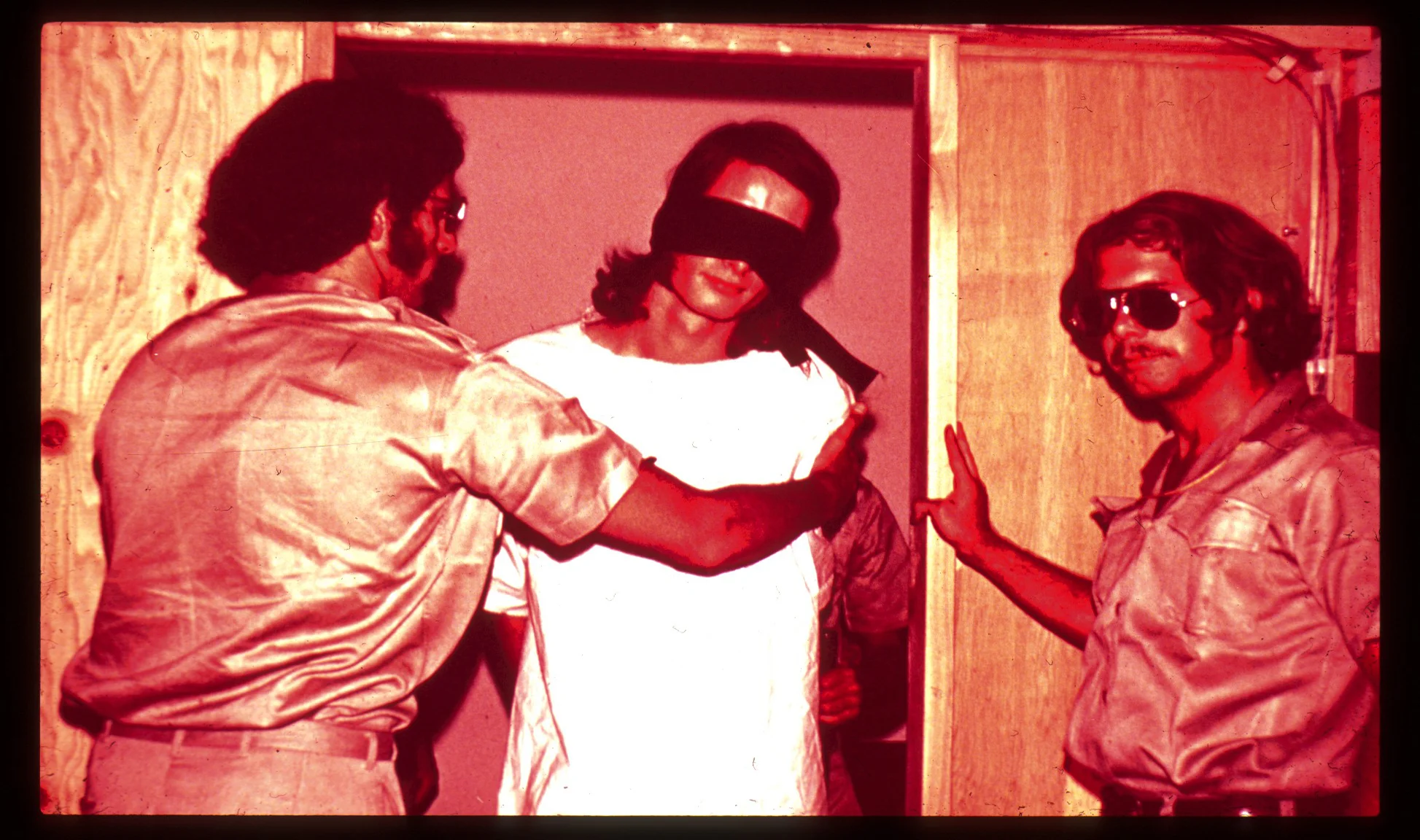
In 1971, 24 college students were assigned roles as prisoners or guards in a mock prison in the basement of Building 420. Led by Stanford psychologist Philip G. Zimbardo, the experiment was meant to last two weeks but halted after six days as guards’ treatment of prisoners grew increasingly abusive. The Stanford Prison Experiment became a deeply controversial case in research ethics, prompting scrutiny over safeguards for human subjects.
Today, it is the inspiration for a new Netflix series premiering Wednesday.
In the six-episode series titled “The New Stanford Prison Experiment,” thirty voluntary participants enter a decommissioned section of the Cherokee County Adult Detention Center, a real jail in Georgia. Like the original participants, they are randomly divided into guards and prisoners. The series will follow them as they test whether ordinary people conform to assigned power dynamics.
“We’ve always been fascinated by the Stanford Prison Experiment because, despite all its controversy, the question at its core remains incredibly relevant: What happens when ordinary people are given power over others?” Jane Lipsitz, the series’ executive producer, wrote in an email to The Daily.
Lipsitz wrote that an unscripted format “felt like the only way to explore this [question].”
“We were not disappointed,” she wrote of the series. “What unfolded was surprising, uncomfortable, funny, compelling and at times completely unexpected — the kind of moments you simply cannot predict.”
Dave Eshelman, who participated in the original experiment as a guard, shared his experience with Stanford Magazine in 2011.
“I was kind of running my own experiment in there, by saying, ‘How far can I push these things and how much abuse will these people take before they say, ‘knock it off?’” Eshelmen said. “But the other guards didn’t stop me. They seemed to join in.”
At times, prisoners were taunted, stripped naked, deprived of sleep and forced to use plastic buckets as toilets.
In light of this background, many have expressed disbelief that Netflix would attempt to reimagine the experiment.
In response to an X post about the series, one person commented “Leave it to Netflix to reproduce one of the most notorious and unethical social experiments ever, but as reality TV.” Another wrote, “The idea was to learn FROM this failing the first time.”
Stanford students, too, have raised concerns.
“The documentary gives a bad name to Stanford’s psych department,” Anh-Thu Dang ’28, who is studying psychology and English, wrote to The Daily. “We’ve done a lot of work over the years promoting ethical, open science that is meant to help people and it is not fair to behave as if we are defined by the Stanford prison experiment.”
The Daily has reached out to the Stanford Department of Psychology for comment. Multiple faculty members in the department declined to comment as well.
Lipsitz shared her perspective on the broader public response: “There was a lot of outrage that anyone would even attempt the Stanford Prison Experiment again — and given what happened with the original, I completely understand that reaction,” she wrote. “If we were simply recreating the original experiment, that would be unconscionable. But this is a different time, with different participants, different safeguards, and ultimately, a very different journey.”
Lipsitz told The Daily her team spent more than a year developing the series, “thinking through every detail” to ensure the experiment would be conducted responsibly and ethically.
The production team put numerous guardrails in place to protect participants throughout the experiment. Participants made informed decisions when they signed up, underwent psychological screenings before they entered the experiment and had a safe word they could use to opt out at any time. They had 24/7 access to psychologists for support, along with access to a medic.
Producers and psychologists also monitored the experiment so they could intervene if concerns over the wellbeing of a participant arose.
Unlike the original experiment, “The New Stanford Prison Experiment” takes place in a real prison, which the production team decided on to create a realistic environment.
Although the original experiment featured all-male college students, Lipsitz wrote that it felt “fundamental” to the legitimacy of the experiment to cast a wider net and assemble a group that better reflects the world today — diverse in geography, gender, political beliefs, socioeconomic background and life experience.
“If we were going to explore how people respond to power, we wanted as many different perspectives in the room as possible,” she wrote.
When asked why “The New Stanford Prison Experiment” was made now, she wrote that the world is at “a moment where we are constantly confronting questions about authority, conformity, group identity, and the systems that divide us.”
“It felt like the right time to revisit that question with a new generation and ask whether power inevitably changes us — or whether we’re capable of resisting the roles, the rules and the systems we’re placed into,” she wrote. “What we discovered during this process was something we never saw coming.”