
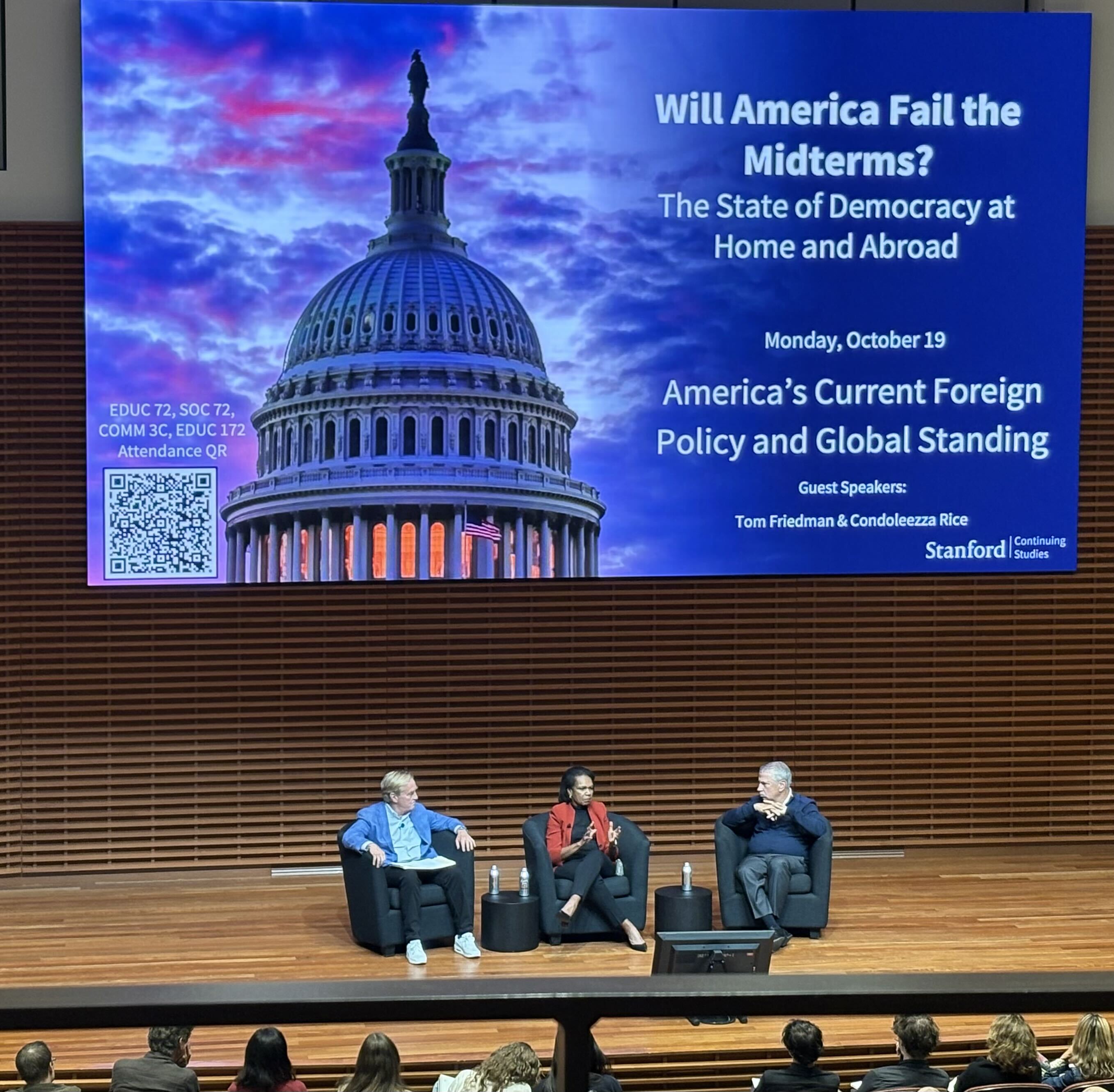
Director of the Hoover Institution Condoleezza Rice and New York Times foreign-affairs columnist Thomas Friedman debated Ukraine, Israel, Iran and AI on Monday.
As the latest entry in Jim Steyer’s ’78 J.D. ’83 speaker series “Will America Fail the Midterms?” the talk focused on American foreign policy.
The panel tackled big questions, such as AI regulation on the global stage. “We’re waiting for the Goldilocks moment where we have an AI event that is big enough to get everybody focused on putting the proper guardrails on — both in America and with China — but not such a big event that [it] ends the world,” Friedman said.
Rice warned that “something’s going to happen that nobody foresaw.” She advised the U.S. government to prepare by looking at early warning systems and intelligence to “keep an eye on what the adversary is doing,” and developing a consequence management plan.
On foreign policy, Friedman highlighted the novelty of the Trump Administration’s attitude towards Ukraine. “I’ve never seen an American president side with a Russian president over a democratic Ukraine,” he explained, “I think that’s a travesty and it’s unforgivable.”
As a result, Friedman thought the only possible outcomes for Ukraine were a “dirty deal or a filthy deal.” The journalist foresaw Ukraine forfeiting part of its territory to Russia as part of a peace deal, and said it wasn’t certain if Ukraine could join the EU and secure security guarantees under such a framework.
Rice had a more optimistic view on Ukraine. “If the Ukrainians can survive this year through to the next fighting season, I think [Putin is] out of options,” she said. Rice predicted that enough stalling by Ukraine could cause the war to “peter out.”
The panelists found a consensus, however, on their characterizations of Russian President Vladimir Putin.
Friedman stated that a need for dignity drove the Russian leader, who he said saw the end of the Soviet Union as “an act of incredible humiliation.”
Rice agreeably characterized Putin as a Russian imperialist. “You cannot have a Russian empire if you have an independent Ukraine,” Rice explained, paraphrasing Zbigniew Brzeziński’s famous axiom.
Steyer then asked the speakers how they understand President Trump. Rice argued that “this presidency is also a symptom of something, not necessarily a cause of it,” explaining that “there was a sense that global elites were completely out of touch with ordinary Americans.”
She said that Trump picked up on the “four horsemen of the apocalypse: populism, nativism, isolationism and protectionism. And they ride together. And they’re not just riding in the United States; they’re riding in Europe too.”
Criticising Trump’s policy on Iran, Friedman asserted that there was little planning that went into the Iran war. He advocated for an alternative solution, stating that “there is nothing that would improve more things in the Middle East than a change of regime in Iran that was replaced by a consensual Iranian government.” He then added, “You can talk about Israeli colonialism all you want. Iran is the biggest imperial power in the region.”
Friedman expressed concerns that pressure on the Iranian regime would not result in an orderly transfer of power. “It’s going to be really difficult because in the Middle East, the opposite of autocracy is not always democracy. It can just as easily be disorder, and in fact, it may more likely be disorder,” he said.
Rice furthered Friedman’s concerns of possible disorder, hypothesizing that the “corrupt, mafia-like group that is running part of the Iranian economy” would become the next Iranian regime.
Moving onto Israel, Rice argued that “Israel sits at the precipice of being in the best security situation that it has been since its founding. All of the Arab armies that questioned its right to exist and tried to take it out in ‘48, ‘67, ‘73, and then with the Syrians, we took out the Iraqis. They’re all gone, not to mention that the Iranian tentacles, Hezbollah and Hamas in particular, even the Iraqi militias weakened by these recent events, and the Saudis and the Emiratis and others are modernizers and want to move on.”
Rice and Friedman expressed concern that Israel would become an “isolated pariah state.”
“Hatred for Israel, particularly in Europe, has been given fuel,” Rice said. “What keeps the Palestinian people down in Gaza is not Israel; it’s Hamas.”
The discussion ended with a question regarding how to conceptualize AI as an existential threat. Rice responded saying, “I do think that we have to leave human agency in the equation, and say we have a chance to make some choices that might not lead to that. In other words, it is not inevitable.”