
The Trump administration announced on Oct. 8 that it had served subpoenas to Stanford and eight other universities, accusing them of using J-1 visas in ways that “disadvantage American workers.”
An analysis by The Daily found that federal records back only one of the three statistics which Vice President JD Vance used to make the accusation.
The J-1 program lets noncitizens temporarily study, teach or conduct research in the United States. Universities commonly use it for foreign postdoctoral researchers, or postdocs, who take temporary research and training positions after finishing their doctorates. Unlike the H-1B work visa, which requires employers to pay a federal prevailing wage, the J-1 carries no federal wage requirement. Federal investigators say they are examining whether the nine schools used it in ways that “disadvantage American workers.”
Vance said that universities “are employing J-1 visas for federally funded grants at a rate of about 61 percent,” compared with a national average of 38% at an Oct. 8 White House Fraud Task Force event. D’Esposito said nine schools, including Harvard, Yale and Brown, had been served subpoenas.
The University confirmed it had received a subpoena and is “working to respond to the Department of Labor,” University spokesperson Angie Davis wrote to The Daily. Earlier this month, Davis wrote that Stanford “complies with all applicable visa laws, including those relating to J-1 visas.”
Using National Science Foundation’s fall 2024 Survey of Graduate Students and Postdoctorates, The Daily reviewed temporary visa data for postdocs at various U.S. institutions, including the nine named in the investigation. The Daily also analyzed the 67 Stanford postdoc H-1B applications the Labor Department approved between November 2025 and June 2026, and compared them with Stanford’s published postdoc pay and visa policies. The NSF survey does not distinguish J-1 holders from other temporary-visa holders.
The 61% share of foreign postdoctoral researchers, or postdocs, at the nine schools matches National Science Foundation (NSF) data; however, the 38% national average Vance cites does not, and neither does the claim that American researchers earn $20,000 more than J-1 holders. The records instead point to a different question: whether Stanford’s written policy of placing nearly every foreign postdoc on a J-1 — a visa with no federal wage floor — treats them as trainees or as workers.
Testing the 61% and 38% figures
The inspector general’s written release describes the 61% statistic differently: as the share of “postdoctoral workers and researchers” supported by federal grants who are “foreign nationals,” not J-1 holders, compared with 38% “at other universities.”
STAT News contacted the White House and the vice president’s office for clarification on where the 61% and 38% figures came from and did not receive immediate replies.
The NSF’s annual survey of graduate students and postdocs counts temporary-visa holders at every U.S. research institution. In fall 2024, 60.7% of postdocs at the nine named schools held temporary visas. At all other institutions, the share was 57.7%. This reflects a gap of three percentage points, not 23.
The closest federal figure to the 38% value is the share of science and engineering graduate students on temporary visas: 38.5%, according to the same survey.
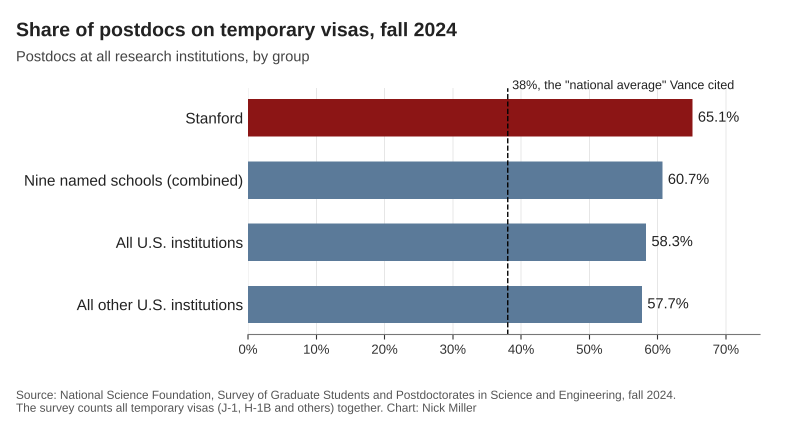
Federal survey data show the nine named universities’ share of postdocs on temporary visas is about 3 points above other U.S. institutions, not 23.
Stanford sits above both groups at 65.1%, and at least 13 institutions with 400 or more postdocs that were not named sit even higher, including Northwestern University at 72.8%.
Testing the $20,000 claim
American researchers, Vance said, are “making about $20,000 more than someone brought in under a J-1 visa.” The inspector general’s release also does not mention this figure.
At Stanford, the pay rules leave no room for such a gap. University policy requires that “all Postdoctoral Scholars, regardless of their source of funding” receive a set minimum, now $79,056 a year, according to the Office of Postdoctoral Affairs. “Pay does not differ by visa status,” Sofie Kleppner, associate vice provost for postdoctoral affairs, wrote to The Daily in an email.
Federal wage filings tell the same story. Of the 67 Stanford postdoc H-1B applications which the Labor Department decided between November 2025 and June 2026, 59 carried a federal wage floor below Stanford’s own minimum. Moving a typical postdoc from a J-1 to an H-1B would not have raised the pay the law required.
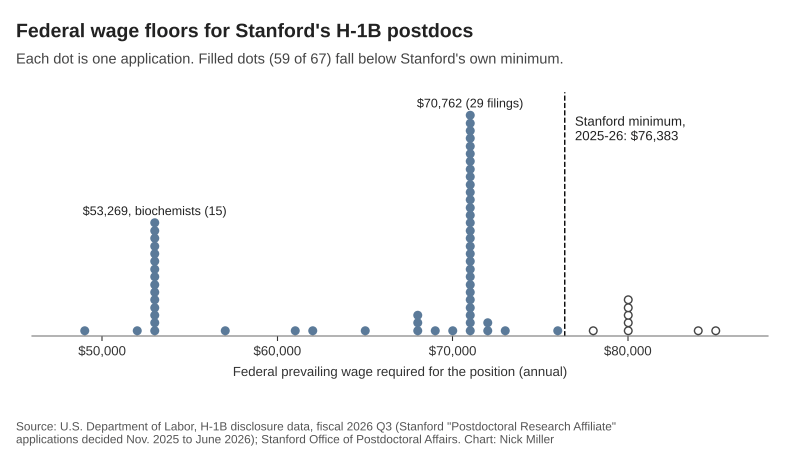
For 59 of 67 Stanford postdoc H-1B filings decided between November 2025 and June 2026, the federal wage floor sat below Stanford’s own minimum.
The best national estimate is far smaller than Vance’s. A 2024 study in Research Policy found that foreign-trained postdocs on temporary visas earned 5.6% less than U.S.-trained citizens, after controlling for factors like the rank of a researcher’s doctoral institution. That figure amounts to about $4,100 a year. The gap was widest for J-1 holders required to return home after their programs: 8.8%, or about $6,500. Shulamit Kahn, a Boston University economist and co-author of the study, wrote that the 5.6% figure is the one she would use.
Vance’s $20,000 would be a gap of about 27%. About two minutes before his J-1 remarks, he had used the same number for a different visa; H-1B workers, he said, are “earning $20,000 less than an American citizen hired in the same position.”
Stanford’s J-1 default
Stanford’s postdoc policy says the University “appoints international Postdoctoral Scholars in a J-1 (Research Scholar) status.” Departments may request an H-1B only in “compelling circumstances,” according to the postdoctoral affairs office. Kleppner’s office declined to say how many exceptions it has approved.
The two visas carry different obligations. An H-1B employer must pay at least the federal prevailing wage. J-1 rules require only that sponsors confirm a visitor has “adequate financial resources.”
The gap between the two visas’ wage requirements grew on July 1. New Labor Department wage tables set the entry-level academic wage in the San Jose area at $92,830 for biochemists and $90,293 for medical scientists, both above Stanford’s minimum. For biological scientists and chemists, the federal wage still falls below it. In the higher-paid fields, a J-1 now avoids a floor an H-1B would impose.
Underneath the pay question is the harder consideration of whether a postdoc is an employee at all. Stanford’s policy defines a postdoc as “a non-matriculated trainee, in graduate student status” and says postdoctoral fellowships “do not lead to an employer-employee relationship.” D’Esposito warned that “improperly used J-1 visa classifications to avoid employment obligations” would not be tolerated.
The National Postdoctoral Association defends the J-1 on exactly that point. The visa “allows talented individuals to enter the United States and begin critical work relatively quickly without the need for an employment relationship,” Tom Kimbis, the association’s executive director, said in comments which the association emailed to The Daily.
Stanford’s own postdocs once argued the opposite. The Stanford University Postdoctoral Association recommended in 2023 that postdocs “be employed as permanent staff,” with work visas to match. Asked whether it still holds that view, the association’s leadership wrote that the recommendations “were priority topics in SURPAS advocacy” when the report was published in 2023.
Where the growth came from
Stanford’s postdoc growth has come from abroad. An Office of Postdoctoral Affairs slide from Feb. 2026 shows international postdocs rising from 1,338 in 2016 to 1,730 in 2025. The number of postdocs who are citizens or permanent residents fell from 925 to 856 over that same period. Kleppner said the slide’s counts were accurate to within one or two people.
Stanford has also sponsored more H-1Bs. The Bechtel International Center processed 575 H-1B petitions in 2024-25, up from 384 the year before, according to its annual reports. Those petitions cover faculty and staff as well as postdocs.
The inspector general’s press office and the Office of the Vice President did not previously respond to questions about the data behind the 61%, 38% and $20,000 figures and whether the 61% figure counts J-1 holders or all foreign nationals.
Stanford’s policy says postdocs come to campus “for the purpose of advanced studies, research, and training.” Federal investigators will now decide whether they see students, or workers.