
Editor’s Note: This article is a review and includes subjective thoughts, opinions and critiques.
“What can poetry offer us today, living as we do in an era of spectacular difficulty?” asked Bhion Achimba, a second-year Stegner Fellow, as he introduced fellow poet David Gorin at the first Stegner Fellow reading of the academic year.
In addition to Gorin’s poetry, Wednesday night’s reading also showcased fiction by Stegner Fellow Jiachen Wang. The fellows are part of two-year artist-in-residence program for emerging writers in fiction and poetry.
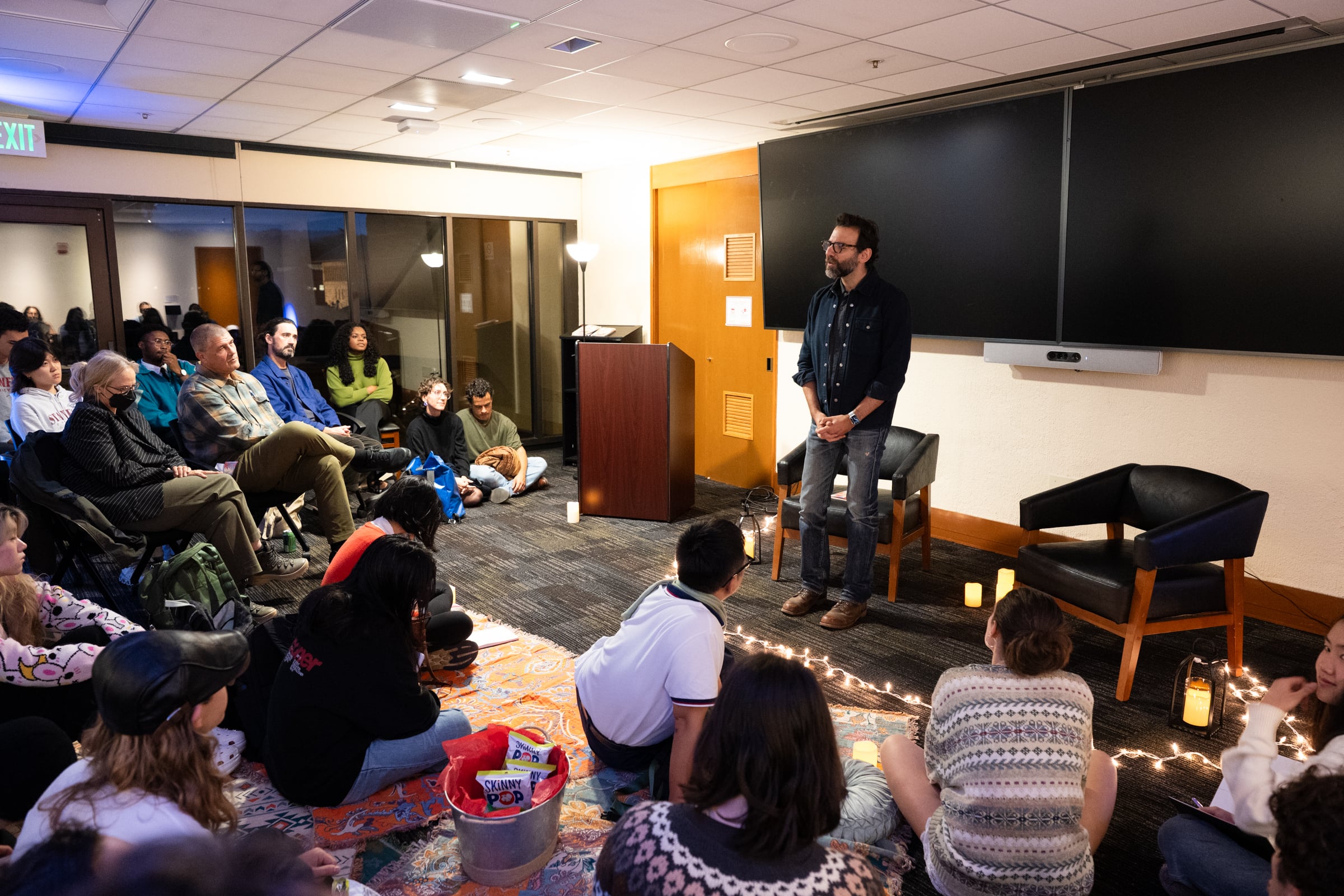
A crowd composed of students and faculty alike had filled the Margaret Jacks Terrace Room in anticipation of the showcase. Many attendees chose to sit at the speakers’ feet on cushions and threadbare rugs — giving the night a casual, almost intimate ambience.
Gorin gave Achimba a long hug, thanking him for his flattering introduction, before addressing the audience.
“It’s magic that a university building can give me the vibes it gives right now,” Gorin remarked, referring to how the Terrace Room was illuminated by orange string lights and glowing LED candles on the floor. The ambience had provoked immediate reactions of awe from the public as they streamed in. One attendee even exclaimed that the room was “so vibey.”
Prior to the reading, Gorin spoke about his love for performing poetry with The Daily.
“I really like having a stage, because I don’t like to grab attention for myself from a room full of people just with no excuse,” he said. “But I love having an excuse — because I’m a Leo.”
Gorin, who believes that poetry can be as fun as pop music, also remarked that while readings can be boring, he hoped to create a more enjoyable experience for his audience.
“Many of the readings with my peers are not boring at all,” he said. “They’re incredibly alive experiences. And I like being able to bring something like that to other people.”
Gorin kicked off his reading with the titular poem of his 2025 chapbook “To a Distant Country.” Described by Gorin as an “elegy without a name” for critic and activist Liu Xiaobo, the piece transported the audience into an airplane in which the speaker has visions of Liu.
“At such a speed clouds feel like sandpaper,” Gorin read. “The teeth of tiny frozen fish / When the cabin lights came on he disappeared from view.”
Despite the literary and introspective nature of many of the poems Gorin read, there were also moments of levity throughout.
“I have twisted with jealousy over a lover’s ex and learned, years later, she had made him up,” Gorin read from “I Have Never Disappeared for Even a Single Instant.” The line sent waves of laughter through the room.
Following a round of applause, Gorin turned the floor over to first-year Stegner Fellow Jiachen Wang. Wang was introduced by second-year Stegner Fellow Adams Adeosun, who described Wang’s work as “brutal yet tender, personal and political.”
Wang took to the podium to read an excerpt from the titular story of his collection “Stealing Fire.” Telling the story of a 12-year-old boy living under the 1943 Japanese occupation of Manchuria, Wang vividly described the “purple toes sticking out of the rag” in which the narrator’s little brother was wrapped up to be buried.
Prior to the event, Wang told The Daily that his enjoyment of readings comes from their usefulness to him in honing his craft.
“It helps me hear my work out loud,” he said. “It’s more helpful to myself [than it is to] the audience.”
More than anything else, Wang also hoped the audience would enjoy the reading. “I hope they won’t find it boring,” he said with a chuckle. “I hope they don’t yawn and fall asleep.”
Like Gorin, Wang brought elements of humor to his reading. The room rumbled with laughter at Wang’s description of a teacher known as the “Tigress,” and the narrator’s remark that it was “a wonder how anyone would want to marry her.”
The reading was followed by a Q&A session, during which those sitting on the rug snacked on complimentary SkinnyPop.
Both writers offered insight on their craft. Responding to a question about how to know when a poem is finished, Gorin recommended the book “Poetic Closure: A Study of How Poems End” by Barbara Herrnstein Smith. Wang received many questions about being a bilingual writer. He revealed that he first started writing in English because he had no choice. Later he discovered that writing in English was actually beneficial to him, since it made everything he was writing “so exotic.”
Present in the audience was Alice Cao ’27, a regular attendee of the Stegner readings.
“I go to these ‘cause they make me sane,” she said when asked what had brought her out to the reading. “I am mostly here for the atmosphere, to be among other people who want to listen.”
Cao also expressed appreciation for Wang’s self–translated work, which she says she could tell had been translated from Chinese because of its cadence.
“I like hearing words. I like in general just feeling that words still matter to people, even if they’re not necessarily as in the cultural zeitgeist as they were in the 1920s or as they are in Chile or as they are in China,” she said.
First-year Stegner Poetry Fellow Daniel Lurie said that while readings are easy for Stegner poets to attend, since they take place right after the group workshop, he would have come out to support the Stegner artistic community regardless.
“It’s incredible to just be in a space like that, in a space with people who take their writing and their craft so seriously, where you kind of just get swept up in their writing,” Lurie said.
As the evening ran late and the Q&A wrapped up, the candle-lit room hummed with voices, painting a picture of the Stanford community drawn together by the power of fiction and poetry.
It was a sight that would’ve made Wallace Stegner himself proud.