
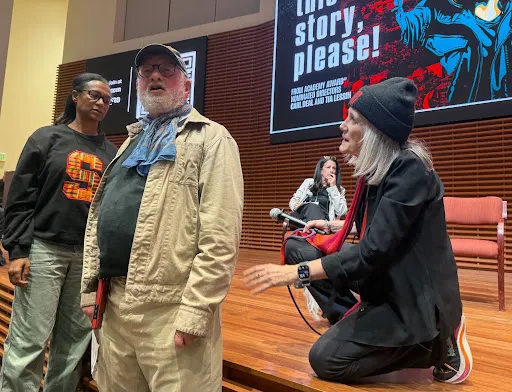
“Democracy Now!” host Amy Goodman held a conversation on journalism and independent media following a screening of her documentary at CEMEX Auditorium on Friday. The event was interrupted by Palo Alto City Council candidate Henry Etzkowitz, when he abruptly took center stage.
“Steal This Story, Please!” a documentary detailing Goodman’s life, has toured cinemas and film festivals since its release last year. Friday marked the first time the film has been screened on a college campus.
Goodman was accompanied by her brother Steven Goodman, associate dean of clinical and translational research at Stanford School of Medicine; Tia Lessin, one of two producers of the documentary; and Janine Zacharia, the Carlos Kelly McClatchy lecturer in Stanford’s Department of Communication. The group formed a panel that discussed and answered questions about media and journalism following the screening of the documentary.
Lessin prefaced the documentary’s importance by explaining the difficult conditions that journalists currently face in the U.S., setting up the theme of journalistic integrity and perseverance that the documentary focused on.
“Journalists are under attack on a daily basis under this administration,” Lessin said, introducing the screening. She characterized Goodman as a journalist who persisted despite such adversity.
Fittingly, the documentary opens with footage of Goodman chasing down Wells Griffith, an energy advisor for the Trump administration, as he ran away from questioning. The sequence set the tone for the documentary, drawing laughter from the audience throughout the interaction with Griffith.
The audience laughed and clapped during the screening as the film oscillated between Goodman’s “perfect comedic timing” (as Lessin put it), and depictions of her various journalistic achievements.
The documentary highlighted perseverance in journalism, showing Goodman as she survived the East Timor massacre, marched into Chevron’s headquarters in Nigeria to make its chief spokesperson admit that Chevron facilitated the murder of protestors and turned a get-out-the-vote call to her radio station from Bill Clinton into a 30-minute interview that grilled the president.
The film concluded with a warning about the current state of journalism and media in the current day, urging journalists to speak out on prescient issues regardless of consequence.
“The media has to reflect on itself,” Goodman said in the final section of the film. “‘We will not be silent’ should be the Hippocratic Oath of the media.”
After the credits rolled, Goodman came out in person alongside the panel for a conversation about the film. But the conversation could not start as Henry Etzkowitz, a Palo Alto resident running for city council, started protesting near the stage.
Etzkowitz stood up from his front-row seat immediately following the screening, waving around a piece of paper. He was protesting being banned from Stanford’s campus, he said. Despite the interruption, the panel tried to start the on-stage conversation. The effort was not successful.
“I will not leave here unless I’m arrested,” Etzkowitz repeatedly said. “I want to be arrested,” he later added.
The crowd booed and heckled him as he spoke. “We want to hear Amy,” one audience member shouted. “We don’t want to arrest you,” said another.
When it became apparent that Etzkowitz would not leave, Goodman tried to placate Etzkowitz. “I’d like to have a conversation here, and then in 25 minutes I’ll talk to you,” Goodman said.
Etzkowitz refused.
As a compromise, Goodman allowed Etzkowitz on stage for a five-minute interview, in the process moving him away from the crowd and near an exit.
Goodman asked Etzkowitz about his presence at the event and his candidacy for city council. Goodman kept keen track of Etzkowitz’ five minutes, updating him as his time depleted.
When Goodman noted that Etzkowitz had used all of his time, he refused to end the interview.
“I’m going to treat you the same way I treat people on the show,” Goodman said, laughing, “you have 30 seconds to go.”
Shortly after, authorities entered the auditorium and Etzkowitz was grabbed by a group of event staff that had surrounded him during the interview. As he was taken backstage, Goodman kept her microphone near his face with one hand, and held her dog Zazu’s leash with the other.
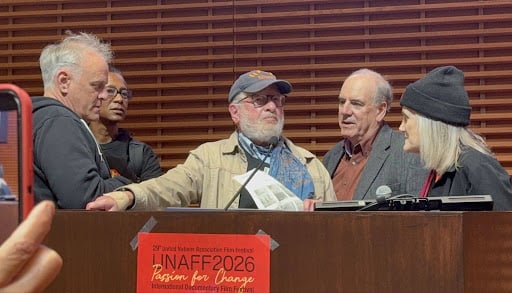
After Etzkowitz was removed from the venue, Goodman quickly returned to her seat and began her scheduled conversation.
PhD Student Sarah Chow, who was sitting next to Etzkowitz, told The Daily that the city council candidate was asleep during the screening of Goodman’s documentary.
“He was snoring through the whole thing,” Chow said.
During the on-stage conversation, Steven Goodman confirmed that Etzkowitz was not arrested at request of the event staff. He praised his sister’s role in placating and calming Etzkowitz.
“We saw the peak of Amy’s powers there as a peacemaker,” Steven Goodman said.
Amy Goodman was then asked about the tension between prioritizing free speech and Etzkowitz’ removal. “I agree with freedom of speech,” Goodman said, “which is why I talked to Henry [Etzkowitz].”
The remainder of the conversation focused on topics of journalism, corporate versus independent media and the importance of fighting for democracy. Goodman lauded The Stanford Daily for its journalistic work and for its work suing the U.S. government to protect international students.
“I want to thank you and the student newspaper here,” Goodman said, speaking to The Daily’s editor-in-chief George Porteous ’27, “you did something so important.”
“These are issues we’ve been covering for years now,” Goodman said of the lawsuit, which focuses on first-amendment rights for student publications. “The paper here has shown how important a student paper is,” she later added. Goodman also advised student journalists to “follow your passion, be dogged.”
Speaking more broadly, Goodman encouraged the audience to always stay aware and resistant of threats to democracy. “You never achieve democracy,” she said, “you have to fight for it every single day.”
Goodman also emphasized how journalists who represent everyday people can be agents of peace.
“When you hear someone speaking from their own experience, whether it’s a Palestinian child or an Israeli grandmother, an uncle in Iran or an aunt in Afghanistan, it changes,” she said. “It makes it much less likely that you will want to destroy the person.”
“I think media can be the greatest force for peace on earth. Instead, all too often, it’s wielded as a weapon of war,” Goodman added, “which is why we have to take the media back.”