
Editor’s Note: This article is a review and includes subjective thoughts, opinions and critiques.
An unexpected film has captivated the American zeitgeist — not a Ryan Gosling movie or a superhero flick, but a documentary about Theranos founder Elizabeth Holmes.
Directed by Nathan Fielder and Lance Oppenheim, “You Can See Everything” (2026) documents the days leading up to and during the disgraced CEO’s incarceration. The film revolves around three enigmatic figures: Holmes, her partner, Billy Evans, and Fielder himself.
From the beginning, “You Can See Everything” is a film about deceit. The title itself drips with irony, because despite the nearly three-hour runtime, the viewer leaves the theater certain of very little. Holmes would have you believe she is less culpable in Theranos’ blood-testing fraud than the public believes, but the film reaches no conclusive verdict.
To even call it a “documentary” carries hints of equivocation: Fielder and Oppenheim blur the line between nonfiction and dramatic performance, and, at times, render it nonexistent. “You Can See Everything” is also filmed and scored like a thriller during its most intense scenes, while its mellow moments carry the tension of a mystery. Indeed, it is a mystery where the audience is always searching for the truth about Holmes and her intentions.
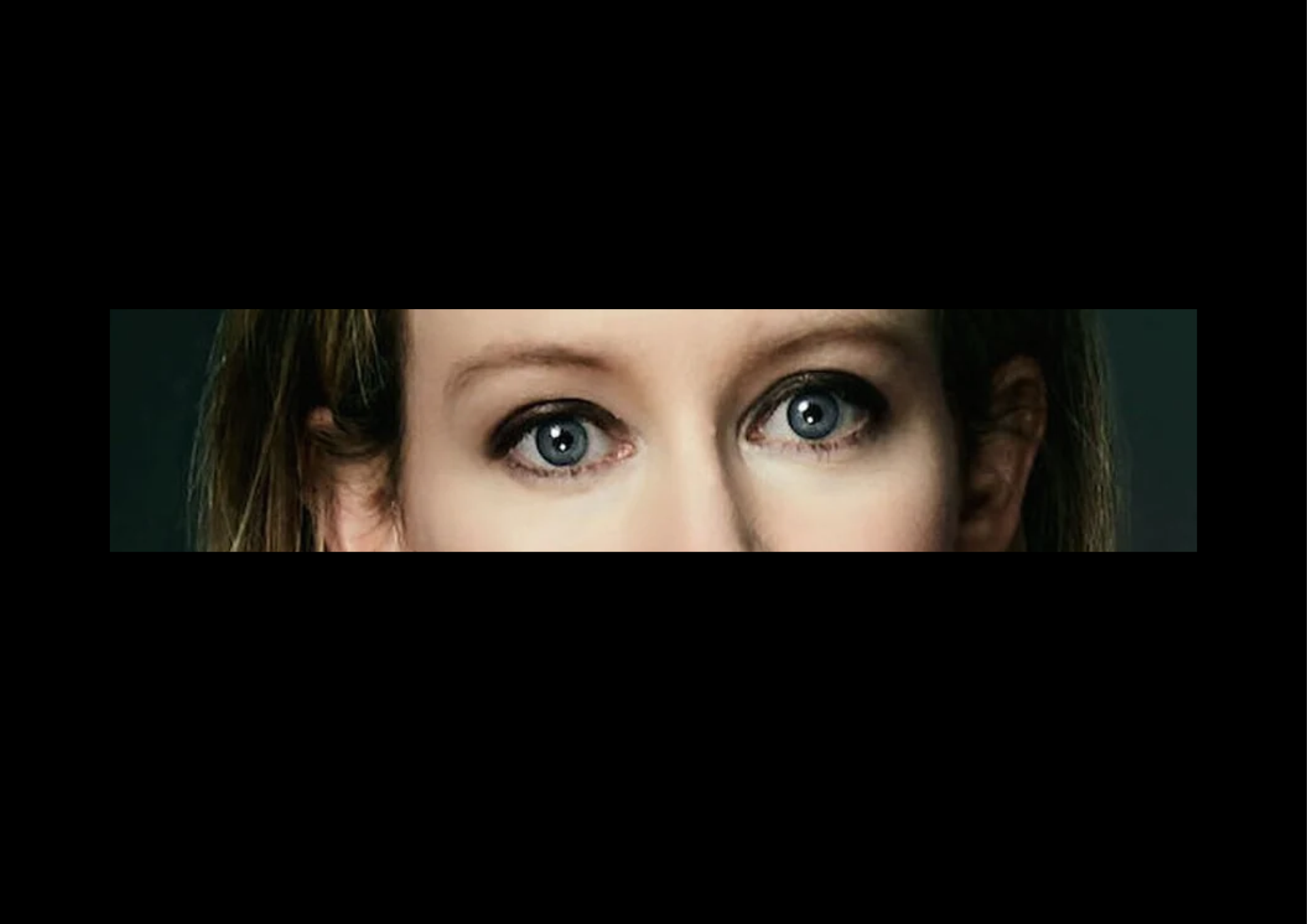
Fielder and Oppenheim’s collaboration creates one of the most intense cinematic experiences of 2026. “You Can See Everything” shoves the camera uncomfortably close to the face of its subjects — highlighting every twitch of the lips and blink of the eyes (the frequency of which was disturbingly few, because both Holmes and Evans never seem to blink). The viewer is so close they can see every pore … and yet Holmes’ terrifyingly wide, blue gaze remains as empty and cryptic as ever.
That image embodies the film as a whole. Even though we are shown intimate moments of Holmes’ and Evans’ lives, like Evans showering and Holmes breastfeeding, we swiftly discover that we still cannot be certain of anything.
The appeal of “You Can See Everything” lies in its voyeuristic premise, but by zooming in too close, Holmes’ character becomes even blurrier than before. At the heart of it, Fielder and Oppenheim are not telling a story about Holmes at all. The film doesn’t cover the wealth of implicating evidence against Holmes — not the lies she told about the military using her blood-testing machine, not the Pfizer logos she added to falsified lab reports. But perhaps Fielder and Oppenheim didn’t think they needed to. Whether Holmes is guilty was never the question; the film is actually a meta-commentary on truth and information.
Despite the film being classified as a documentary, everyone is performing. Halfway through, the film shifts from a conventional documentary to something more experimental. After Holmes is imprisoned (and unable to be filmed), Amanda Seyfried, who played Holmes on Hulu’s 2022 show “The Dropout,” returns to reprise her role. It’s a clever narrative technique, but more importantly, it parallels the unreliability of Holmes’s testimony itself. If she can so easily be replaced by a literal actress, then what worth did her words ever hold?
Even Fielder plays the role of the increasingly unreliable narrator and throws his credibility into question. When the credits roll and Nathan Fielder is listed as playing “Nathan Fielder,” one can’t help but wonder if this means that he was acting as himself or as a character. How much of his onscreen persona is an invention? Did he truly grow to care about Holmes’ wellbeing, or was he just playing his designated role?
One peculiar scene sums up the film’s interest in interrogating the truth. Early on, Holmes invites Fielder to swim with her, to which Fielder responds that he dislikes cold water. The scene cuts and the conversation ends, leaving the viewer under the impression that Fielder did not swim with Holmes. Initially, I thought that this was an insignificant moment, perhaps orchestrated by Holmes to endear herself to Fielder. At the end, however, it is revealed that Fielder did in fact swim with her — and rather joyfully too. Here, Fielder and Oppenheim demonstrate the power they wield as directors. The viewer’s perception of reality entirely depends on what they choose to show, and perhaps more importantly, what not to show.
Some sites like NPR have argued that by failing to report on Holmes’ crimes with harsher scrutiny, “You Can See Everything” does a disservice to the art of documentary. Yet, this is precisely the notion that this film seeks to challenge. When all viewers see is a carefully constructed collection of scenes, how can they discern the truth? Documentaries tend to be seen as authoritative sources on the materials they cover, but as famed documentarian Frederick Wiseman said, “Everything about a movie is manipulation.”
Fielder and Oppenheim play heavily into the idea that it is impossible to deliver an objective truth — and they find the perfect vessel for this message in Holmes, one of the most infamous con artists of our time. By pushing the limits of what it means to be a documentary, “You Can See Everything” puts its own creative medium on trial.