
Sobremesa is a Spanish phrase describing the time spent lingering at the table after a meal is over, sharing stories and laughter with loved ones. In each installment, Natalia Sabato ’28 pulls up a chair and shares her honest reflections on life studying abroad in Madrid.
Olivia Dean plays on the radio as the bus pulls out of the Best Western hotel.
A few days ago, my host parents asked, “Before studying abroad, what were your biggest misconceptions about Spain?” I answered: “In a word, industrialization.”
I had envisioned myself getting lost in the cracks between cobblestones, wandering into a tiny cafe to revel in a maroon-bound volume of Spanish poetry I bought at a hole-in-the-wall bookstore. I dared to expect the kind of modernity where it takes longer to ride a taxi than to walk. Instead, I find myself seeking out history rather than being enveloped in it.
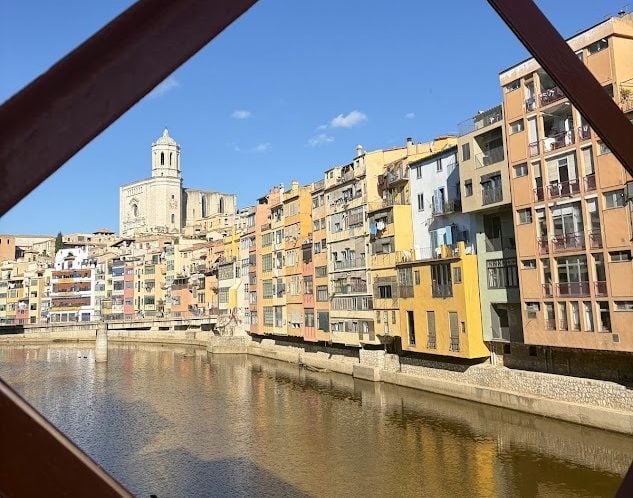
Even here, in the small city of Girona, concrete is never far away. The centuries-old wall that once protected the cozy historic center against foreign invasion now serves to slow the osmosis of industry. Our two-day trip marks the midway point of the quarter, and we’re on our way to visit the Ruins of Empúries, an archaeological site that physically traces the shift from Greek to Roman power. Looking into the hills, trying and failing to sleep, I search for evidence of antiquity.
I glimpse a river under an overpass. The water is clear enough that I can see rocks lining the bottom. I wonder whether they would be smooth under my bare feet. The mountains are draped in fog, and I smell the faraway rain of summer hikes I took in high school, when the dew-saturated earth was so vibrantly brown it looked orange. It was the kind of dirt you wanted to sink into and hold in your hands. In my mind’s eye, my limbs are splayed, making a snow angel in the mulch.
Pressing my forehead into the cool glass on the bus, I think of those August days spent picking leaves out of my hair and smile. I am convinced that the creative directors at Crayola once took this same trip, because as we pass an aging house with a sunburnt roof, the fading tiles are colored in with Burnt Sienna.
I see all of this without ever touching the ground. When I shake my legs awake and step off the bus, the miles of rivers and leaves and tiles we drove past will become indistinguishable from every other view, every other landscape. These travels have no texture; they blend together into a gray, homogeneous smoothie.
It’s not just this bus. I spend flights scrolling through the hours, I roll my eyes when the train is late, and it strikes me that I am alienated from the process of journeying. As I make what feels like the mandatory mental disclaimer that I am endlessly grateful for plumbing and air conditioning, I wonder whether we lose something important, something human, in transit.
For the Greeks and Romans who established cities in Girona, journeying was essential to the survival of their nation and the persistence of their culture. Movement wasn’t frivolous; accepting the very real dangers of hunger and exposure to the elements merited a purpose. In the past, as in many places struck by conflict and internal displacement today, journeying is an act of survival, something inseparable from livelihood. In parts of the world today where the luxury of travel is commonplace, trip planning is something we delegate to travel agents and manage with a few clicks online. The ideal journey is one that involves us as little as possible, where we can just show up, Venmo in hand, trusting that someone else made the arrangements.
Yet a journey, in the purest sense, is something that engages the mitochondria. Your breath, your footsteps, your corporeal self participate. More than participation, a journey requires your wholehearted involvement. You become inextricable from it. A journey is physical. It is embodied.
Back in Madrid two weeks later, watching as the annual Transhumance Festival brings hundreds of sheep gallivanting through the city center to the delight of thousands of onlookers, I wonder how we might reconcile the historic and modern journey. Madrid’s Transhumance Festival began in 1994 to raise awareness for pastoral communities whose livelihoods have often been overlooked.
By parading a flock of sheep through the city center, retracing a historical migratory route from summer to winter pastures, the festival pays homage to Spain’s heritage of transhumance. It begs the industrialized public to contemplate the archival, embodied journey, to think about those sheepherders who dutifully paraded their four-legged livelihood through mountains and valleys that we’ve long since paved over. It recalls the same kind of journey I wistfully imagined on the bus. It announces that tradition has not yet ended.
At the same time, I wonder whether journeying in this sense is best left unresurrected.
For shepherds, it wasn’t an afterthought but an imperative. There was no alternative. Today, this kind of journey becomes absurd and disruptive; it stops traffic and clogs the surrounding roads. The crowds resemble a herd themselves, crowding and clamoring, even scaling scaffolding for the best view. From what I can tell, people only seem to care insofar as they can get a picture of the sheep, and the sheep themselves seem terrified. The kind of journey that was once an essential part of living has now become a spectator sport.
On the one hand, is it ungrateful to romanticize a journey that we are fortunate enough not to require? On the other hand, if we never touch the ground we traverse, what will make us feel responsible for it?