
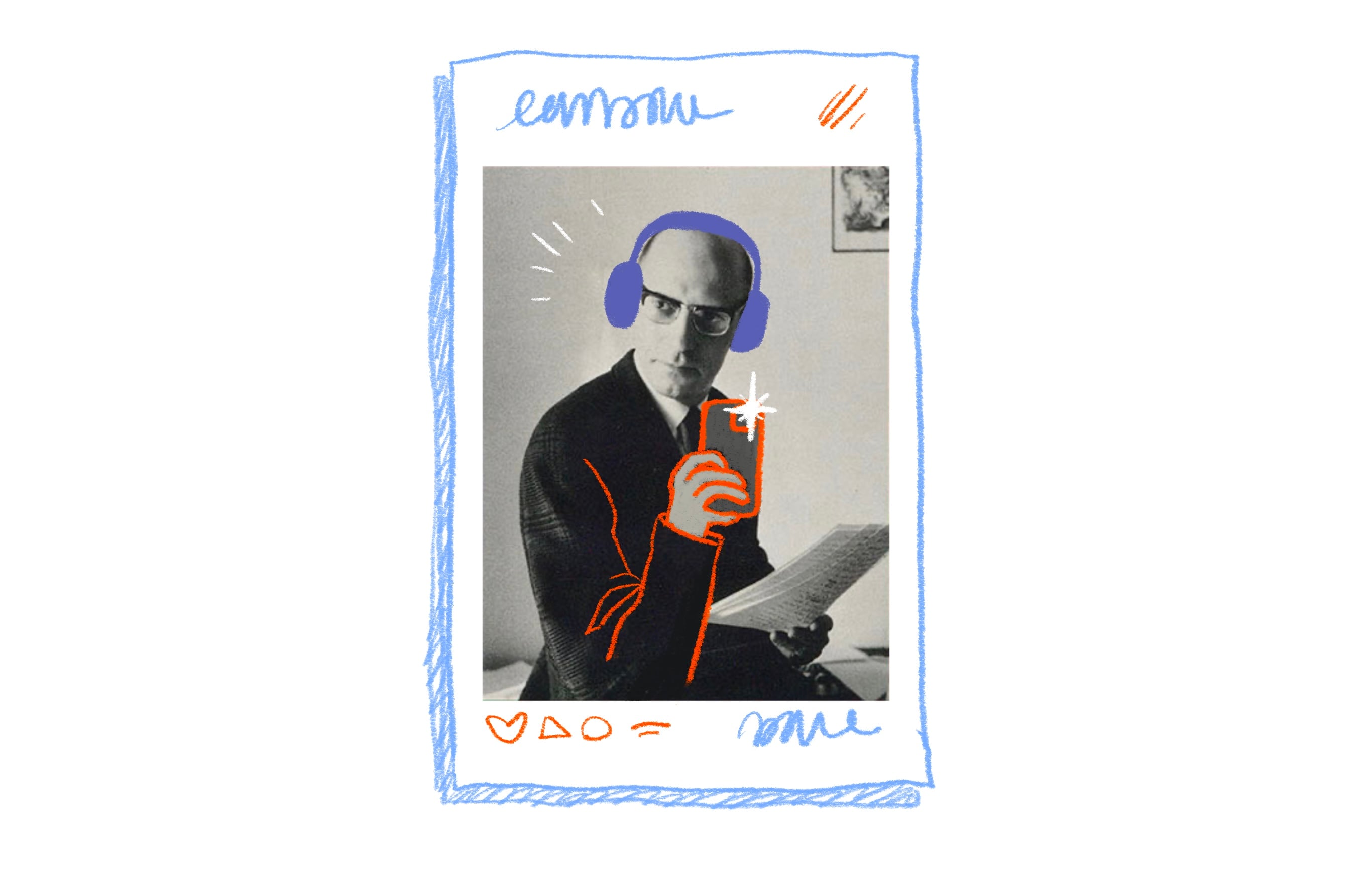
In “Sign of the Times,” Quinn Cook ’29 brings the work of various social theorists and philosophers to bear on aspects of contemporary (student) life.
Philosopher Michel Foucault argues that “discourses really began to have authors … to the extent that authors became subject to punishment.” For us students, being held accountable for our writing is not novel: Since the invention of schooling, we have risked punishment for attaching our names to a particular work. Unlike the authors Foucault has in mind, the issue does not arise from the content of our writing (as heretical, insulting or dangerous), but from the question of our having written it — or not.
In the 2,000 years since the poet Martial first used the term plagiarius — literally “kidnapper” — the motivations, modes and consequences of plagiarism have mutated endlessly. The advent of AI, however, has brought to the fore one aspect less commonly examined: the status of the “author” from whom we degenerate undergraduates steal.
While we have heard plenty about “plagiarism machines,” the interesting question is not whether large language models themselves plagiarize, but what it means to plagiarize off of them. It is certainly cheating (of that, students should have no doubt), but what does stealing the words “written” by an AI agent actually entail? Is the model itself an “author”? Might Claude join the ranks of mononymous writers, alongside Aesop, Confucius, Homer and Voltaire?
In this regard, French philosopher Roland Barthes was somewhat prescient. In 1967, Barthes published an essay titled “The Death of the Author,” arguing that the “author,” in effect, is not of central importance to the text.
For many, this unsettling of the “author” does not always bode well when it comes to human authors. To Barthes’ assertion that “writing is the destruction of every voice, every origin,” I hear Joan Didion respond that “writing is the act of saying I”; to his derisive claim that “explanation of the work is still sought in the person of its producer as if … it was always, ultimately, the voice of one and the same person,” I see an army of Kierkegaard’s pseudonyms and Pessoa’s heteronyms simultaneously cock their heads.
When it comes to AI “authors,” though, Barthes is eerily prophetic. The claims which fit so poorly with human authors are precisely the ones which are so uncannily applicable to AI, and not merely for want of relegating it below the status of a “real author.” The age of AI writing raises Barthes’ concerns anew by introducing a form of authorship which the court of public opinion is equally willing to put to death as he is.
Barthes’ clairvoyance begins at the level of AI training. Dozens of lawsuits filed against Anthropic, OpenAI and Google focus on the training of AI models with vast databases of copyrighted work. Necessary to an AI’s production of a new text, then, is a web of prior texts in which it is suspended, and through which it is made intelligible.
This constellation of preceding work is exactly the same precondition for human authorship that Barthes describes as the “multi-dimensional space in which are married and contested several writings,” where the new text forms “a fabric of quotations, resulting from a thousand sources of culture.”
From this ocean of prior work results another disqualification of authorship common to both Barthes and popular conceptions of AI: originality. In parallel with Barthes’ assertions that the writer “never [has an] original gesture” and that “his sole power is to mingle writings,” LLMs cannot yet escape their statistical foundations, mixing only probable formations of words based on that which has already appeared in its training data. Though few professors will argue that undergraduates produce particularly original works, this statistical model effects an especially egregious homogenization of both prose and ideas.
The process of next-token-prediction thus yields a real-time stream of text which, on first blush, squares well with Barthes’ claim that “the modern scriptor is born at the same time as his text.” It is here, however, that we begin to depart from the parallel between Barthes’ conception of human authors and our own of AI.
While the live generation of a text is, in the case of AI, a technical feature, it is, for Barthes, a function of the reader. The text is created synchronously as it is read, instead of being preceded by its author both chronologically and intellectually. “The unity of a text,” Barthes writes, “is not in its origin, but in its destination.”
He thus concludes that “the birth of the reader must be requited by the death of the Author,” and in doing so introduces an irreconcilable break between his times and ours. Barthes insists that the birth of the reader is the antecedent, but today, quite the reverse is true: generative AI has begun instead by undermining the very integrity of the designation “author.”
Even further, AI does so without offering any concurrent renaissance of the reader. Indeed, by allowing students to avoid the necessary precursors of writing — collecting, synthesizing and reconciling texts for themselves — AI as a tool of plagiarism actually demeans the status of the reader.
We must, then, abandon Barthes’ call for the death of the author. The author was killed, and we need not kill again. The true value of his arguments lies with his faith in the importance of the reader. To heed Barthes’ call in the age of post-literacy means to insist on reading and writing for oneself. The author already having died, we must now demand the birth of the reader.