
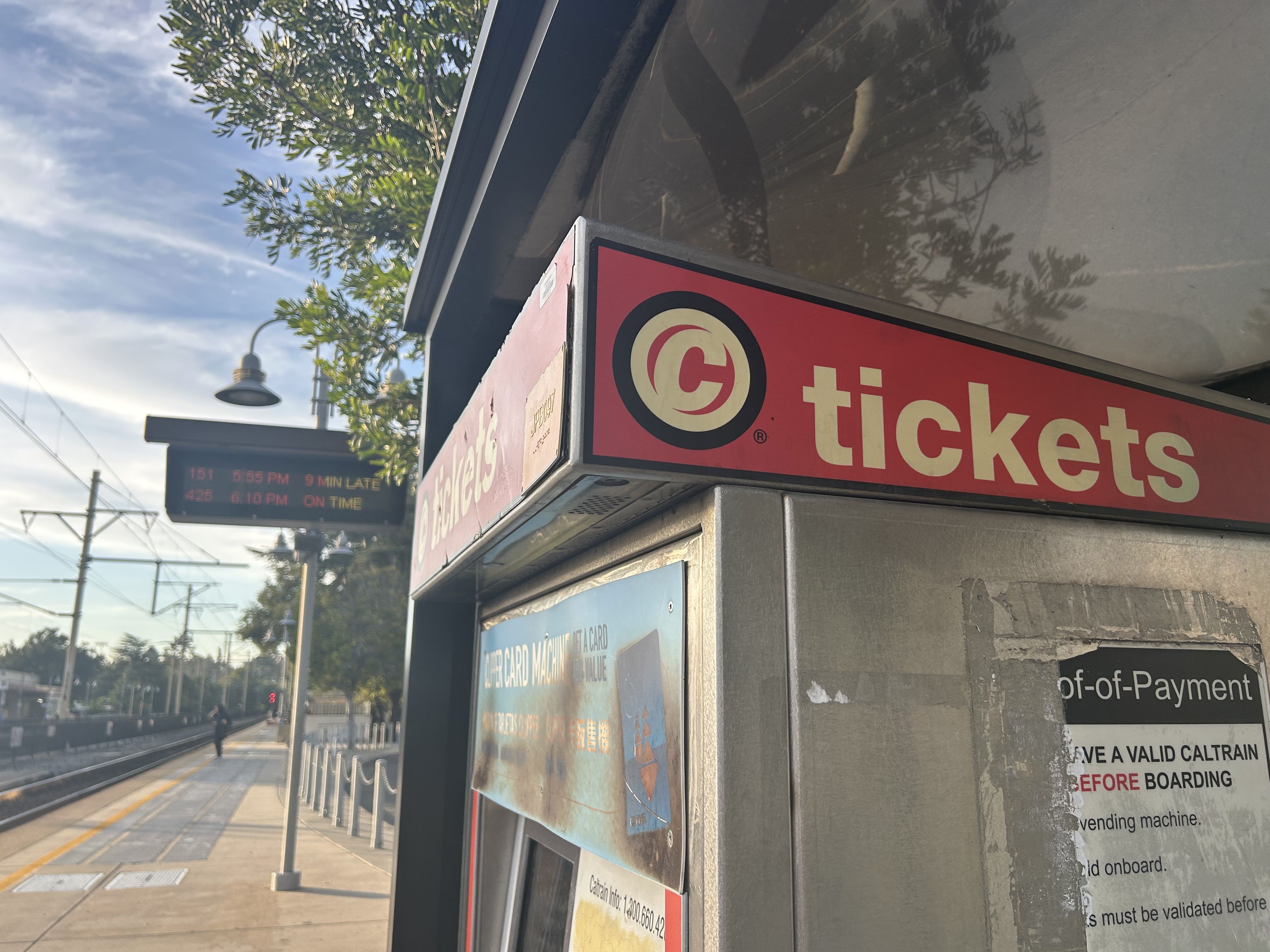
Five Bay Area counties will decide the fate of a key transit policy on Tuesday, affecting multiple transit systems that Stanford students rely on. The Regional Transit Measure, also known as Measure RTM, would enact a 0.5% sales tax in four of the counties, alongside a 1% sales tax in San Francisco, to raise funds that proponents say are necessary to rescue public transportation in the Bay Area.
Most at risk of service cuts, according to proponents of Measure RTM, are the Bay Area Rapid Transport (BART) and Caltrain systems.
“Measure RTM will prevent severe cuts to Caltrain and BART,” Adina Levin, executive director of transit advocate not-for-profit organization Seamless Bay Area, wrote to The Daily. “If the measure fails that will limit the mobility of Stanford students.”
Urban studies and public policy double major Minji Cho ’28 agrees. “For a lot of Stanford students, Caltrain is the difference between ‘let’s go into the city this weekend’ being a plan and being a fantasy,” Cho wrote to The Daily.
Cho further emphasised the importance of preserving existing transit systems. “It’s how people get to internships in [San Francisco] and the South Bay, to SFO via Millbrae, and away from campus when the bubble starts to feel a little too bubbly,” she wrote.
Mandatory lockdowns in 2020 dramatically reduced ridership of services like BART and Caltrain, as companies largely shifted to remote work models. The change heavily accelerated the pre-existing growth of remote work options, dramatically reducing the revenue of services like BART, whose ridership was 54% lower in 2025 than it was in 2019.
While Caltrain ridership has recently surpassed pre-pandemic levels, and BART ridership has surged significantly as well, both transit systems are still struggling. BART is currently running on emergency funds while Caltrain faces an annual budget shortfall of $75 million.
To ameliorate these issues, the Government of California enacted a bill in 2025 that allowed Measure RTM to appear on the Nov. 3 ballot for voters registered in Santa Clara, San Mateo, Alameda, Contra Costa and San Francisco.
As Stanford is situated in Santa Clara — and partly in San Mateo — registered students will in part determine the measure’s outcome.
“I don’t think most students realize how big the consequences could be,” Cho wrote. “When transit funding disappears, it comes out of service: fewer trains, longer waits, routes gone.”
If Measure RTM fails, Caltrain’s contingency includes plans to cease service on weekends, nights, close more than one-third of stations, and reduce train frequency even when in service.
A lack of funding would hit BART even harder, leading to over 50% of service and several stations being cut, according to Levin.
Despite the precarity of public transit, Measure RTM has drawn vocal opposition. The most prominent group opposing Measure RTM is the Committee for Affordable Bay Area Transit (CABAT). The coalition sees Measure RTM as a bailout that will not fix underlying issues with the Bay Area transit system while further taxing working class families.
“We are pushing for real reforms, beginning with governance and leading (hopefully) to an agile and affordable transit system,” Gregg Diéguez, the President of CABAT, wrote to The Daily.
“We are leaving [Generation Z] with multiple future problems because we have not dealt with them enough,” Diéguez wrote. “They include climate change, unfunded pension liabilities and national debt and — less understood — a huge deficit in our public works infrastructure.”
While he opposes Measure RTM, Diéguez said that he understands the perspectives of Stanford students who support Measure RTM, citing their priorities as a predominantly transit-dependent group which largely does not own property and is purportedly less impacted by a sales tax.
“I understand that the cost side is real, but modest for most students,” Cho wrote. “I’d rather pay a few extra cents on my ice cream than pay $70 for an Uber to SFO because the train and BART I needed got cut.”
Levin responded in a similar manner. “The sales tax is not charged on groceries, pharmacy, utilities or rent, and is 35 cents on a $70 pair of shoes,” Levin wrote. “It’s about $7 per month, which is less than having to take Uber even once if Caltrain isn’t running.”
The sales tax, proponents argue, would do more than keep deficit-ridden transit systems afloat. The Valley Transport Authority (VTA) and SamTrans will see improvements funded by Measure RTM, according to Levin.
The chair of the VTA, Sergio Lopez, echoed these claims.
“VTA is much more stable than many of our neighboring agencies, and we’re not facing the scale of cuts that they are but passage will make a big difference for our region,” Lopez wrote to The Daily.
On Measure RTM’s regressive sales tax, Lopez stated that the benefits outweigh the cost. “I strongly believe drastically cutting transit service throughout the Bay Area would be even more regressive,” he wrote.
“Due to fixed costs and reduced utility of service, these initial cuts would reduce fares and necessitate a ‘death spiral’ of further cuts,” Lopez wrote. “Personally, I love the Frost Amphitheater, but I also like the option of getting to shows in the city or the East Bay.”
Diéguez, however, decried the current direction of Bay Area transit. “As a supposed innovation center of the world it is astounding that our public transit system has been entrusted to a bloated bureaucracy that is a bloodclot in the artery of progress,” he wrote.
In contrast, Cho saw a brighter future for public transportation in the Bay Area.
“I’m also genuinely optimistic about where Bay Area transit is headed,” she wrote. “Caltrain’s electric trains are faster, quieter and beautiful, and riders have noticed: ridership has jumped since they launched. The region is finally talking seriously about free transfers and making 27 agencies feel like one system.”
“RTM won’t fix everything overnight, but it keeps the momentum going instead of hitting the brakes right as things are getting good,” Cho wrote. “It would be a shame to have gorgeous new trains and nobody running them!”