
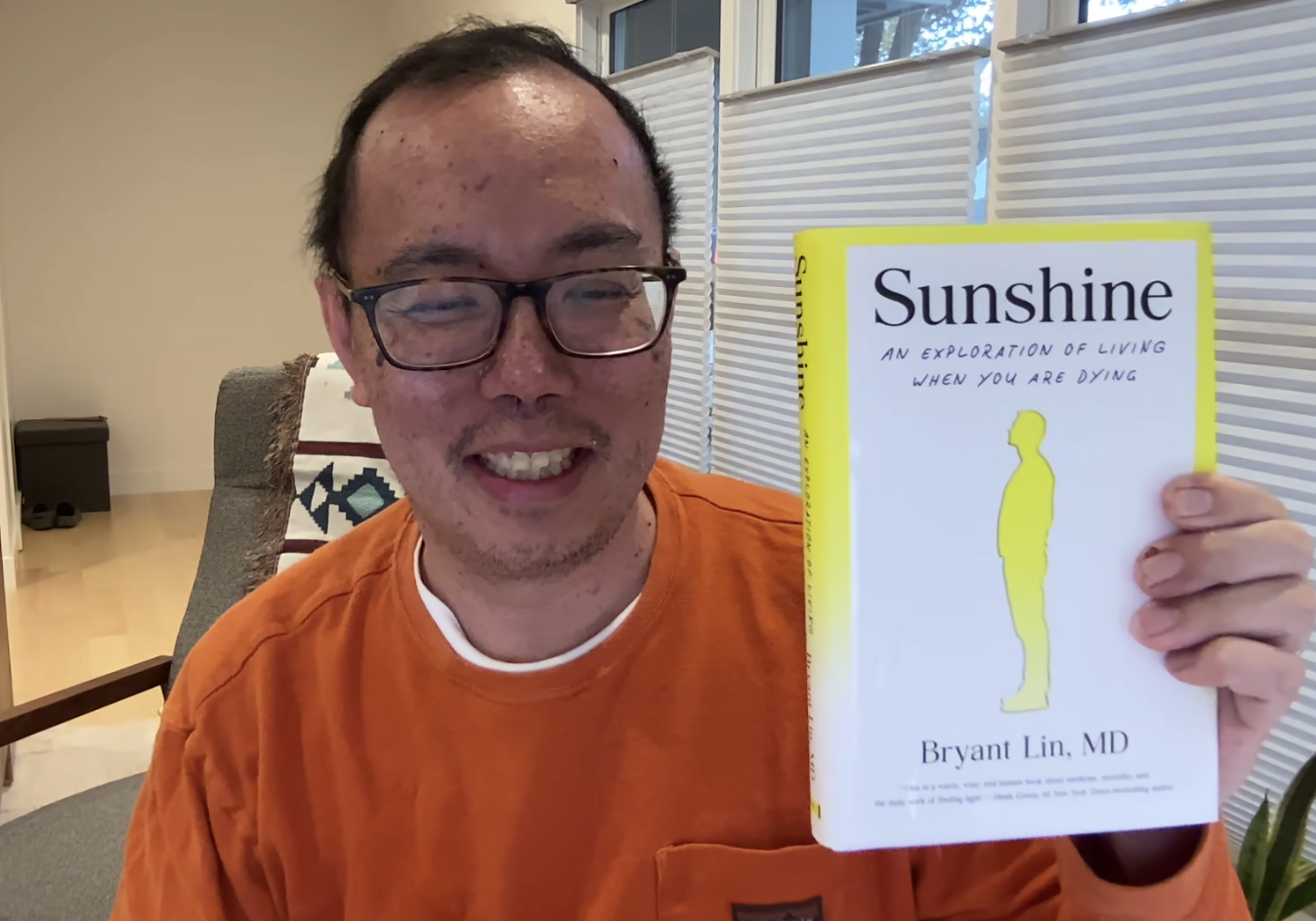
A Stanford Medicine physician and co-director of the Center for Asian Health Research and Education (CARE), Bryant Lin “never expected to be a cancer patient myself,” he recalled to The Daily.
In May 2024, Lin was diagnosed with terminal stage four lung cancer. By drawing on his medical knowledge and family for support, he “was able to go through the stages of grief and come to acceptance relatively quickly,” Lin said. That same year, he created the course “From Diagnosis to Dialogue: A Doctor’s Real-Time Battle with Cancer” to teach students about both patient and physician perspectives.
Now, Lin has written a new book about his experience titled “Sunshine: An Exploration of Living When You Are Dying,” to be released Nov. 10. Based on “From Diagnosis to Dialogue,” the book shares what Lin has learned through his illness.
In an interview with The Daily, Lin offered insight into “Sunshine” and the life lessons he hopes to impart to students and readers.
He also previewed his three upcoming events: the Jonathan J. King Lecture on Nov. 5, his Medicine Grand Rounds speech on Nov. 11 and his conversation with researcher Latha Palaniappan M.S. ’01 on “Sunshine” on Nov. 14.
This interview has been lightly edited and condensed for clarity.
The Stanford Daily (TSD): Can you talk more about the word “sunshine” within your [book’s] title and why you named it that way?
Bryan Lin (BL): My philosophy is to really look for sunshine, [the] silver lining, every day. But I specifically chose the word “sunshine” because of my mother. I was lucky to give the graduation keynote at the Stanford Medical School graduation in 2025. I discussed with the attendees, “Don’t forget to be curious, creative and kind.” The example I gave of kindness [was] my mother. …When I was a kid, she would sing “You Are My Sunshine” to me and my brother and sister. She has advanced dementia now, and she attended the graduation.
I asked the attendees to do me a kindness and to sing with me, “You Are My Sunshine,” to my own mother … So they joined me, the whole group in Maples Pavilion … 4,000-plus people … I couldn’t have titled my book any other way. It had to be “Sunshine” because of my mother and how she’s been just a great example of positivity and kindness to me.
TSD: Why did you decide to write your book?
BL: I really wrote it because there are so many great books out there about cancer, and of course the most famous one is [written by] Stanford [neurosurgeon Paul Kalanithi B.A. M.A. ’00], “When Breath Becomes Air.” When I got cancer, I was like, “I’m never writing a book. Why would I write a book? There’s this awesome book out there.” [But] strangers reached out to me and said hearing my story helped them because they found some sort of connection with my story. I thought, “Hey, if it’s going to help people, it’s worth spending the non-small amount of time it takes to write a book.”
TSD: From your keynote speeches and interviews, you describe yourself as a pretty positive person. Were there times after your diagnosis that you had difficulty keeping this positive mindset and this hope? How did you or do you process those moments?
BL: I gave a talk recently to the Medical Humanities Workshop. We discussed something called toxic positivity or toxic optimism. You know, you shouldn’t be forced to be positive. In my book “Sunshine,” I wrote chapters about hope and fear, happiness and sadness, because that’s just the natural way humans react. Humans have happiness, but they also are sad. You can’t take one from the other. You have hope, but also you have fear.
TSD: Is there a specific audience that you hope to reach with your book?
BL: [There are] three audiences. One is, of course, cancer patients, people who are undergoing either a cancer journey or a serious illness journey. [The second is] people who have families and friends and they’re trying to grapple with what happened or how to help their family members or friends. [The third is] people who are early in their journey in life, which could be at any age, and they’re trying to figure out how to find their own happiness, how to find their own sunshine.
TSD: You are an educator for medical students as well. Is there a specific takeaway that you want them to have?
BL: I hope [my book and class will] encourage people to go into some aspect of cancer care, whether [they become] an oncologist, radiation oncologist, or radiologist, or pathologist or primary care doctor. Or [an] industry person who’s developing drugs for cancer. I hope it does encourage them to seek cancer as a priority in their professional life, to hopefully move the needle on where we are. … [I also want] to show them the patient side, [to] rebalance the story to show them what a patient goes through on this cancer journey.
TSD: On Nov. 5, you will be giving the 36th annual Jonathan J. King Lecture. What should audience members expect?
BL: I think it’s going to be great. It’s not a formal talk. It’s really a fireside chat with Shoshana Ungerleider, who’s a well-known physician. I think it’ll be a great conversation about living, dying, terminal illness and also happiness and sunshine.
TSD: You will be giving a Medicine Grand Rounds speech on Nov. 11 as well. What will you be discussing?
BL: I call the talk “Adventures in Cancerland,” because I want to share the ups and downs of my adventures in getting treatment, diagnosed, [obtaining] insurance …. [the talk will also cover] exploring new treatments like personalized cancer vaccines, using AI for my own care.
TSD: Also, on Nov. 14, you’ll be discussing “Sunshine” with Dr. Latha Palianappan. How will this event be different?
BL: It’ll be different because Dr. Latha Palianappan co-founded CARE with me. So I think we’ll touch on the Asian experience more specifically in that area. … [We will] talk about the amazing things we’re doing at CARE and how to transform lung cancer for the future, and probably talk more about screening, early detection, in addition to revolutionizing next-generation treatments.
TSD: What piece of advice do you have for us to bring a little more sunshine into our lives?
BL: We’re in this rating environment now. You go on Yelp and you’re like “Oh, I’m going to only look for the four-star restaurants.” So I think getting away from that comparison mentality is hugely important. I couldn’t compare going to a restaurant [to] seeing my son come home from school … They’re just different things.
One of the great things I enjoy is sitting in the backyard in my camping chair, listening to the hummingbirds, watching the bumblebees and smelling the lemon blossoms in the air. Some people would call that a little thing. I don’t think that’s a little thing. I think that just brings enjoyment and happiness. … The bottom line is just to think about what brings you meaning, right? I think we’re, myself included, a little too focused on purpose. And I think that to me, the happiness at this point in my life comes from meaning — the meaning of life’s experiences.
“Sunshine” is currently available for pre-order.