
Editor’s Note: Seven sources for this story spoke on the condition of anonymity due to fears of retaliation. Pseudonyms have been used for readability. Two sources chose to use their real first names.
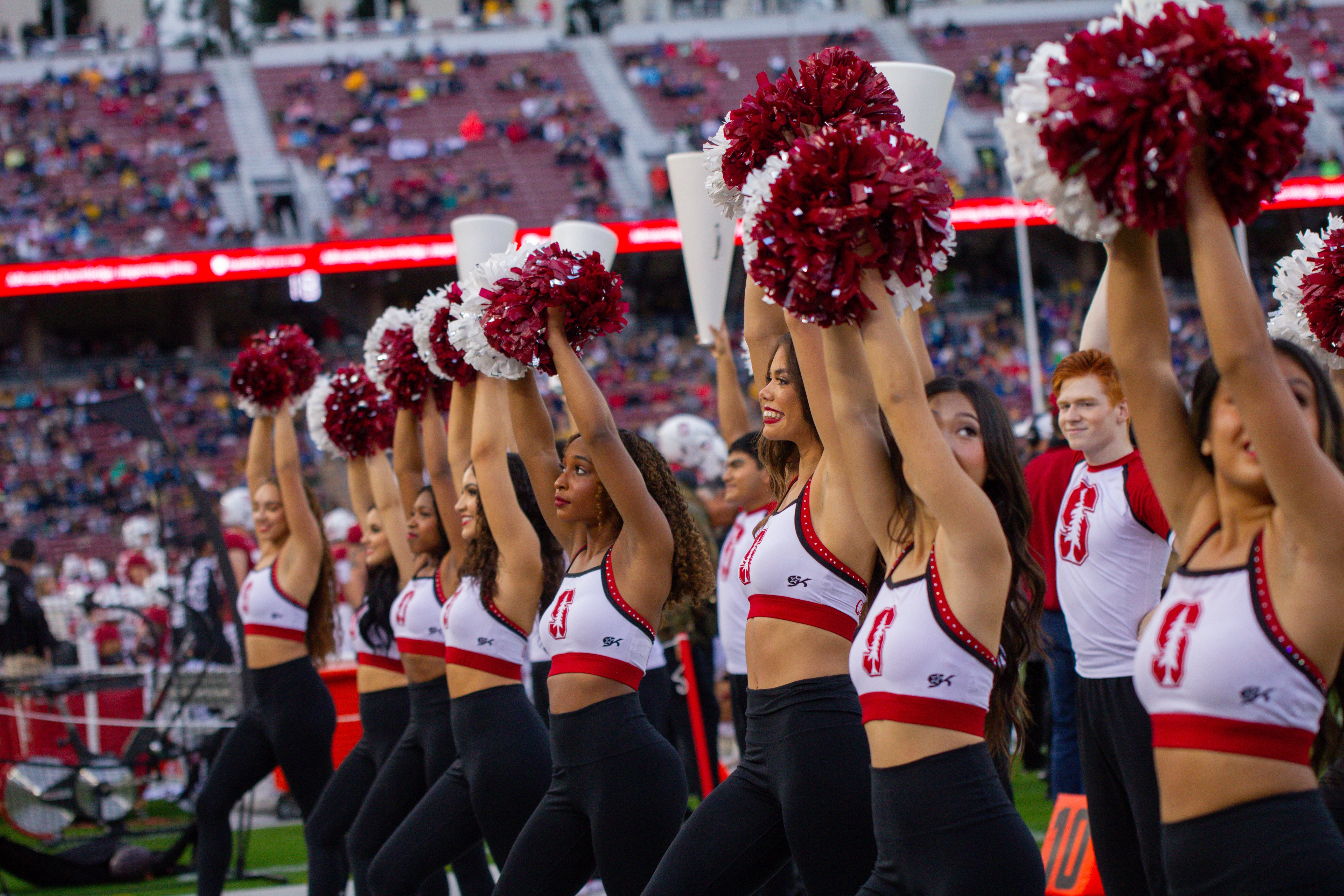
Nine current and former members of the Stanford Cheer Team told The Daily that Head Cheer Coach Sarah Levine has neglected concerns of safety, overworking cheerleaders to the point of serious injury, including a concussion and back injury. They described a hostile team environment that Levine allegedly cultivated through yelling and public humiliation.
“It’s probably the most visibly abusive experience that I’ve ever had in my life,” said Rush ’27, who experienced a concussion and spoke on the condition that only his first name be used to protect online privacy. “I felt like I could not leave because I was too scared to leave.”
Levine began coaching in fall 2008 as a volunteer assistant coach and then transitioned to become interim head coach later that year. She was then appointed head coach, according to Assistant Athletics Director Brian Risso.
“Stanford Athletics will continue to prioritize and support the health, safety and well-being of all individuals affiliated with its student support groups,” Risso wrote to The Daily. Risso did not provide any additional information about specific reports, allegations and procedures, citing legal and privacy concerns.
Levine did not respond to multiple requests for comment.
‘I warned her this would happen’
In Oct. 2024, Rush experienced a bicycle accident that resulted in stitches on his forehead. His medical exam did not diagnose him with any mental difficulties. Around a week and a half later, Rush returned to stunting despite telling Levine he felt uncomfortable.
“I pointed out my scar on my head and said I want to be super careful it does not [get hit] and take the stitches out,” he wrote to The Daily.
According to Rush, Levine told him that he would be fine.
During the practice, someone fell from a stunt while Rush was spotting. He took the weight of the fall onto his head. He then walked off the court in pain, but Levine told him to repeat the stunt, he said.
Later that night, Rush recounted feeling unfocused and stuttered while talking to a friend. He called Levine and told her he thought he had a concussion. Levine, he said, told him that he did not, and recommended waiting until the morning to have Stanford Athletics doctors examine him.
When the pain did not subside that night, Rush went to the emergency room and was diagnosed with a minor concussion, according to medical documents obtained by The Daily. Rush’s friend on the team informed him that Levine had told the team his concussion was solely due to the bicycle accident. According to his medical records, the initial bike accident was not diagnosed as a concussion.
“I got really upset by it because I warned her that this would happen, and she told me that wouldn’t happen,” he said. “And then I got the concussion, and now she’s telling me it’s my fault for getting the concussion, not hers.”
Rush resumed cheering in November after recovering. In February, a teammate hit him again in the head during a stunt. He recalled Levine yelling at him for walking off the court.
He quit the team the same day. “I can’t be in an environment where I’m being yelled at for getting hurt,” he told The Daily.
‘It wasn’t a safe environment to stunt in’
Another former team member, who requested to use the pseudonym Ashley for fear of retaliation, injured her back after practicing a new stunt during a practice outside of usual hours. The practice was held to fit in more stunting time with a small group of cheerleaders. Ashley said only one or two ‘spots’ — whose role is to protect flyers from injury— were present. The number was one too few, as someone canceled last minute.
Ashley described there being only a few temporary mats on the hard ground of the men’s volleyball court floor in place of the usual spring floor they practiced on in the gymnastics facility. Some cheerleaders made comments about the gaps between the mats, she said, but were told by Levine and the assistant coaches to stand between them.
“The whole setting was very uneasy,” Ashley said. “It wasn’t a safe environment to stunt in.” She told Levine she felt uncomfortable in the space, but Levine allegedly responded saying that there would be no safety nets on game day.
As she practiced the new stunt, Ashley fell forward and landed on the ground, resulting in a sharp shooting pain up her back and spine. While she was taken out of the practice, she said that coaches expected her to return to stunting after only one or two missed sessions out of the four each week.
Ashley believes that the injury could have been prevented had the practice been a regular session with the appropriate number of spots and equipment, as well as better instruction.
After the injury, she sent a text message to Levine reading, “It scares me to try the individual stunt group sessions again because of the lack of spots and also the gaps in the mats we were using.” Levine responded writing, “Well, tonight is a full practice and we should talk about this, because we won’t usually have a full team to spot around a stunt.” The Daily obtained and reviewed these messages.
A few months later, Ashley was re-injured while stunting during a regular practice with the appropriate number of spots. She landed incorrectly on her back spot’s knee and re-injured her sacrum, the same area that had been injured before.
After the re-injury, she met with a doctor at Vaden Health Services, who said she likely had a soft tissue injury around the side of her ribs and obliques and should avoid strenuous exercise. “I will need a doctor’s note if you’re sitting out longer,” Levine wrote in a text message to Ashley after she expressed concern about cheering during a game. “If you can’t cheer, that’s fine. You will go in your leggings, cheer shirt and team jacket. Just to support and continue to be with your team.” The Daily reviewed these messages.
Ashley said she had to keep providing “more information than necessary” about her injuries to sit out of cheering, which she found “accusatory.” This added emotional stress and made her feel like she was “letting the team down,” she said.
“No matter how much information I provided, there was still a pressure and an expectation to perform despite the injuries and to keep going for the sake of the team,” Ashley said.
She felt the pain in her back for months after the re-injury while doing day-to-day workouts, she said. Ashley quit the team at the end of the year.
‘I’m just coming here to get bullied’
Levine’s hostile style of coaching has repeatedly led to at least two members quitting mid-season and almost all leaving the team at the end of the year, several cheerleaders told The Daily. The cheer team typically has around 15 to 20 members each year.
According to multiple cheerleaders, several former team members have sent complaints to Stanford Athletics. The Daily was able to obtain and review one formal complaint, which former cheerleader Mark ’26, who spoke on the condition of partial anonymity due to online privacy concerns, sent to Stanford Athletics in Oct. 2025. In his report, he labelled her conduct “a serious abuse of her coaching authority.”
“She verbally abused and humiliated me by yelling at me in front of the entire team,” Mark wrote in the formal complaint. “I was met with unprofessionalism. Levine was not performing constructive coaching. Rather [her coaching] was a demeaning act.”
Levine’s behavior led Mark to take antidepressants, he told The Daily. After one season in 2023-24, he quit the team to prioritize his well-being.
“Am I really going to go through another year of being abused mentally?” he said.
Mark said that he attempted to try out for the team again for the 2025-26 season during the 2024-25 spring tryouts because he felt that he should not let Levine’s coaching prevent him from pursuing cheer.
He said that while he was not selected to advance due to an incomplete video, Levine later encouraged him to pursue fall tryouts. However, he said those tryouts were never announced, and that Levine ignored his multiple calls and messages inquiring about how to rejoin the team.
“I believe this was an unfair action taken by Coach Levine that prevents me, a former athlete she has a history with, from having a fair opportunity to rejoin,” he wrote in his formal complaint to Athletics.
While Mark met with Associate Athletics Director Ted Seilheimer to discuss the complaint, Mark stopped pursuing it and nothing came of his report.
Other cheerleaders said that Levine frequently yelled at individuals, often in front of the rest of the team. Mary, a former cheerleader who also asked to use a pseudonym for fear of retaliation, alleged that Levine would often yell at cheerleaders when they were already crying, which she called “inappropriate” behavior from an adult.
“I still get anxiety when I remember moments where she was emotionally abusing us,” said Jane, a former cheerleader who requested a pseudonym for fear of retaliation. Jane added that cheer was one of the main reasons she had to seek professional mental health treatment.
She also said Levine’s behavior entailed public humiliation, private berating, fearmongering and manipulation, which drove cheerleaders to “intense levels of anxiety,” she said.
Jane described Levine’s treatment of freshmen on the team as “especially concerning.” According to several cheerleaders, Levine gave freshmen minimal guidance on how to behave during performances and how to put on their makeup, and then publicly berated them in front of the team and audience members as if they had made mistakes intentionally, according to several cheerleaders.
Mary said she has never been a part of a worse environment: “I would actually characterize her as evil.”
She added that Levine failed to offer congratulations or compliments after games. “I’m just coming here to get bullied,” Mary said.
Former cheerleader Charlotte ’26, who requested a pseudonym for fear of retaliation, added that the team had a culture of secrecy, toxicity and cliquiness. Teammates reported each other to the coach in order to get on her good side, she said, creating a lack of team unity. Levine also allegedly shared information about certain cheerleaders to others, creating a “power imbalance.”
“It just felt like a chore at the end of the day,” said Linda, a former cheerleader who requested a pseudonym due to fear of retaliation. “I’ve never had a coach that made me dislike my sport so much.”
A heavy commitment
As a longtime competitive cheerleader, assistant coach and official for STUNT —a sport derived from cheerleading — with USA Cheer, Mark said Stanford’s cheer program operates far below the level he expected.
The team spends an entire season learning skills that many competitive programs master quicker, he said. Mark also questioned why Stanford Cheer does not perform at more athletic events instead of only at football and basketball games. Part of the reason for the lack of skill, he speculated, is because of the high turnover.
Stanford cheerleaders are not recruited to the team, and instead incoming freshmen and other students can try out in the spring or fall. Despite not being a Division I sport, several cheerleaders said they were expected to prioritize cheer over all other commitments, including academics. Several said they skipped class for games and were pressured to do so.
“We were expected to uphold the same level of commitment that recruited Division 1 NCAA athletes have, which I thought was kind of crazy,” said Alex, a former cheerleader who requested a pseudonym for fear of retaliation.
Alex, who was on the team for a year and left due to the large time commitment, said they have “positive memories” of their experience. Alex added that they did not think Levine treated all cheerleaders poorly. Alex attributes their positive experience to being one of Levine’s favorite team members and said that it was common knowledge that she had favorites.
According to Linda, cheerleaders are only allowed to skip practice if they have a fever or academic commitments. Otherwise, Levine “will try and make your life hell,” she said. Linda referenced a time when Levine allegedly reported a cheerleader to the Athletics department for missing a practice for a concert.
If a team member was sick, they would still have to come and watch the team practice, according to Riley, a former cheerleader who requested a pseudonym for fear of retaliation. The only time Riley said she was able to skip practice came when she had a 103-degree fever that the coach said might spread.
Assistant coach Elijah Simeon Buenarte ’24 said the team does not prevent team members from pursuing academics. The cheer team prioritizes “academic excellence,” and many cheer graduates have been able to succeed academically and go on to elite postgraduate schools, he wrote to The Daily.
Regarding cheerleaders who no longer feel satisfied with the team, Buenarte said it was “entirely natural” for students’ interests to shift while at college and “explore other campus opportunities.”
“We remain dedicated to maintaining a positive, communicative environment that sets our student-athletes up for success both on the mat and in their future endeavors,” he wrote. Buenarte was previously a member of the team for four years under Levine, including as team captain.
‘I think that she broke athletes’
“It is a coach’s job to push athletes but not to break athletes,” Jane said. “And I think that she broke athletes.”
Several cheerleaders attributed the team’s low retention rate to Levine’s behavior. People who quit during the season are “never allowed to join the team again,” Jane described Levine telling her.
Mary said she sent an email to Levine to quit the team because she was scared of an in-person confrontation. Several cheerleaders later told her that Levine had read the email to the team during practice in a mocking tone and called the email disrespectful.
Levine often communicated with Rush and other team members over long phone calls. Rush said she rarely expressed harsh language over text messages.
“She’s an in-person kind of person, a phone call kind of person to be abusive,” he said. “There’s no physical proof of what it is.”
At the start of her time on the team, Riley thought she was “crazy” for feeling like Levine’s coaching style was abnormal. She said she was thinking of quitting in the middle of the season and, after talking to the then-captain, realized she was not alone in her experience.
Jane expressed frustration that members of Stanford Athletics know about cheerleaders’ concerns but have not pursued changes.
“It seems for some reason she’s untouchable in a sense, and she knows that,” Mary said.