
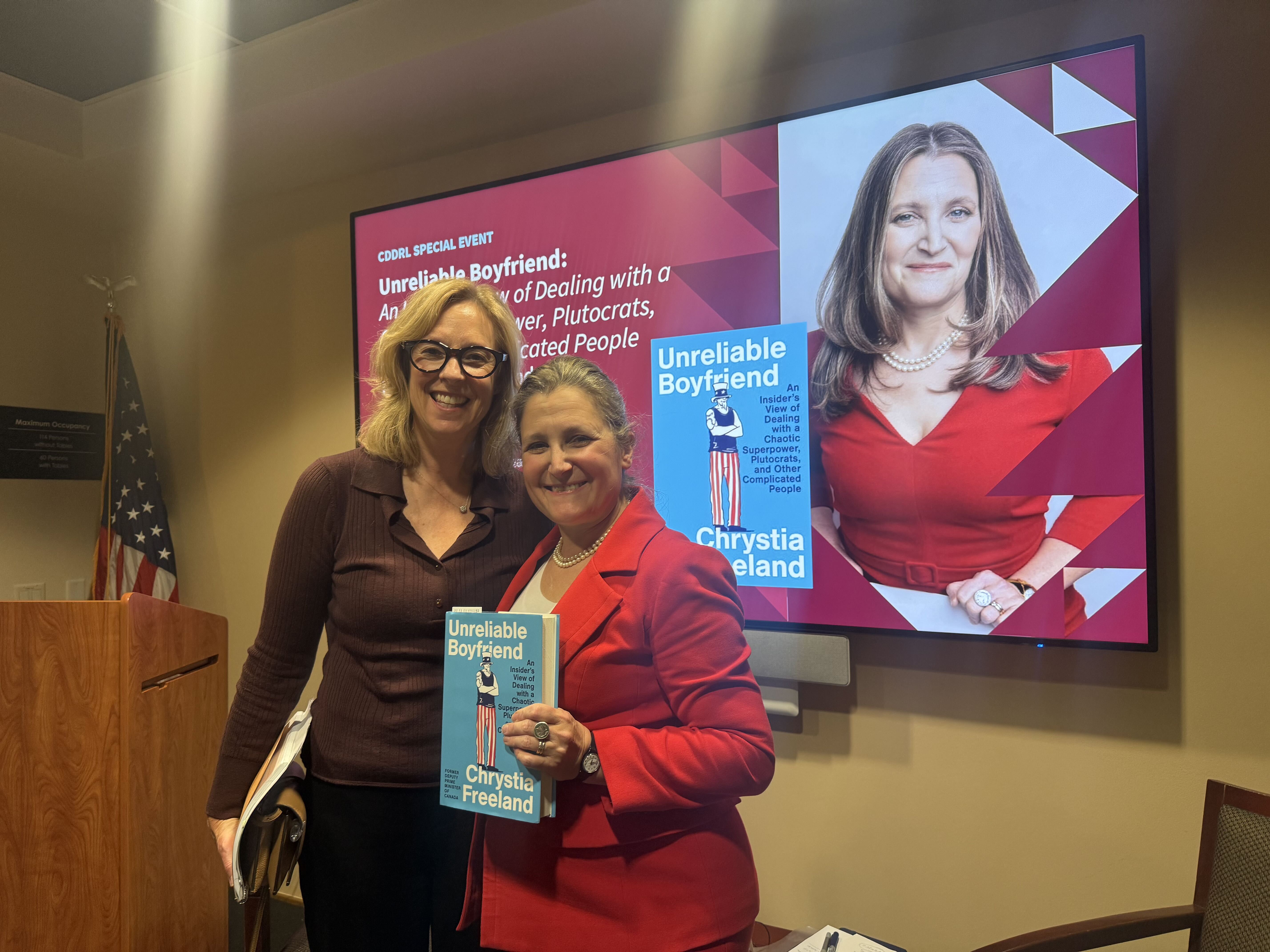
Former Deputy Prime Minister of Canada Chrystia Freeland opened up about betrayal, allyship and making hard choices while in office at Encina Hall this Monday.
At the event hosted by Stanford’s Center on Democracy, Development and the Rule of Law (CCDRL), Freeland discussed her new book, “Unreliable Boyfriend: An Insider’s View of Dealing with a Chaotic Superpower, Plutocrats, and Other Complicated People,” which describes the U.S.-Canada relationship from the perspective of a Canadian diplomat. She also recounted her experience in Justin Trudeau’s government and offered perspective on international political economy and North American politics.
Without preface, Freeland macaronically responded to her first question of the event in fluent French, before quickly changing back to English.
“Canadians are feeling more Canadian than at any time in my lifetime,” she said. “That includes being very clear about the fact that we’re a bilingual country.”
Freeland explained how newly hardened Canadian patriotism now informs their international policy.
“[Canada] does not escalate and we do not back down,” she said. “The only hope of restoring a balanced win-win relationship is for us, clearly, to reject unacceptable behavior.”
Throughout the discussion, the former diplomat pointed out the historical significance of the US-Canada allyship, claiming that “a relationship doesn’t get closer than that.” However, Freeland said that some decisions made by President Donald Trump’s administration felt “like a betrayal.”
Freeland spoke of a shift in Canadian attitudes towards America, citing a recent statistic that shows Canadians now view China more positively than the U.S.
She also discussed her experience working with Trump, who blasted Freeland upon her resignation as finance minister in 2024. “Her behavior was totally toxic,” Trump wrote on Truth Social, “she will not be missed!”
Freeman Spogli Institute (FSI) Senior Fellow Kathryn Stoner, who moderated the conversation, said that Trump’s derisions “could be a badge of honor.”
“You stood up to a bully,” Stoner told Freeland.
Despite Trump’s criticisms, Freeland highlighted a more human side of the U.S. president, explaining how he acted during closed-door negotiations.
“He’s actually quite charming and charismatic. He really is,” she said, recalling that Trump once greeted her by saying: “Ah, the killer has arrived.” According to Freeland, he meant it as a compliment.
Foreign policy was an overarching topic of the conversation, and Freeland emphasized her belief in the value of trade while simultaneously noting that countries “made some mistakes in peak globalization.” She also spoke about the role of values in international politics.
“I think that values are not a luxury,” Freeland said. “If you want to live in a democracy — which I personally really do — you had better build your economic and foreign policy around values.”
Freeland also warned against giving China a “free ride,” and said that it seeks to take advantage of the countries it works with rather than standing as equal partners. She claimed that “Putin’s war against Ukraine would be over in a month if China withdrew its support.”
Stoner detailed Freeland’s political history for the audience, from when Freeland won her first election in 2013 to when she served as minister of foreign affairs, then deputy prime minister and eventually minister of finance.
Freeland’s sudden resignation as minister of finance in Dec. 2024 sent shockwaves throughout the country. Previously one of Trudeau’s greatest allies, her resignation placed further pressure on him to step down.
Stoner also noted that Freeland worked as a journalist for the Financial Times and Reuters before entering politics.
Freeland’s career changes were of interest to Professor Michael McFaul, former U.S. ambassador to Russia. “I want to ask you about these giant decisions,” he said. “You’re at the top of your game, and you pivot.”
“To go back to elected politics, […] it felt nervous to me watching you do it,” he said, “and then tell us about the decision to leave the Trudeau government. Those are two big decisions in your life. Tell us how you made them.”
After explaining that her father had initially requested that she work with Trudeau, Freeland said that she made the difficult decision to leave Trudeau’s government years later after a conversation with former Canadian prime minister Jean Chrétien.
“[He told me], ‘You owe loyalty to more than Prime Minister Trudeau … you have a debt of loyalty to Canada,’” Freeland said. She said that Chrétien told her that the Liberal Party would be destroyed if she stayed and enabled Trudeau to lead it into the then-upcoming elections.
“The hardest thing in politics, harder than standing up to Trump, harder than standing up to Putin, is standing up to your own party and your own leader,” she said. “You’ll probably pay a personal price for it.”
That said, Freeland emphasized that sometimes, stepping down is the correct move. “People used to stop me on the street in Canada and say ‘you need to resign,’” she said. “Now they say ‘thank you very much for stepping down.’”
She drew parallels between her own political situation and the current state of the U.S. Republican Party.
“Those Republicans who do not break with the president, they will be reviled,” she said.
“The ones who find the courage to break with the president, they’ll be punished inside their own party,” Freeland said. “But Americans will be grateful to them.”