
Editor’s Note: This article is purely satirical and fictitious. All attributions in this article are not genuine, and this story should be read in the context of pure entertainment only.
As we reflect on the gains of the Democratic Party this midterm season, consider the question at hand: how much democracy in the world is too much?
Immediately you respond: “Can there truly be too much democracy?” Yes. You want enough such that I, the omniscient social planner, can freely talk to you, but not so much democracy that I have to listen. Q.E.D.
Start by assuming that people generally like democracy and want more. This assumption is tenuous; citizens of democracies often criticize their countries while citizens of authoritarian governments scarcely admonish their leaders. We’ll assume it anyhow.
Consider two countries, A and B, that devote their time between producing two goods: democracy and natural resources. You can interpret natural resources as bananas, or cobalt, or copper. Assume by historical accident that Country A is more efficient at producing democracy over natural resources while Country B is more efficient at producing natural resources over democracy.
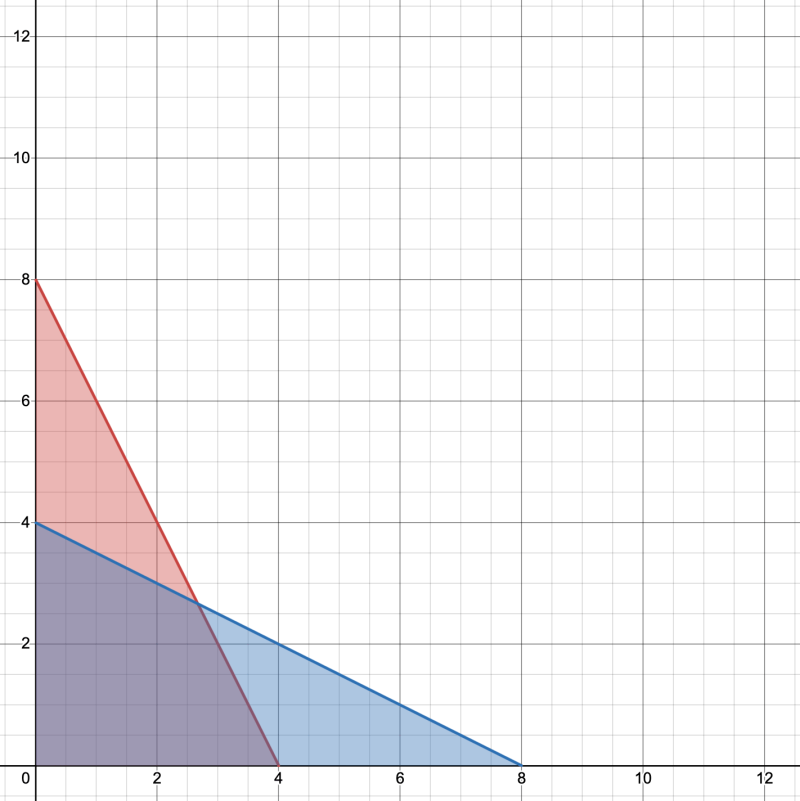
In economics, we refer to this as a comparative advantage: Country A has a comparative advantage in producing democracy while Country B has a comparative advantage in producing natural resources. For the sake of modeling, let’s assign numerical values: Country A can produce at most 8 units of democracy and 4 units of natural resources in a given year, while Country B can produce the opposite. Country A is twice as productive at democracy than at furnishing natural resources. Nice.
Perhaps a graph is cleaner. Plot units of democracy on the x-axis and units of natural resources on the y-axis; all the possible combinations of democracy and natural resources that Country A can produce are in blue and all the possible combinations that Country B can produce are in red.
Sweet.
Assume the world is better with both democracy and natural resources in it, as much of both as we can get. Assume further that the world is composed of only these two countries to simplify our analysis. Let’s model this situation with indifference curves.
If you’re unfamiliar with indifference curves, assume instead that you are. We’ve displayed several below, but we care only about the curve that touches one point only on the pointy part; that one tells us where we’re happiest.
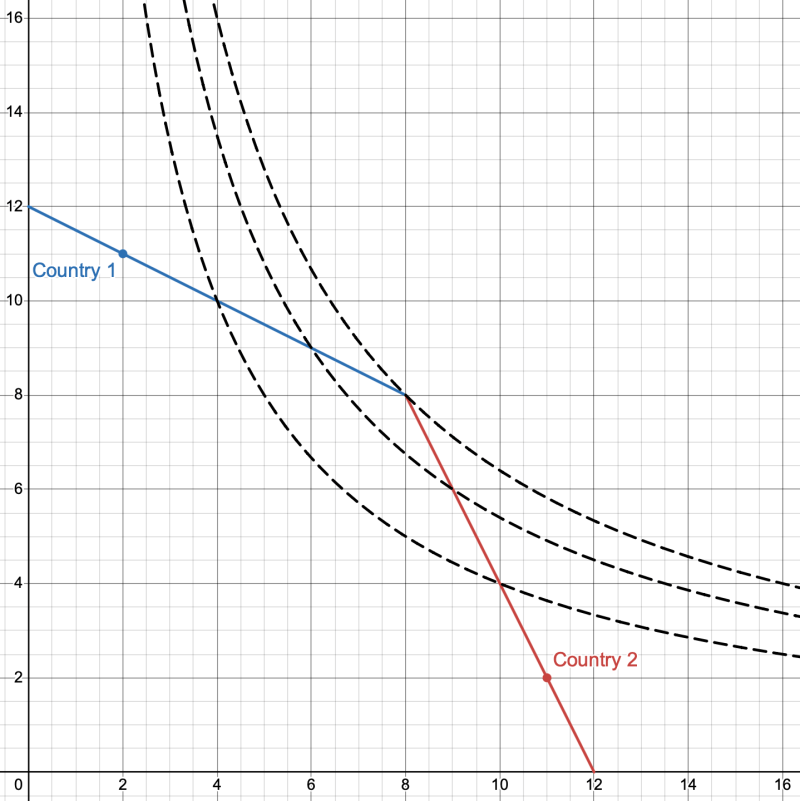
What does our economic model suggest about the optimal amount of democracy? Many things.
Most importantly, it tells us that we’re happiest with 8 democracy and 8 natural resources. Well, with 8 democracy and 8 natural resources, we’ll have the country best at producing democracy producing all the democracy and the country worst at democracy giving up and producing natural resources. Country A should produce democracy and Country B should produce natural resources; we’re simply better off.
There you have it. One Korea can foster democracy while the other one produces nuclear energy. But think bigger; let half the countries on the planet have elected leaders so long as the other half find precious metals. As that omniscient social planner, I’ll say leave the former to the North half of the globe and the latter to the South. And it’s okay that some folks have all the raw materials; we’ll bring them our democracy and remind them to share every now and then.
Yes, friends, we can have our cake and eat it, too. Perhaps the lesson for Democracy Day, then, is the same as Halloweekend. Consume responsibly and enjoy the holiday, but know when too much is too much.