
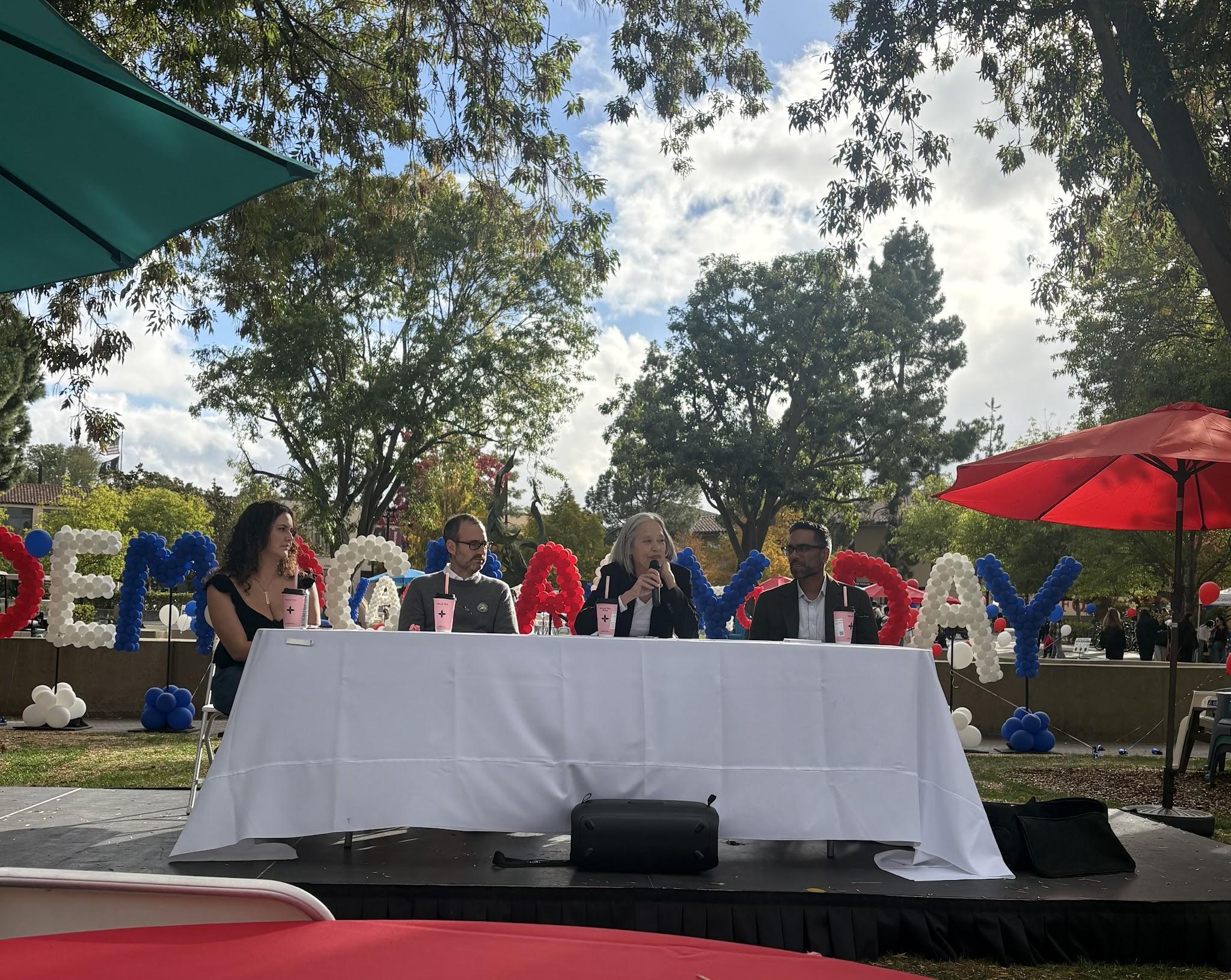
While Americans watched election outcomes on Tuesday, Teach For America (TFA) founder Wendy Kopp told a crowd in White Plaza that there is another way to predict the country’s future: look at where college graduates take their first job.
“First jobs matter a whole lot more than people think,” Kopp said. “Those first jobs influence everything you do thereafter.”
Kopp spoke alongside TFA CEO Aneesh Sohoni and Dan Edelstein, faculty director of Stanford’s COLLEGE program, at a Stanford Democracy Day panel hosted by the Haas Center for Public Service. Their message: graduates’ first job shapes what they care about for decades, so students should spend it close to a problem they want to solve.
“We need many more of the most promising leaders, many of whom are here at Stanford, to take first jobs that face the reality of our country and our society,” Kopp said.
TFA is a nonprofit that places recent graduates in teaching positions in urban and rural public schools for two years. Kopp said about 130,000 people have made that commitment, 70,000 through TFA in the U.S. and 60,000 through similar programs in other countries.
Kopp added that teaching changes the teacher, too. Studies of TFA applicants found that, after the two years, the ones who taught believed much more in the low-income communities they worked in and in their own ability to make a difference. Participants arrived thinking more funding would fix schools, Kopp said, and left seeing it as “a much more complex, systemic, adaptive challenge.”
According to Sohoni, teaching experience matters more now, with AI changing entry-level jobs and the country deeply divided. Future decision-makers, he said, need to first understand the communities, families and students their decisions affect.
Kopp’s advice to students who say they want to change the world is to start close to the problem. “Don’t think you can skip the step of working in proximity to those challenges you want to solve,” she said.
Panelists encouraged students not to put off that decision. Edelstein said many students plan to take a job for a few years and figure out what they care about later. That only gets harder at 25, he said, when people have to begin dealing with mortgages and kids. While the pressure students feel around job choices is real, students should chase a problem instead of titles, Sohoni said. He encouraged students to test the waters now, through internships about issues they care about.
Edelstein brought up how Stanford’s own curriculum advances these goals. “The whole point of a liberal education is to make you almost like an intellectual stem cell,” he said. “You can go on and become any kind of specialized cell afterwards.”
Kopp told students to step off the treadmill that carries them from one achievement to the next, even if it means feeling lost for a while.
“Take back your freedom and decide you’re going to pursue your interests,” Kopp said. “Better now than when you turn 30 and realize, ‘What am I doing?’”