
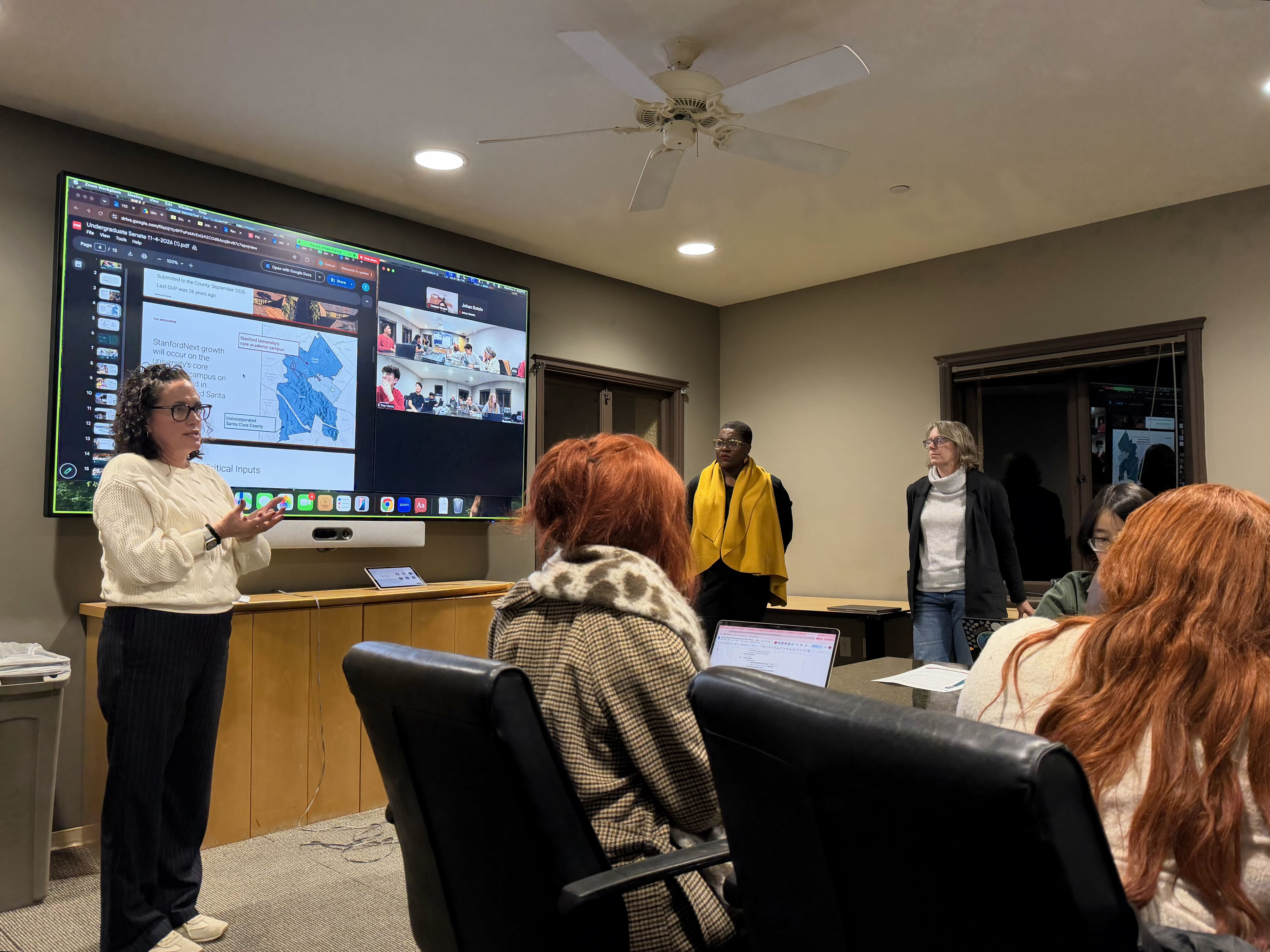
The Undergraduate Senate (UGS) heard proposals to expand international student opportunities affected by Curricular Practical Training (CPT) changes and to increase students’ role in recognizing campus organizations at its Wednesday meeting.
UGS Co-Chair Laila Ali ’28 and Communications Committee Co-Chair Ashton Dolce ’29 presented four proposals to help international students. The proposals included creating academic tracks that require internships, establishing an experiential learning requirement, expanding summer research funding and increasing and developing partnerships with international organizations and employers to offer more opportunities abroad. Ali and Dolce said they had discussed the proposals with Vice Provost for Undergraduate Education Jay Hamilton. The Associated Students of Stanford University (ASSU) has scheduled a roundtable on the issue for Nov. 5 from 5 to 6 p.m. on Thursday in the ASSU office in Old Union.
“We want to be able to do something that’ll help students now,” Ali said.
The proposals are intended to open interim support while a lawsuit challenging the CPT restrictions continues. Under the current restrictions, international students are unable to participate in off-campus internships unless the internships are required for graduation.
“This isn’t a complete fix, but it is sort of a Band-Aid on a difficult problem,” Dolce said.
The Senate also heard a proposal from Associate Director of Student Organizations Pete Cerneka to create a student committee that would make final decisions on certifying new student organizations after administrative review.
Stanford currently has 581 recognized student organizations and more than 800 groups across additional categories such as ASSU events and Athletics. Cerneka said the proposed sustainable target number of student organizations is roughly 500 recognized organizations. He cited limits on campus space and resource allocation as rationale for the cut-down, while also acknowledging the breadth of representation in the student body made it difficult to decide which groups should receive recognition.
“These are all very difficult decisions. And as you can see, we’ve not done a very good job because we have over 800 student groups,” Cerneka said.
Cerneka brought up a winter pilot of the proposed committee for consideration. Cerneka said many groups also struggle to become and stay active in years after recognition.
“When the fall comes, we usually have somewhere around 100 groups that actually never get off the ground because they never find officers,” Cerneka said.
The Senate also heard presentations about halal dining and StanfordNext. Ali said the halal dining proposal, which UGS discussed with Residential and Dining Enterprises (R&DE) and the Muslim Student Union (MSU), would clarify food labeling, transparency requirements and provide staff training.
“Nothing has changed about the actual halal dining experience,” Ali said.
StanfordNext representatives presented the University’s General Use Permit (GUP) application, which they submitted to Santa Clara County in September. The speakers — including Stanford Director of Land Use Planning Diana O’Dell, Office of Development Chief of Staff Irene Ibidapo, Associate Vice President for Land Use and Environmental Planning and StanfordNext Project Manager Erin Efner — anticipated county approval of the GUP in 2028. The proposal would create 1.8 million square feet of academic space, 2,500 new student beds, up to 500 workforce housing units and a $100 million Community Fund. Some of the housing could be located near Governor’s Corner (GovCo) in Sterling Quad, according to O’Dell.
“When we talk about adding student beds, we are talking about brand new buildings,” O’Dell said.
Ibidapo said that the University is considering holding quarterly office hours to give community members a regular opportunity to ask questions.
Ali introduced a joint bill establishing a protocol for sending UGS and Graduate Student Council (GSC) resolutions to the Faculty Senate. Ali said the protocol would help make sure faculty senators are aware of the work students are doing in student government.
“It’s just a protocol so we can put this in writing, so that we can make sure that this happens, and the Faculty Senate knows of the work that the UGS and the GSC are doing,” said Ali.
The Senate also reconsidered a joint bill confirming Charlie Schumer J.D. ’28 as Election Commission chair and Anson Omar ’29, Chloe Chou ’27 and William Charouhis ’27 as assistant election commissioners after tabling the vote last week. The bill passed unanimously.