

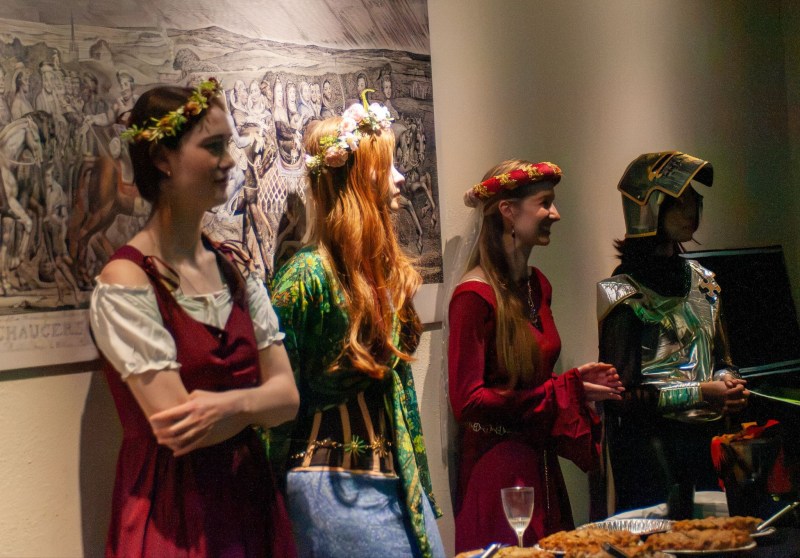
On Thursday, the third floor of Margaret Jacks Hall transformed into the Tabard Inn, the Southwark hostelry in “The Canterbury Tales” where Geoffrey Chaucer’s pilgrims gather before riding to Canterbury. A printed stone cellar hung behind a table of pewter tankards and electric candles.
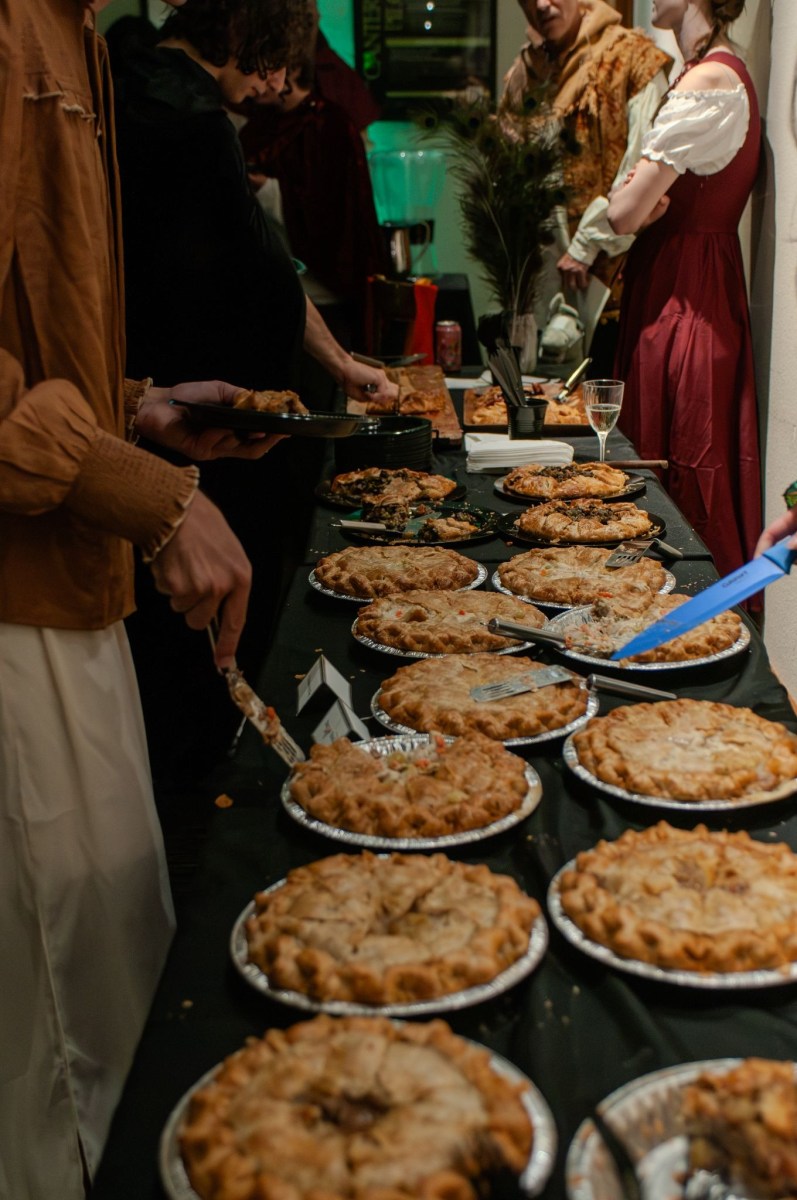
Those 21 and older indulged in brewed ale and mulled wine. Medieval meat pies went to everyone; guests came in tunics and cloaks; I was lent a velvet cloak and a jeweled crown from the department’s stash.
Anyone who has attended a Row Sig would recognize the format: a theme, a bar, a menu and an attraction. Here, the attraction was the faculty.
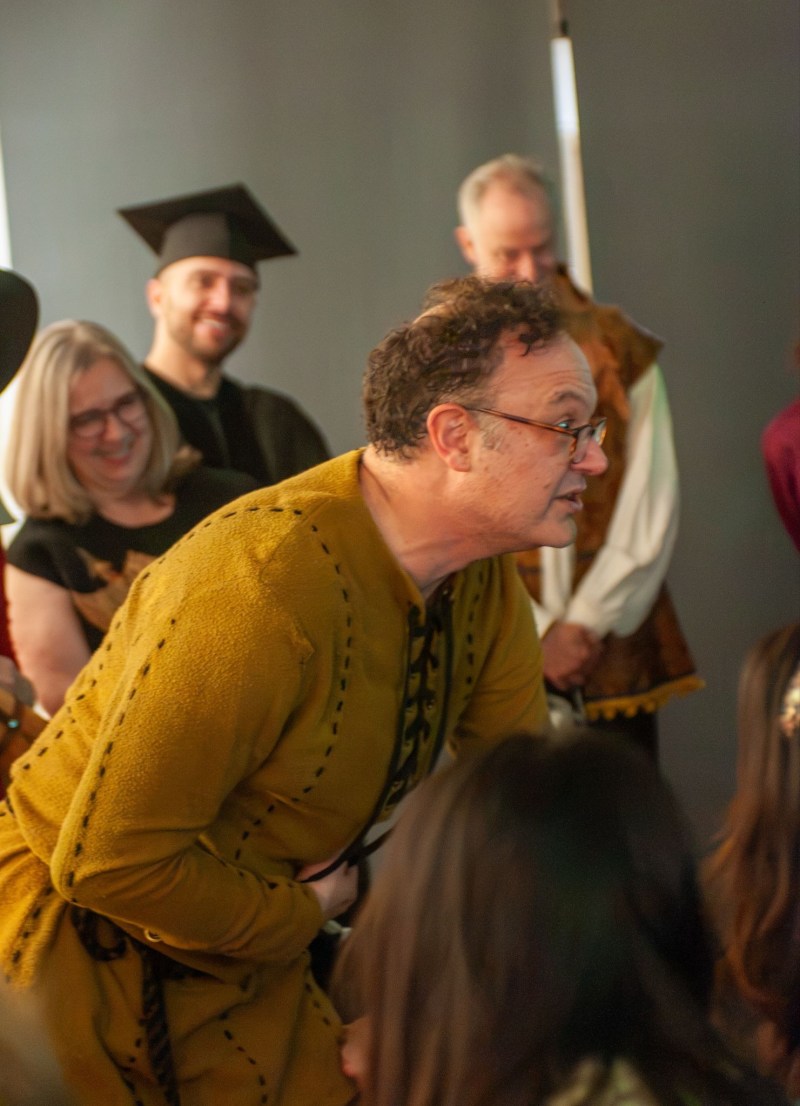
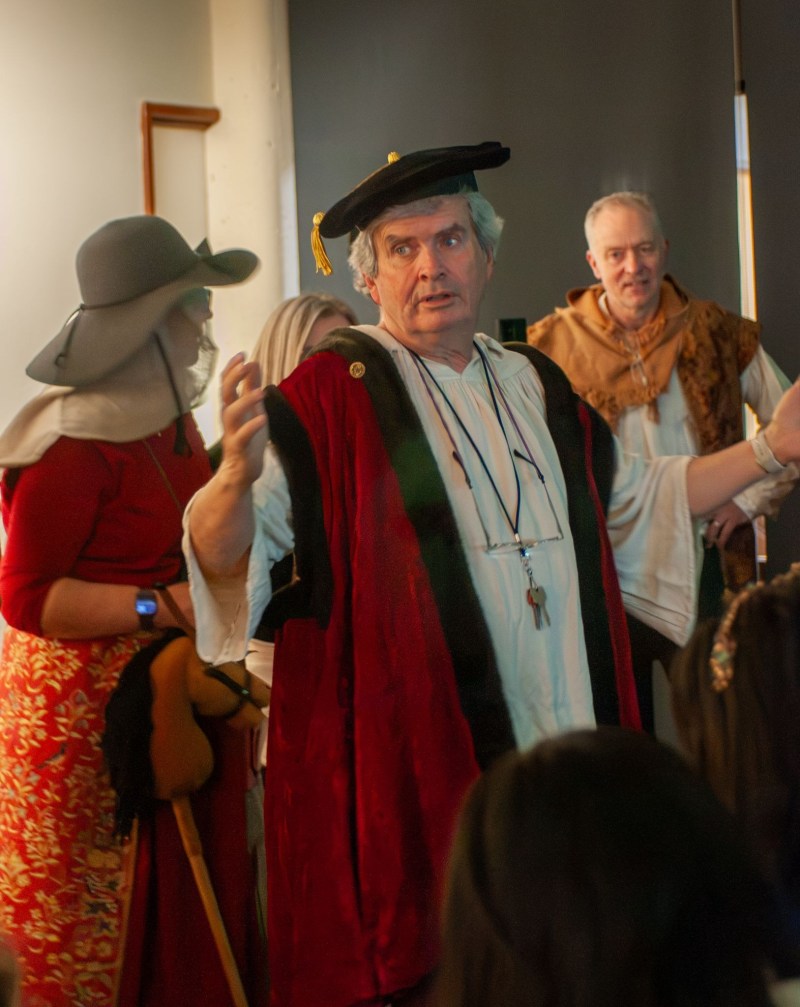
“Quiz the Pilgrims” was the second of three events in “Chaucer’s Canterbury Pilgrims,” a series conceived by Denise Gigante, professor of English and the department’s director of undergraduate studies. The anthology inspiring the series consists of a prologue and 24 tales, each dedicated to a different pilgrim. At the first series event on Oct. 15, students read the General Prologue in Middle English and brainstormed questions for its characters. On Thursday, students drew these questions rom a box and posed them to the pilgrims who answered in character, unscripted.
Most of the cast were English professors: Bernardo Hinojosa as Chaucer, Blair Hoxby as the Knight, Blakey Vermeule as the Prioress, Elaine Treharne as the Wife of Bath, Mark McGurl as the Plowman, Mark Greif as the Miller and Nicholas Jenkins as the Host. Department chair Gavin Jones played the Reeve; senior lecturer Alice Staveley, the Cook; lecturer Zoe Goldstein, the Pardoner; and Max Ashton, the Oxford Clerk. Gigante was costumed as the Fool.
As part of the opening, Taber Cannon ’27, a senior writing his thesis on Chaucer and the video editor for The Daily, recited the Prologue’s first 18 lines in Middle English, April showers and all. Each pilgrim then read Chaucer’s portrait of their character. Rehearsal, said McGurl, “happened seven minutes before we actually walked out.” McGurl said his role was suggested to him by Gigante, and he accepted after recalling that the Plowman is “the most minor of minor characters, and the most boring.”
“A character of pure goodness,” he said. “I said, ‘that’s me.’”
After being asked his favorite destination, Hoxby’s Knight chose Granada, where “I saw gardens that recreated Eden.” When asked how pilgrimage helped him recover from war, he weighed the matter. True to Chaucer’s meek-spirited Knight, “of his port as meeke as is a mayde,” Hoxby answered in the mild tone of a museum docent, without a change of expression.
“It’s a lot of fun to kill people in some ways,” he said. “But on the other hand, sometimes you kill too many, and they’re not always the right people.” Pilgrimage, he added, makes it “kind of a wash.” The room hollered, and an “Oh, no” rose through the laughter.
Treharne entered as the Wife of Bath to applause and threw her hobbyhorse to the floor. When discussing a secret about one of her husbands, she recounted her fifth, Jankin, who read aloud to her from “the Booke of Wikked Wives” until she took a knife to his hair. Treharne brought charm and wit to her character. After being asked for relationship advice, she said she was on a pilgrimage for husband number six, then surveyed the room.
“I like the look of you. Or you. Or you,” she said. “Not you.”
Vermeule’s Prioress disclosed she ran a TikTok channel after being asked about her brooch engraved “Amor vincit omnia.” Staveley’s Cook, asked about the sore on her shin, said it had come upon her “when I realized how sinful I really am.” It then oozed down her leg, she said, and “dripped into your pie.”
After being asked what makes a good dirty story, Greif’s Miller offered a formula: “It begins with a man, you see? And a pig. And a parson. The rest is up to chance.” McGurl’s Plowman was asked about his vices and answered that “sometimes I pray a little hard.” Hinojosa’s Chaucer answered “2028” when asked when he would finish the Tales, which the poet left unfinished at his death in 1400.
Attendees voted for their favorite pilgrim by QR code. Treharne’s Wife of Bath and Jones’s Reeve took the top two spots, and won scrolls lettered in the hand of Chaucer’s own scribe.
“This is a 600-year-old story and still entirely alive and full of all humanity,” Staveley wrote in a statement shared with The Daily.
“It’s such a uniquely Stanford thing to have such a quirky and weird professor body as well as student body,” said Nika Farokhzad ’27.
Jake Matlof ’28 called the professors he has come to know “so smart and passionate and such witty people, and you can just see that here.”
The lesson of the evening was that a 600-year-old text does not need protection from laughter and irreverence: Its written for it. Chaucer is meant to be met in community, with full bellies and high spirits, before he is met in a seminar room with fluorescent lighting and footnotes.
“Humans have not changed that much,” Cannon said. “We’ve always laughed at the same things.” He cited the fart jokes in “The Miller’s Tale.”
Jones traced the English-language canon as a chain of debts from Chaucer to Shakespeare to Herman Melville to Richard Wright to Gwendolyn Brooks. Literature, Gigante said, can only be brought to life “in community.”
The series concludes Feb. 11 with “Gaming Chaucer,” where students can play medieval-themed video and board games, including “Crusader Kings” and “Hammer of the Scots,” and learn about games from the Middle Ages.
McGurl, for his part, offered a disclaimer on the department’s behalf. “We only secretly take ourselves seriously,” he said.