
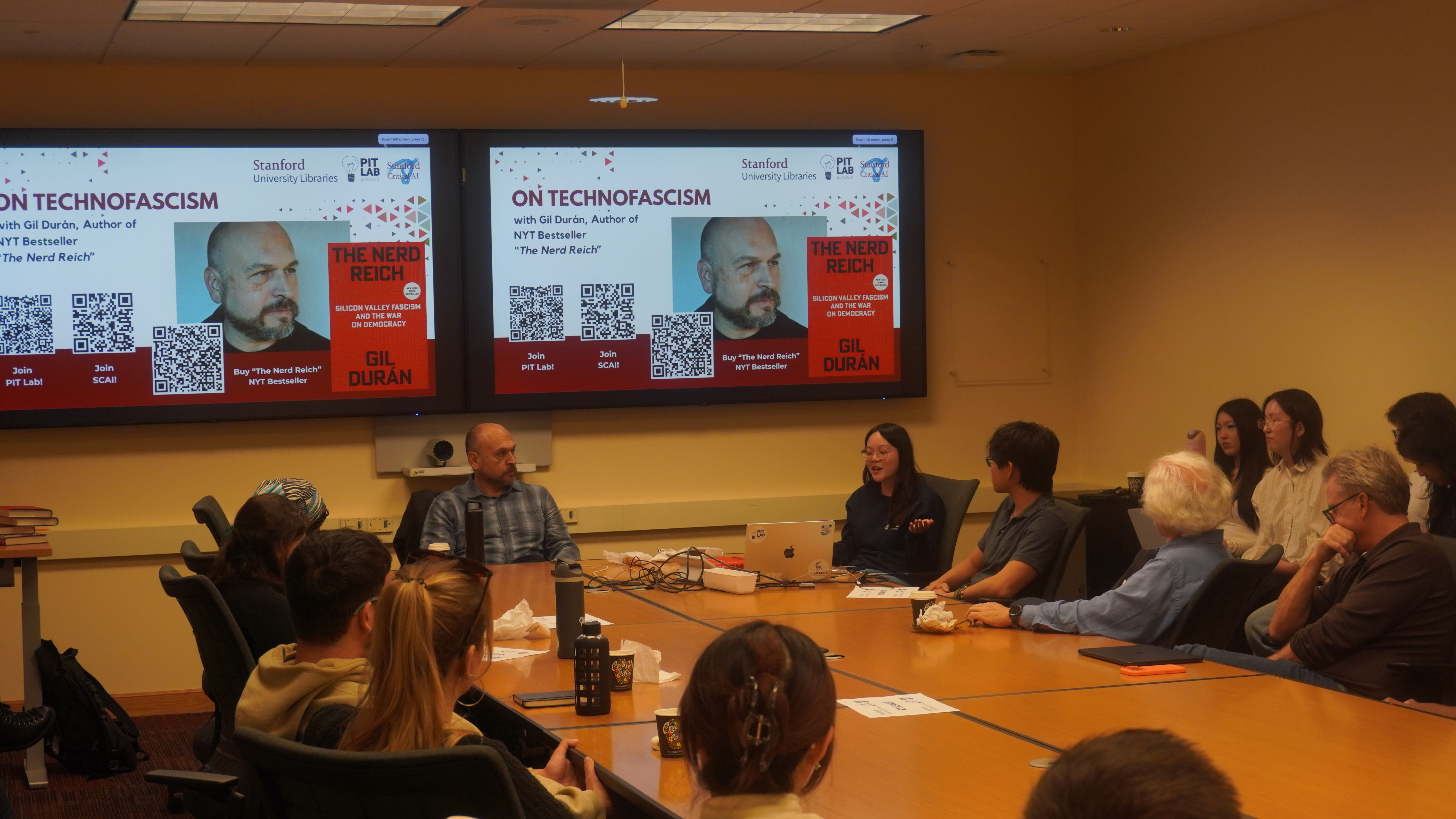
Independent journalist and author of “The Nerd Reich” Gil Duran criticized Silicon Valley’s growing influence over American politics and warned against the political ambitions of technology billionaires during a talk at Green Library last Friday.
At event, titled “On Technofascism,” Duran discussed his book “The Nerd Reich,” which examines the origins, strategies and ambitions of what he describes as Silicon Valley’s disregard for democratic institutions. It was cohosted by Stanford’s Public Interest Technology Lab (PIT Lab) and Stanford Critical AI, and sponsored by Stanford University Libraries. Throughout the talk, Duran argued that a group of technology billionaires and venture capitalists has sought to reshape American politics, prioritizing wealth and corporate power over maintaining democracy and long-standing institutions.
“They want capitalism without democracy,” Duran said, comparing Silicon Valley freedom from public responsibility to the Chinese government’s similar lack of accountability.
Duran pointed to venture capitalist and Stanford alumnus Peter Thiel ’89 J.D. ’92, who has questioned whether capitalism and democracy can coexist in his political writings. Duran argued that Thiel’s influence is symbolic of Silicon Valley’s broader reality, where a small group of wealthy elites is increasingly gaining power within American politics. At the same time, Duran joked that it was a pleasure to be on the campus where Thiel had come to “misread philosophy.”
According to Duran, the rapid growth of wealth for these technology executives has also changed how they view the government.
“We now have this class of super billionaires drunk off of public money, who think they are more powerful [than] the government, and therefore entitled to rule instead of the government,” he said.
Duran also criticized the political culture of Silicon Valley’s startup industry, describing Y Combinator as a “right-wing boys club.” He said the startup accelerator had shifted from what was once a more politically neutral environment into an extremist one. Duran also questioned why so many tech leaders were focused on projects like space colonization and artificially extending their own lives, as opposed to developing technology that works towards solving pressing global problems.
“We’re going to have to find a way to create a technology stack that is for people who believe in democracy, people who believe that technology should serve humanity and the world,” Duran said.
When asked about Stanford’s connection to technofascism, Duran said the University should not be defined solely by its most prominent or controversial alumni. He also encouraged students to question the influence of wealthy donors and technology companies at universities, arguing that their wealth allowed them to shape how such institutions are perceived.
During the audience Q&A, Brian Nguyen ’27 described feeling overwhelmed by the University’s technology and start-up focused culture. Nguyen said seeing primarily venture capital and technology companies recruiting at career fairs made it difficult to imagine pursuing a different path.
“I’ve just been overwhelmed with how crazy the tech culture is here. Going to the career fair and seeing that 99% of the companies there are just VC’s and tech companies. It kind of just demotivated me, and when you’re surrounded by so many people who just want to do that, it’s kind of hard to stray the other way,” Nguyen said.
Duran sympathized with the pressure students face, but encouraged them to consider what they actually want to do. He noted that change sometimes required acting against the grain, while other times it required “good” people to work from “bad” places in the tech world.
Duran also addressed audience members who felt discouraged by the current political climate.
“I think you have to find hope in the fact that you were born at a very important time, and there’s a tremendous amount of work to do,” he said, noting that free speech and democracy are not free, but rather privileges people fight for. Duran recalled his own experience of starting college in 1998, when he believed many of the world’s major political questions had already been settled. At the time, Duran said he wished he had been born during a more interesting period of history.
“You have to find hope in the work that there is to be done,” Duran said. “Because if it didn’t exist, what would your purpose be?”