
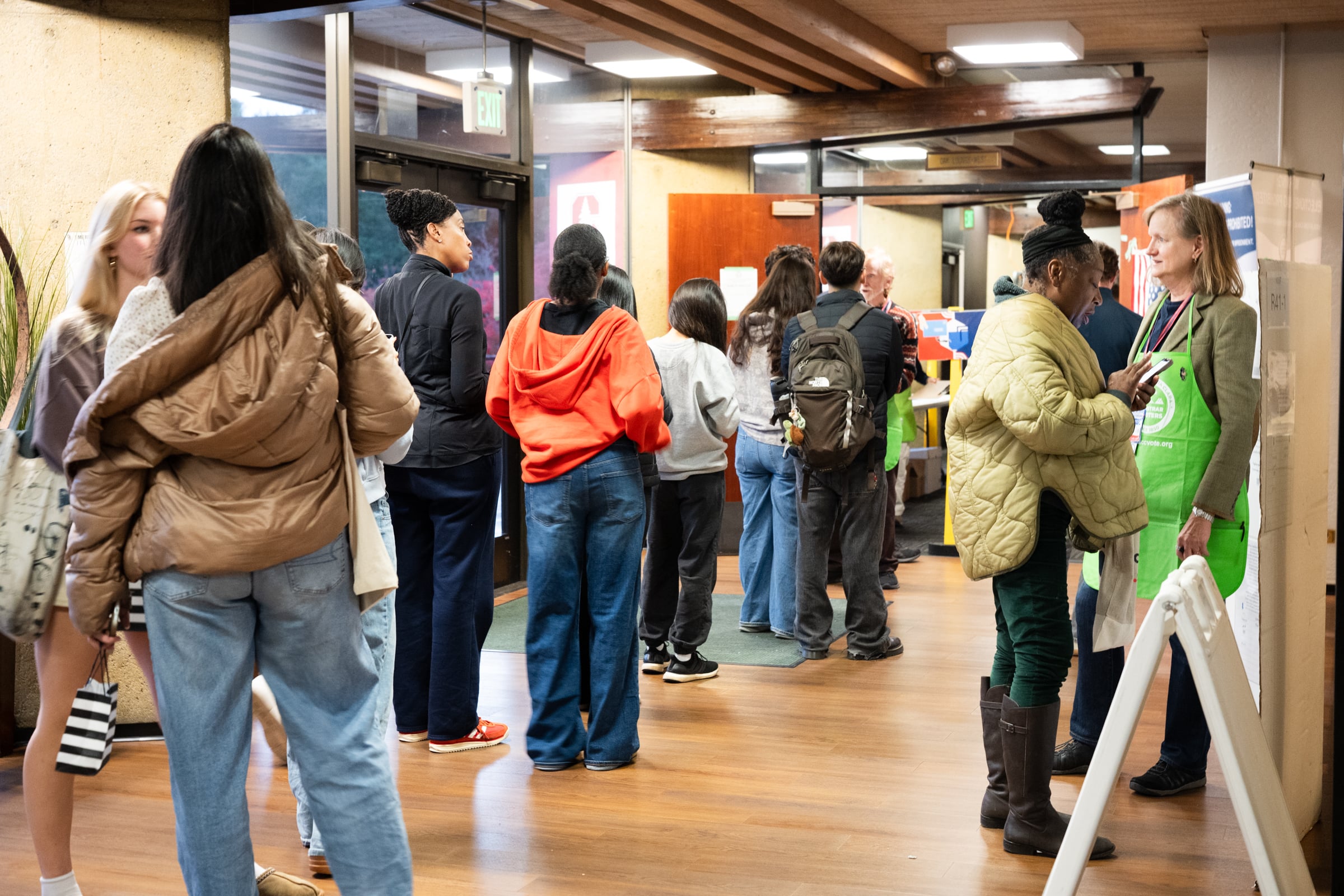
Students in the course SOC 150 “The 2026 U.S. Election: How to Understand and Participate” did what the syllabus requires before last Tuesday’s election. They had to register to vote, if eligible, then canvass or phone bank.
Last Tuesday’s midterm election put all 435 U.S. House seats, 35 Senate seats and 36 governorships on the ballot, according to Ballotpedia. The syllabus calls the fieldwork “the most important part of the class,” alongside readings on democracy, voting rights, polling and elections.
Taught by sociology professor Michael Rosenfeld, 42 students are enrolled in the course across its cross-listings as of Oct. 31, according to Stanford Navigator.
Every eligible student had to register and vote, which counts for 10% of the final grade, according to the syllabus. Students who cannot vote receive full credit for that portion but must still canvass or phone bank, Rosenfeld wrote to The Daily.
Students were able to choose any candidate, party or nonpartisan cause to canvass for. The syllabus names groups from the National Rifle Association to the Environmental Defense Fund to the League of Women Voters. Rosenfeld estimated that the 42 students represent about 35 campaigns, roughly two thirds for partisan candidates and one third for ballot measures and nonpartisan offices.
Rosenfeld said he taught a freshman seminar on elections before. He pointed to his childhood in New York City, where he followed his mother, a community activist, door to door with a bag of leaflets and a clipboard.
The fieldwork is the point, according to Rosenfeld. Canvassing requires knowing how rules on ballot drop-off, voter ID and whether people with felony records can vote differ between states, and students must learn them well enough to teach others.
“Oftentimes students think that politics is about ideology,” Rosenfeld said. “But politics also, and perhaps mainly, is about practical things.”
Caleb Polster ’29 picked Rep. James Gallagher’s campaign to follow for the course, he said. Gallagher, a Republican, ran in California’s 1st Congressional District, which Proposition 50 redrew to favor Democrats. The Cook Political Report rated the race solidly Democratic. Polster signed up three times on the campaign website to volunteer, then called every district office there directly “to try and get a start,” he said. None had any opportunities.
Instead, Polster said he checked in each week with friends at Stanford, back home and at other California universities, helping them find county office numbers, request replacement ballots and locate drop boxes. According to Polster, most of the people he spoke with assumed they would miss the election because they had been away from home since August or September.
“Most people are excited to learn that even though they are off at school, they can still cast their vote,” Polster said.
The fieldwork changed how he sees campaigns, Polster said. “Learning from my own experience has taught me that the most effective way to get out the vote is to talk to the people you know: your friends, family and neighbors,” Polster said, “They will all trust you a lot more than they’ll trust any politician, and therefore you will likely be able to make a bigger impact than you would expect.”
Laila Ali ’28, a political science major, chose the race between Rep. David Valadao, a Republican, and Democrat Randy Villegas in California’s 22nd Congressional District in the Central Valley. She rode a bus with the group Swing Left to Delano, a town in the district, and knocked on about 100 doors over five or six hours, she said in an interview with The Daily. “We just got to see what priorities actually mattered to people,” Ali said. Voters raised Medi-Cal, gas prices, the war in Iran and money in politics, she said.
The course’s “Get Out the Vote” reading weighs the evidence on which tactics raise turnout, Ali said, and the fieldwork lets students test it themselves. Villegas won, by a wider margin than Ali expected.
“Having to do it for a class gave me the opportunity to actually get involved civically in a way that was more meaningful,” Ali said. Most volunteers she met were in their 60s, 70s or 80s. “Everybody out there was just so excited to see somebody young,” she said. “I’m here because of my class, but it shouldn’t be that way. We should be able to be there and have more young people out there in general.”
Students are now giving post-election presentations and will write final reports on how their candidates or causes won or lost and why, according to the syllabus. Gallagher, whose campaign Polster chose for the course, lost to Democratic state Sen. Mike McGuire, according to the Associated Press.
Rosenfeld said the results will teach students either way.
“Election victories can lead to overconfidence,” he said. “Election losses can lead to a healthy reassessment that the political opposition may have had a good argument or two.”