
In each installment of “Liminal Language,” Valery Liang ’30 captures liminal spaces — abandoned barns, empty motels, dorm laundry rooms at 3 a.m. — across both The Farm and her rural Southern hometown.
Since starting college a month ago, I’ve become a fervent proponent of the Procrastination Walk. It goes like this: the clock tower’s just struck 11 p.m., a minute or two offbeat. Never-ending midterm season is breathing down your neck — three essays, one p-set, tomes of ancient Greek philosophy, all widening their jaws and coming in for the kill. It’s entirely too much — so you stand up. You grab a jacket. You grab any friends you find awake. And you blow off some steam by wandering aimlessly around campus for an hour.
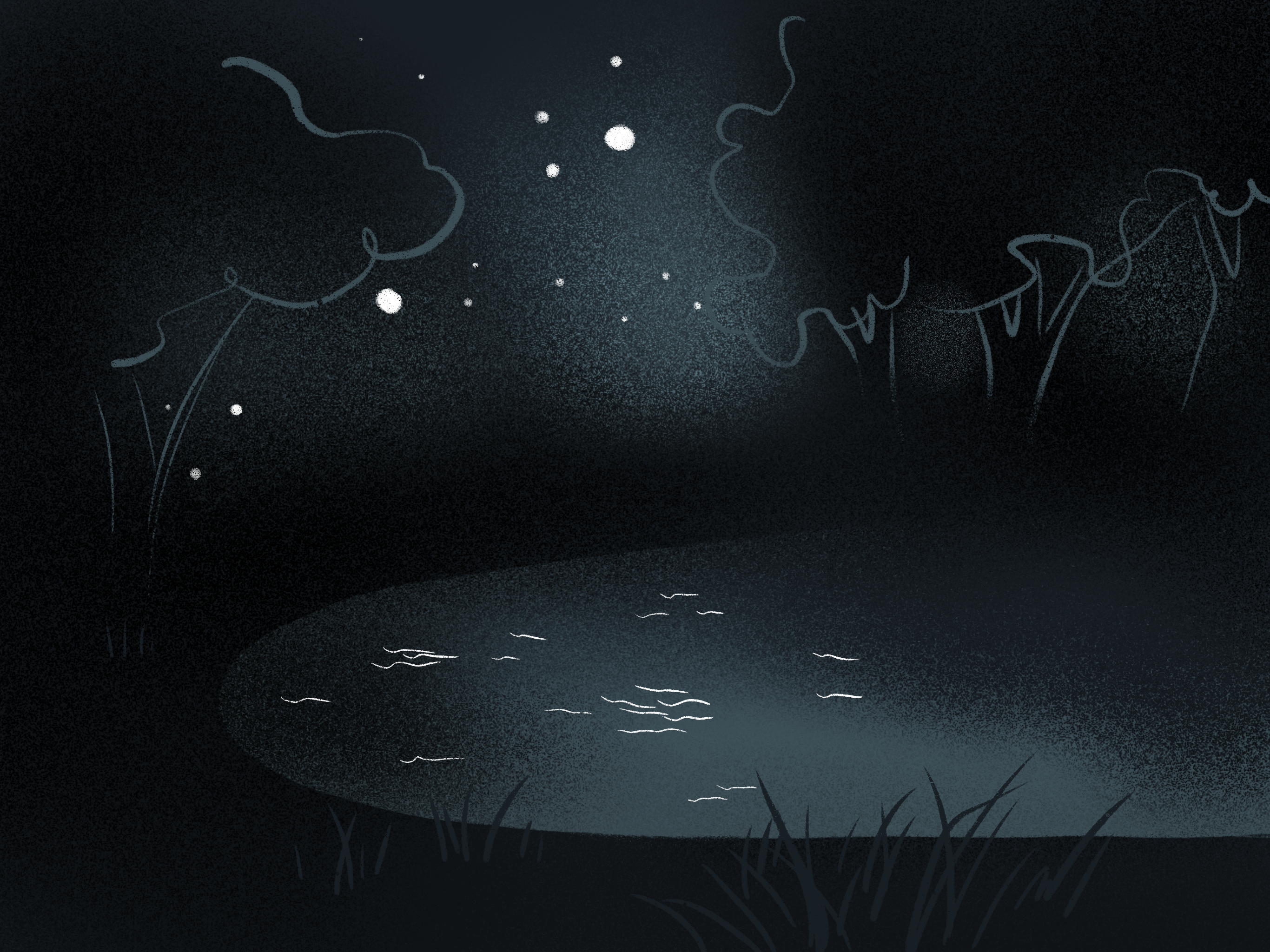
Last week, during one such rudderless trek, I ended up alone by the dry shores of Lake Lagunita. Dim under the starlight, its trails and fire pit empty, the lake was a half-lidded divot in the earth. Grassy, silent, breezy, it seemed like a soft, great circle, pressed down centuries ago by an errant giant’s thumb. The night was so silent; the night was so late. For a moment, ensconced in wind-swept quiet, I felt worlds removed from the rest of Stanford. In the middle of a campus I’d learned to associate with vivid sunlight and resounding noise, with busyness, with brisk and bountiful and blaring opportunity — here, against all odds, was an uneasy hush.
A mid-autumn chill rippled through the air. Pebbles crunched beneath my feet. Faint lights glimmered in the distance, warped between black ranks of trees. There was stillness, an endless concave field of grass rippling in repetition and barely visible through the mute darkness.
Part of my unease — my quiet, my wonder — came from misplaced nostalgia. (The other part probably came from the 300 pages of class readings I was neglecting. Whatever.) I spent my high school years in rural Missouri, inside a town locals fondly call “Midwestern-boned but Southern-souled.” There, wilderness reigns king: forests, gullies, wildflowers, too much growth and too few people to weed it back. Green things eat at every corner of town.
At the end of my neighborhood lies a narrow river that offshoots into small lakes every few dozen feet, spooling into the gravelly pits that abandoned construction projects have left behind. It dries and fills, seasonal like Lagunita but far more erratic. When you walk along that river during a late summer night, you’ll find striking silence, humid, heavy, hoarsely pierced by croaking toads and creaking oaks.
It’s different from The Farm, much more cramped and much more green. Still, at heart, both places feel the same to me: the grassy dirt bottom of a late-night lake. Temporary hush, burnt summer plants, the long sleeping threshold between evening and dawn. Two places mirroring each other from halfway across the country. It’s a feeling that can’t quite be described, preserved over a journey of two thousand miles.
Back at Lagunita, I pretended to exist in isolation. In one scant moment, there were no midterm papers — no MATH 51, no Aristotle or Glaucon. Just me, the lake and lingering liminal emotion. Memory. Quiet.
Tragically, though, all Procrastination Walks must end. P-sets have to be faced and finished, and boring books must be read, no matter how hard you try to put them off.
For what it’s worth, I think there’s value to meandering about campus while contemplating the liminality of lakes — value beyond avoiding your work for another beautiful, nail-biting hour. I found calm in the quiet and the unexpected nostalgia; I found a piece of home that I carried back to my dorm, and that kept me steady through hours of homework.