
Editor’s Note: This article is a review and includes subjective thoughts, opinions and critiques.
Beethoven’s First Symphony occupies a fascinating place in music history. Premiered in 1800, four years before the composer’s monumental “Eroica” (Symphony No. 3) would simultaneously amaze and offend the Viennese public, the early piece largely operates in the shadow of the two Classical masters Haydn and Mozart. As a result, concert programmers and the public have tended to favor other works. Even Hector Berlioz, the quintessential French Romantic composer and a great admirer of Beethoven’s, wrote of the First Symphony, “Ce n’est pas là Beethoven.”
Yet on Saturday, the Stanford Philharmonia repudiated Berlioz in an electrifying rendition that highlighted Beethoven’s more daring choices, kicking off celebrations of the composer’s bicentennial. A second commemoration was also in order: the performance was dedicated to Herbert Blomstedt, the former chief conductor of the San Francisco Symphony Orchestra who passed away on Wednesday at the age of 99.
Under Paul Phillips’ baton, the student orchestra displayed its command of a wide range of dynamics, most notably by powerfully articulating the many sforzandi that pepper the first movement. The scherzo was dispatched with sensitivity and its share of well-handled crescendos, and the staccati and rhythmic nature of the andante were not neglected. Phillips drove the ensemble forward, selecting relatively fast speeds for all but the final Allegro molto.
If only all the players could handle it. Unfortunately, the violins struggled to stay together during the quicker sections of the first movement, and their intonation was far from flawless at certain moments. Similarly, a precise statement of the andante’s main theme had to wait until its first repetition.
Thankfully, the woodwinds and brass did not disappoint in a symphony that relies heavily upon those instruments. The mini-dialogues between the flute and oboe were sensitively phrased, and the sonorities of the Trio were beautifully treated. The brass were also able to strike a balance between individuality and conspicuousness, and any technical deficiencies were too minor to attract significant attention.
The ensemble can take solace in the idea that for a composer such as Beethoven, imperfect execution would matter little, especially in a performance as thrilling as the Stanford Philharmonia’s.
But that inclination towards passion at the expense of accuracy would have been problematic for the other works on the program. Fortunately, the orchestra spared the audience from that experience. If anything, the first half of the concert preceding the symphony suffered from the opposite malady: a flatness caused by a meticulous focus on the score.
It was difficult to find objective fault with the performance of Claude Debussy’s “Petite Suite”: Even the texture, which is all-important in the Frenchman’s works, was well-controlled by Phillips. But although the strings may have shimmered in the opening Andantino (“En bateau”), they did not quite evoke the flowing tranquility of a riverboat. In the minuet, the duets between the oboe and cor anglais were skillfully handled, but they fell short of the pathos often provided by the wistful pair of woodwinds.
Notably, the two other dances — the “Cortege” and the “Ballet,” which move faster and require less sensitivity — were splendid. In the latter, the Philharmonia managed to balance a relatively brisk tempo with crisply articulated contrasts, a feat not often properly achieved by even professional orchestras.
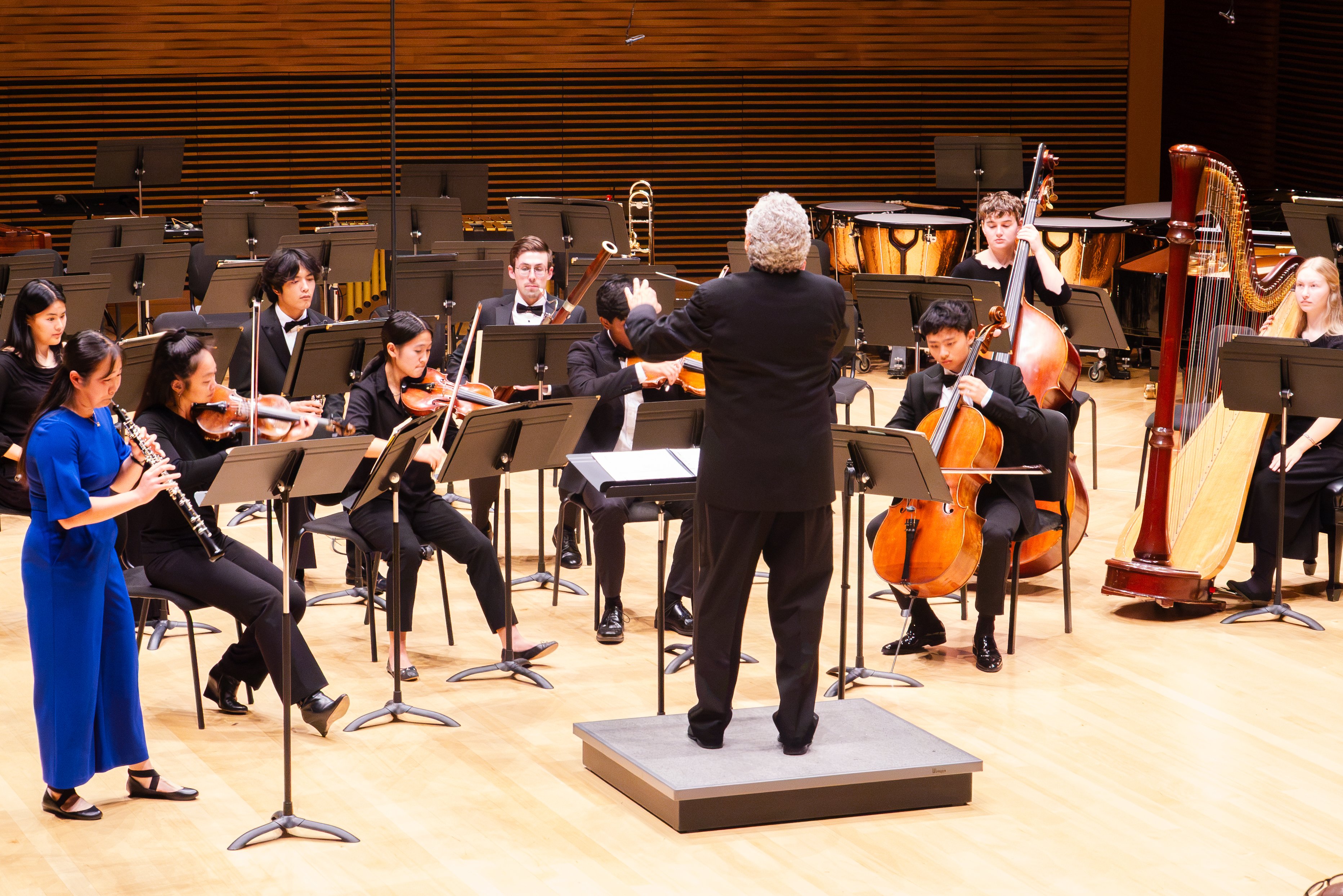
Darius Milhaud’s “Stanford Sérénade,” originally commissioned by medical student and oboist Donald Leake for the Stanford Symphony Orchestra in 1969, was more successful. Cindy Liu ’28 artfully performed the solo oboe part, letting the instrument sing in the second movement and adroitly managing technical and tonally ambiguous sections. The other 11 players leant into their dissonances but rarely overpowered Liu, helping to elevate what was decidedly not Milhaud’s best composition.
The full orchestra returned for “Red Dirt | Silver Rain,” a 2015 work by Australian composer Melody Eötvös that she described in a pre-concert interview with Phillips as about “recalling, remembering and readjusting memories.” The Philharmonia was the first orchestra to perform the short piece: It was originally written for a small chamber ensemble.
The non-standard techniques, of which the drawn-out glissandi were only the most obvious, did not faze the students. The percussion deserves the most praise: the vibraphone animated the rain, while the rest of the section expertly contended with everything from bowed cymbals to a trick involving the piano’s strings. Neither did the rest of the orchestra disappoint. The clarinets were harsh when necessary; the repeated descending figures were properly foreboding; and the strings’ tremolos facilitated a smooth transition between soft glimmers and frantic hysteria.
Nevertheless, the performance did not obscure the issues with Eötvös’ work. The orchestration provided for little dialogue between instruments, and the lack of repetition and motivic development made the piece simultaneously — and paradoxically — too long and too short.
The fact that the most problematic composition received the most impressive performance was emblematic of a middling night. There was much to commend, from Liu’s solo to the energy of the Beethoven, and nothing went particularly badly. But at the same time, nothing quite reached its potential.