
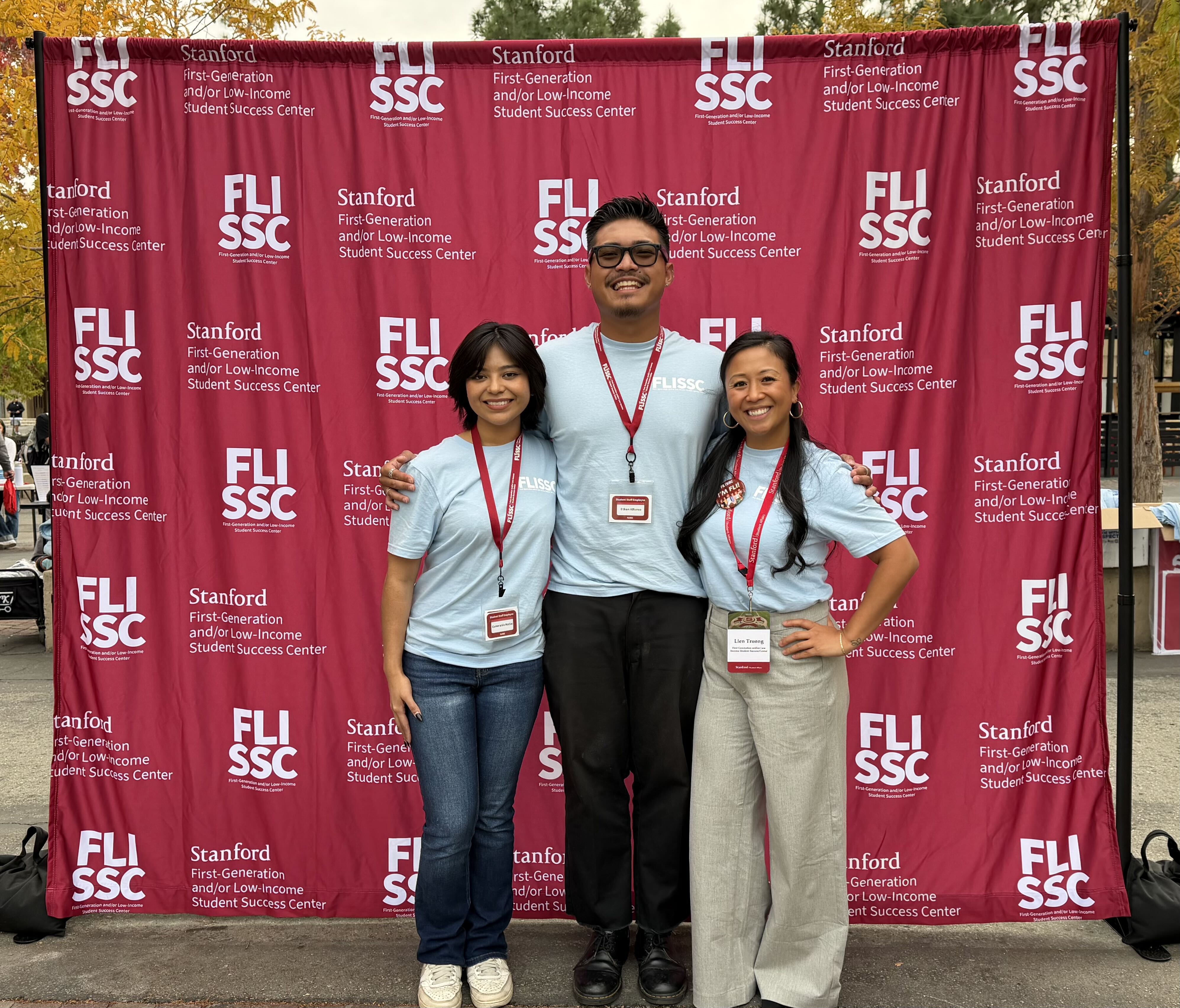
The First-Generation and Low-Income Student Success Center (FLISSC) kicked off First-Gen Week last Monday with a resource fair in White Plaza, bringing campus organizations and student support services together to connect first-generation and low-income (FLI) students with resources.
The kickoff launched a week of programming that ran Nov. 2-8 under the theme “Creating What’s Possible,” highlighting that first-generation and low-income students should have access to resources and a sense of belonging on campus. FLISSC student staff organized the week’s events, many of which were funded by the Undergraduate Senate (UGS) and Graduate Student Council (GSC).
The tabling event saw 16 campus partners set up in White Plaza, offering academic, financial and career support, with food, raffles and music provided by organizations including the Doerr School of Sustainability and Teach For America. The participating programs also included campus community centers and programs that offer academic support.
“We wanted to really bring in a high-energy event: big, out here, and visible for everyone,” said Esmeralda Matias M.A. ’27, FLISSC’s external director’s fellow.
Matias and Ethan Alfonso ’27, FLISSC’s internal director’s fellow, both described the resource fair as an opportunity to connect students with services they may not know about.
“We understand that in all different pockets of the community, there is a FLI student who doesn’t really understand the hidden knowledge or curriculum that Stanford requests of you,” said Alfonso. “You never know what path [an event like this] could have unlocked for someone.”
Lauren Mendoza-Tabinas, director of graduate finance and academic policy (GAP) at the School of Sustainability, said she chose to table because of her own experience navigating opportunities in college.
“As a first-gen student, I remember how hard it was when I started at school,” Mendoza-Tabinas said.
This is FLISSC’s second year hosting a resource fair for First-Gen Week. Matias said this year they hoped to expand the event by reaching out to more campus partners to explain its purpose and encourage them to invest in FLI students.
“Last year was the trial run, so each year we’re trying to make it bigger and better,” she said, adding that organizers had reached out to FLISSC partners to spread awareness of the event.
The center’s efforts to connect students with campus resources originated from a student-led initiative. FLISSC grew from the First Generation and Low Income Partnership (FLIP), a student-run Cardinal Service Organization. Matias attributed the center’s creation to similar student advocacy. Alfonso also said FLISSC plans to continue expanding its partnerships to reach more students, targeting more graduate student engagement.
“It’s not just, ‘Hey, come table.’ It’s, ‘Hey, come table, and invest in our community,’” said Alfonso.
First-Gen Week also included programming designed to address different needs within the FLI community. Events included a credit education workshop, pre-med and STEM panels, a graduate student networking event and one-on-one transfer student advising sessions. Later in the week, students attended a community dinner and were able to find clothes for interviews and jobs at a professional clothing giveaway organized in partnership with Career Education (CareerEd).
Another partner event, “Shattering Self-Doubts,” brought FLISSC and the Women’s Community Center (WCC) together for a discussion aimed at helping first-year students navigate Stanford. Matias led the event, which saw upperclassmen share their experiences with self-doubt and adjusting to campus life. As a closing activity, students smashed clay plates containing their fears and anxieties.
“Many of the programs were student-led and student-initiated,” Alfonso said. “So our student staff here at the FLI Center each were tasked with creating an event and placing it sometime throughout the week.”
Matias explained that the FLI Center’s partnerships extend past undergraduate students to include graduate students, transfer students, undocumented students and guardian scholars.
“Being FLI is a spectrum. It’s not just one identity,” she said.
Alfonso thanked the Undergraduate Senate and Graduate Student Council for their continued support and for funding many of the events this week, saying the funding helps FLISSC provide opportunities for FLI students to connect with campus resources.
“I struggled a lot with finding my place here,” said Alfonso. “FLISSC has definitely been the biggest sense of community for me on Stanford’s campus.”