
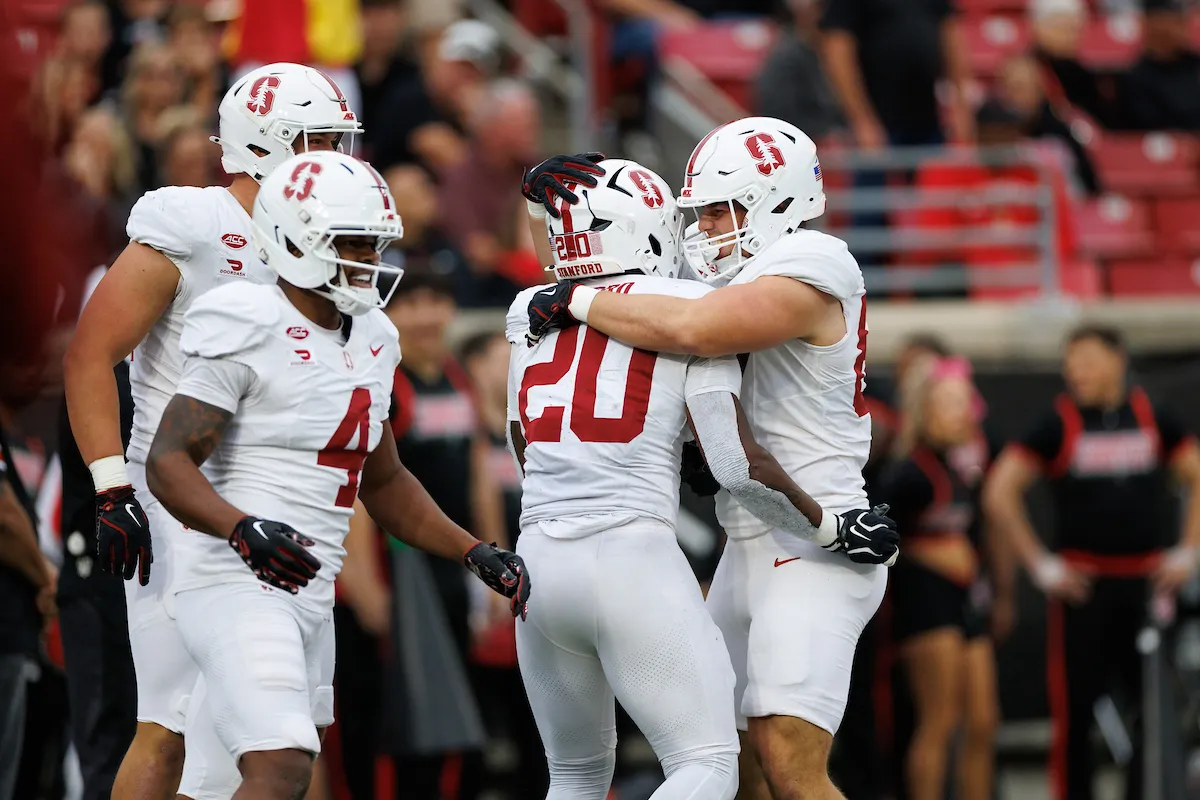
The Stanford Cardinal (4-5, 2-4 ACC) head to Blacksburg, Virginia, this weekend to take on the Virginia Tech Hokies (6-3, 3-3 ACC). This season’s final long-distance road trip comes as bowl eligibility hinges on Stanford winning two of the three remaining games.
Senior wide receiver Caden High said the locker room this week felt “very optimistic and confident.” As they look for their next win, the team is just “taking [games] one week at a time.” This mirrors the sentiment voiced by head coach Tavita Pritchard earlier this season.
Playing in Blacksburg might also present some of the most unique logistical challenges in the FBS. Hokies head coach James Franklin has recently commented about the lack of any major airports in the vicinity. For Stanford, that constraint has turned the already lengthy road trip into a two-plane, two-hotel affair.
The atmosphere in the isolated Appalachian mountain town of about 45,000 is also notoriously hostile for visiting teams. Stanford offensive coordinator Terry Heffernan, who spent the past three seasons at Virginia, is no stranger to the environment at Virginia Tech’s Lane Stadium.
“The whole town’s there, and the stadium’s rocking … they’re loud as hell,” Heffernan said.
The Hokies come into this weekend after a lopsided 51-28 loss at the hands of SMU (7-2, 5-2 ACC) that started out as a close game before SMU scored 21 unanswered points at the start of the second half. Virginia Tech is a team that has been inconsistent throughout the season. They required a fourth-quarter comeback to beat a middling Boston College (4-5, 2-4 ACC) squad, while losing to Cal (3-6, 2-4 ACC) on Oct. 10.
Additionally, the Hokies’ schedule has yet to include an opponent that was ranked entering the game, although both Pitt (6-3, 3-3 ACC) and SMU entered the AP top-25 rankings after their respective victories over Virginia Tech. Compared to Stanford, who has played three opponents that were ranked on gameday, the Hokies are a considerably less tested team.
The Virginia Tech defense is anchored by a strong front seven, creating a stout run defense but a middling pass defense. Heffernan commented on Stanford’s ability to exploit this asymmetry.
“SMU was able to find some cracks, and we feel like we’ve got a pretty good game plan for that … It’s going to take complementary football to win this one,” he said.
The stat sheet is also revealing — the Hokies lead the ACC in both sacks and forced fumbles, while leading the nation in tackles-for-loss. Stanford has been seeking consistent offensive line play all season, and only recently noted some success. This only complicates the game plan and matchup for the Cardinal.
On the offensive side of the ball, the Hokies generate over 285 yards per game — the fourth-most in the ACC — behind the high-powered weapons of junior quarterback Ethan Grunkenmeyer and sophomore running back Jeffrey Overton Jr. They form the offensive engine of this Virginia Tech team, with Grunkenmeyer racking up 2431 passing yards and 18 touchdowns this season, good for the third-most passing yards in the ACC. Overton Jr. is likewise top three at his position in the conference, with 762 rushing yards.
To counter the well-rounded offensive attack, Stanford sophomore defensive lineman Gabe Kaminski said that it all “starts up front… this game is going to be won in the trenches.” Kaminski leads the Cardinal in sacks this season. He will definitely be planning to cause disruption up front alongside linebackers Sam Mattingly and Tevaura Tafiti, who have both been consistent pieces for the Cardinal this season.
Like their opponent, Stanford is also coming off a rough 52-24 loss to Louisville (6-3, 5-2 ACC). However, the Cardinal have had the benefit of a bye week to recuperate and refine their game plan. Heffernan spoke briefly on Tuesday about the work during the off-week being “a lot of fundamentals… just kind of building up for this home stretch” and trying to physically recover and rest injuries while never getting “too far away from execution.”
The Cardinal’s Oct. 31 loss to Louisville was oddly similar to the Hokies’ loss last week: Stanford kept the game close before miscues led to a third-quarter meltdown. High and Kaminski both touched on how the team is aiming to play a complete game going forward.
“We didn’t finish [against Louisville] the way we know we [can] finish, I think everybody knows that,” said High. He said the message this week has been “about starting fast and … applying pressure throughout the whole game.” Kaminski emphasized “mental reps throughout the week” to make the most of his time, with the goal of sticking to the game plan and his assignments.
Stanford’s ascendant run game will be looking to continue their recent levels of production against one of the most unforgiving run defenses in the nation. Junior running back Micah Ford, who has combined for over 500 all-purpose yards in the past three games, is Stanford’s primary asset on the ground and is evolving into a weapon out of the backfield in the passing game.
“I’ll just like to highlight the guys up front, man. You know, I’m going to go as far as they take me,” said Ford. Both Ford and others repeatedly stressed how important consistency on the offensive line is for his success and the overall success of the offense, particularly against the Hokies’ defensive front. Heffernan noted the chemistry and schematic familiarity that has developed between offensive linemen recently.
“A couple games ago was the first time we played five guys every snap,” Heffernan said. “You know, it was the same five guys that were out there next to each other and coming off the ball.”
As the season winds down, with fans and coaches appraising the progress made this year in Stanford football’s rebuild, the team has yet to prove themselves on the road. First-year head coach Tavita Pritchard said in Monday’s weekly press conference that “we have to figure out how to play four quarters or more of winning football. That’s the step that we have to take and the gap we have to close here.”
Kick-off is set for Saturday at 4:30 p.m. PST.