
The Undergraduate Senate (UGS) introduced a resolution calling on Stanford to take greater responsibility for sexual violence prevention, along with proposals addressing bike safety and communication between student organizations and student government at its Wednesday night meeting.
Introduced by UGS Co-Chair Laila Ali ’28, the resolution calls for a permanent, adequately funded and professionally staffed University office dedicated to sexual violence prevention education. The proposed office would be separate from the Title IX & Title VI Office’s investigative and compliance responsibilities.
“Students should not have to be putting on this programming that should be institutionally connected and institutionally supported,” said Ali. “We’re calling for a permanent home.”
The resolution follows student concerns about changes to Stanford’s sexual violence prevention programming and survivor support. The resolution cites changes such as the university’s decision to remove Beyond Sex Ed from mandatory New Student Orientation (NSO) programming. It also cites the student-led Take Back the Night rally and march on Nov. 1, which Stanford’s Title IX & Title VI Office organized in previous years.
Associated Students of Stanford University (ASSU) President Jared Hammerstrom ’27 said sexual violence prevention and education are among his top priorities as president.
“This requires a collective effort from our entire community and a sustained commitment from the University to prevention education and institutional accountability,” Hammerstrom wrote in a statement to The Daily.
The resolution asks Stanford to restore the mandatory, in-person sexual violence prevention and consent education for incoming first-year and transfer students during NSO, starting no later than fall 2027. The resolution also calls for annual prevention training for all active fraternity and sorority members, including returning members and chapter leadership. The resolution also calls for incorporating upstander education into COLLEGE 102 to ingrain consent and mutual responsibility as part of students’ civic responsibility.
The resolution was not voted on at this meeting.
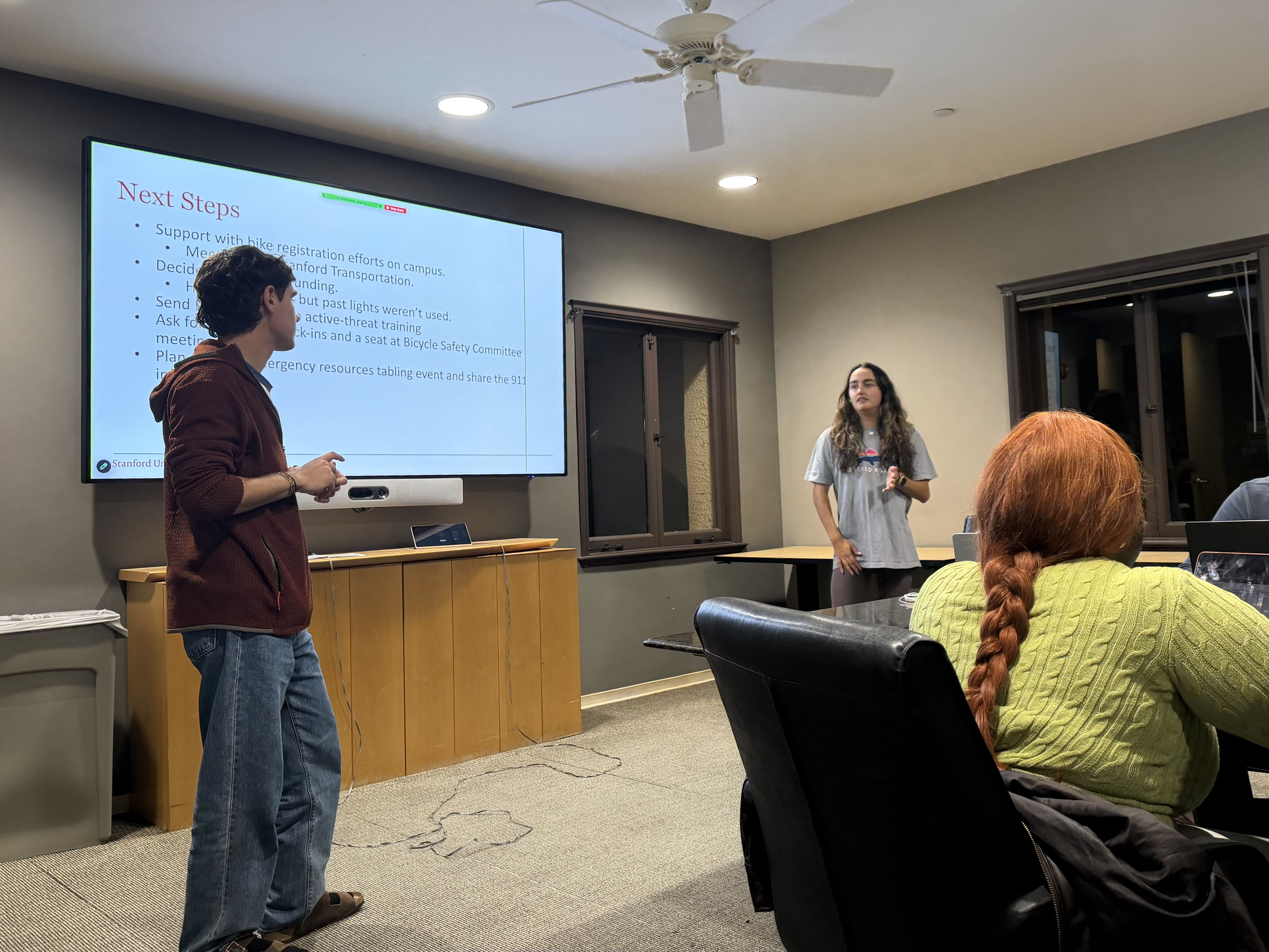
Communications Committee Co-Chair Ashton Dolce ’29 and Senator Anjali Verma ’29 presented on student concerns about improved campus safety – including electric bicycle speeds, bicycle theft, bicycle parking and poorly lit areas of campus. They also addressed the university’s replacement of Flock license plate readers with Genetec technology.
According to Verma, Stanford Transportation has registered approximately 600 to 700 bicycles.
“If your bike gets stolen, [the Department of Public Safety] has no way to track it unless it’s registered,” Verma said.
To identify and address campus safety concerns, a survey will be sent to students asking them to identify locations for additional campus lighting and bicycle parking, including areas around Lake Lagunita and West Lagunita.
Regarding the University’s replacement of Flock license plate readers, Dolce and Verma said that Genetec data is retained for just 30 days and has more stringent requirements.
“They have to list the case number, the purpose and the time,” Dolce said.
Ali and Verma also authored a proposal to establish a Student Organization Leadership Council (SOLC), which would act as a formal communication channel between voluntary student organizations (VSOs) and the ASSU.
The proposed council would include up to 32 representatives from ASSU-funded undergraduate organizations. Each organization could have one representative who would be nominated or endorsed by their VSO. This student would not necessarily need to hold an executive position in their VSO.
The council would meet at least twice per academic quarter, providing a forum for student organizations to raise concerns while also allowing the Senate to share information.
“They currently don’t have a formal platform to really be in constant communication with the ASSU,” said Verma.
Dolce and Verma also presented plans to fashion the Vaden Student Health Advisory Committee (VSHAC) into a communication channel between students and Vaden Health Services.
“One of the main things we’re trying to address this year with Vaden is that Vaden has no good way of telling students what it’s offering,” said Dolce.
The committee would share information about insurance and available resources while giving students a method of raising concerns about services. Applications are open to undergraduate, graduate and medical students. The deadline is Nov. 30 at 11:59 p.m.
The Senate also unanimously passed three bills that addressed hand sanitizer access, halal dining and collaboration with the Faculty Senate.
A joint bill presented by Dolce and Verma called for improved hand sanitizer accessibility in Stanford dining halls and in residences. The bill formalized a partnership between UGS, the Graduate Student Council (GSC) and Residential & Dining Enterprises (R&DE) to install hand sanitizer dispensers at entrances and exits of all R&DE-operated dining halls. R&DE expressed support for making dispensers available across all dining halls before the end of the academic year.
“These are basic sanitary needs,” Dolce said.
Ali presented a joint resolution on halal dining that called for improved food labeling and staff training so dining employees can better identify ingredients and know when to consult managers or chefs. The resolution encourages continued communication between R&DE and the Muslim Student Union (MSU) about dining access, including making halal certification documentation available to students and conducting additional reviews of dining programs by a qualified Muslim religious authority if requested. It also called for R&DE to work with the university’s Office for Religious & Spiritual Life to prioritize filling the existing halal dining internship position, designed to give students a dedicated role in providing feedback.
“MSU seems generally content and happy, and RD&E was able to communicate with them on it as well,” Ali said.
The vote passed UGS unanimously.
The third bill, introduced by Ali, established a protocol for the UGS and GSC to submit passed legislation to the Faculty Senate. Under the bill, the chairs of the student legislative bodies would select between one and four resolutions or bills passed by both bodies each academic quarter to emphasize to the Faculty Senate.
The UGS passed the bill unanimously.