
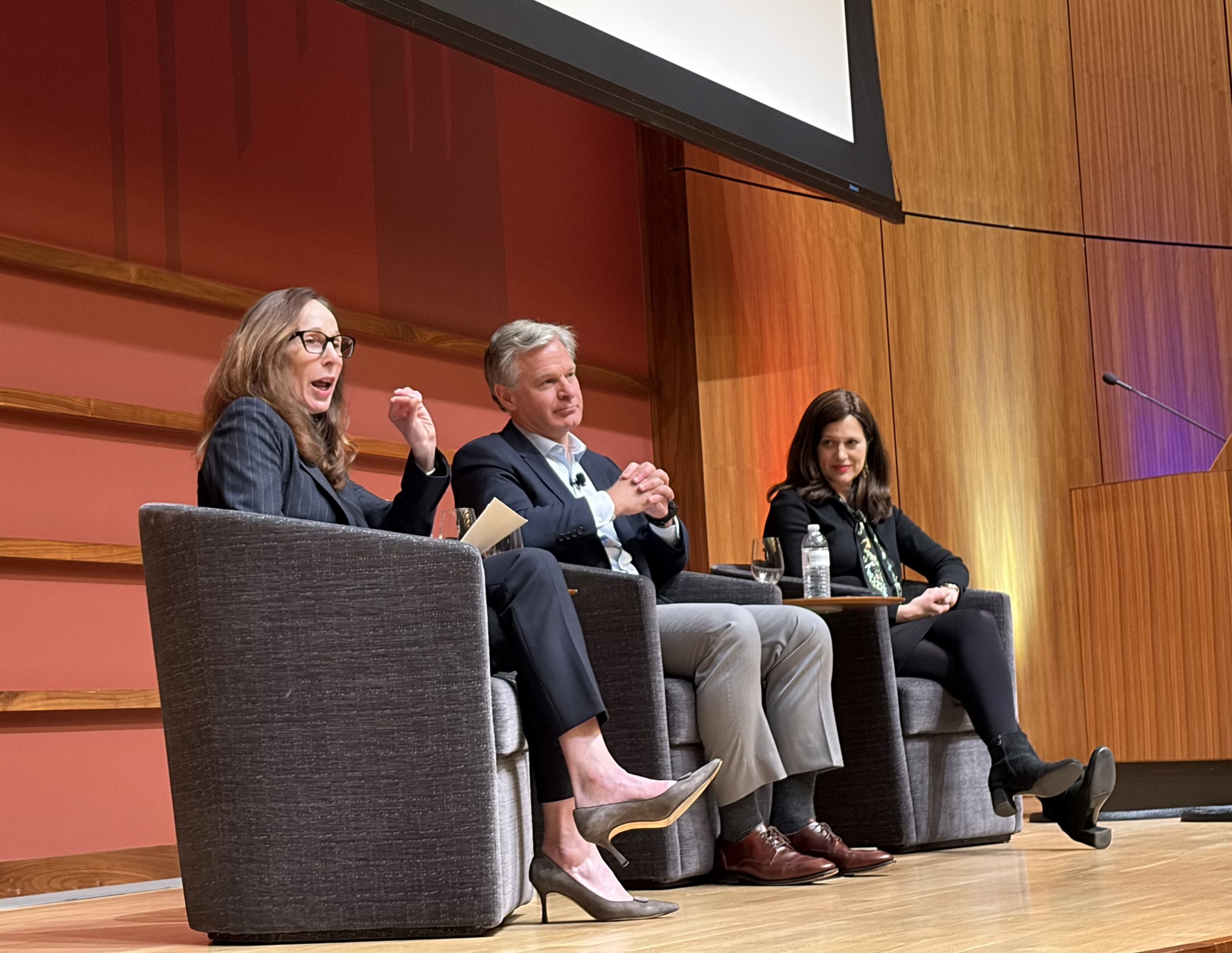
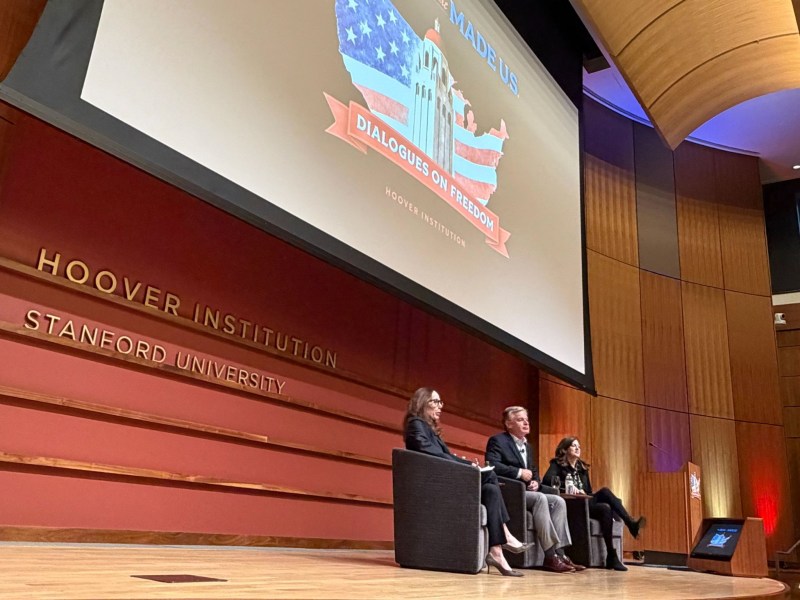
The Hoover Institution invited former government security officials Anne Neuberger and Christopher Wray to weigh in on the country’s current surveillance state and secret intelligence 25 years after 9/11.
The Thursday event was part of the Hoover Institution’s series commemorating the United States’ 250th anniversary. Neuberger was a deputy national security advisor under the Biden Administration and is currently a Hoover visiting fellow. From 2017 to 2025, Wray was the director of the FBI and is also currently a Hoover visiting fellow. The event’s discussion panel was moderated by political science professor and Hoover fellow Amy Zegart, who leads the Technology Policy Accelerator and the Oster National Security Affairs Fellows Program, in addition to teaching INTNLREL 115: “Spies, Lies and Algorithms.
Zegart asked Wray and Neuberger how they balance protecting the public with protecting individual rights and public accountability, a debate that emerged after the U.S. government rapidly expanded its national security apparatus and surveillance after the 9/11 attacks.
Wray turned to his experiences immediately following 9/11, citing the interactions he had with the families of victims as a personal touchstone.
“When you hear ‘to protect the American people’ as part of your mission, there’s a real risk of that becoming a sort of intellectual or even abstract concept,” Wray said, “until you’re actually face to face with the flesh and blood — humans — that you’re protecting.”
Wray reminded the audience of the over 3,000 American lives lost on 9/11. He recalled a story of a man who had spoken to his wife trapped on one of the hijacked planes. After her funeral, he discovered a tearful goodbye she left on the voicemail of their landline phone.
“I bring that up because when you have that kind of interaction, you start to appreciate the importance of the mission, not just up here in your brain, but in the pit of your stomach,” Wray said. “And that, in turn, is what drives public servants to pursue a mission, which is to protect the American people, because you’re picturing the faces of those people.”
Immediately after the attacks, the U.S. government created the Department of Homeland Security (DHS) and the Transportation Security Administration (TSA). Former President George W. Bush also signed the USA PATRIOT Act, which loosened surveillance laws, and separately issued a secret order authorizing the National Security Agency (NSA) to monitor international phone calls and emails made inside the U.S. without court warrants.
Zegart mentioned that some Americans feel that government surveillance has gone too far. However, Neuberger and Wray believe that intelligence agencies and other branches of the government have improved at cooperating and sharing information compared to pre-9/11, which is crucial given digitalization and the speed of internet communication. Wray also believes the debate of security versus privacy is no longer between the government and the public.
“There’s a third actor here now, which is industry,” Wray said. “And to a large extent, decisions about everyone’s safety are being made by industry … so I think there is a need to bring that third player into that dialogue and have more effective partnership between government and the private sector.”
Wray said that the U.S. is “chronically behind” in dealing with the threat landscape today, particularly against the Chinese government. He advocated for additional laws so security intelligence can act more efficiently on matters.
“Think of the difference,” Wray said. “For example, it was sleeper cell training in a camp in Afghanistan before 9/11, to now, where an operator is getting inspired online on his laptop from somebody oceans away. One cyberattack, one keystroke within seconds, [and] cataclysmic consequences can happen.”
Through another personal story, Neuberger emphasized the importance of a strong intelligence agency. When she was six months old, her parents went on their first international trip, and their flight was hijacked on the way home by terrorists who directed the flight to Uganda.
Once in Uganda, the terrorists separated the passengers by faith, keeping the 106 Jewish passengers as hostages, including Neuberger’s parents. Mossad, Israel’s foreign intelligence agency, did aerial reconnaissance, obtained airport terminal blueprints and secured Kenyan support, all of which resulted in the Israel Defense Forces’ (IDF) successful execution of Operation Thunderbolt. Out of the 106 hostages, 102 were rescued.
“My life would look very different had that military operation not been successful,” Neuberger said. “I think there are times there are threats to civilians that only a military with an effective intelligence community can protect people from. I would think of that often when I started at the National Security Agency.”
Members of the audience included Hoover fellows, staff and students. One student attendee, Avani Ganesan ’29, said she hopes the event inspires other students to enter public service and give back to the country.
“It is such a privilege that we’re able to live here,” she said. “So I really hope this is a wake-up call and incentive for people to join public service.”
During the event, Ganesan asked the panelists how other students could be better incentivized to pursue careers in public service.
“Think about the greatest gift we have, which is the gift of time,” Neuberger responded. “What you can take is knowing that you’ve saved a life, knowing you’ve prevented something bad from happening … This democracy, it doesn’t continue, necessarily, without folks giving up some of their time. We don’t know how much time there really is. Why not do it now?”