
In 2000, former Wired Magazine writer Paulina Borsook cautioned in her book, “Cyberselfish: A Critical Romp through the Terribly Libertarian Culture of High Tech,” that Silicon Valley’s anti-government, anti-regulation culture would spread beyond the tech industry.
“I know my history,” she said. “I’m very suspicious of something that asks you to just believe. I don’t care what it is.”
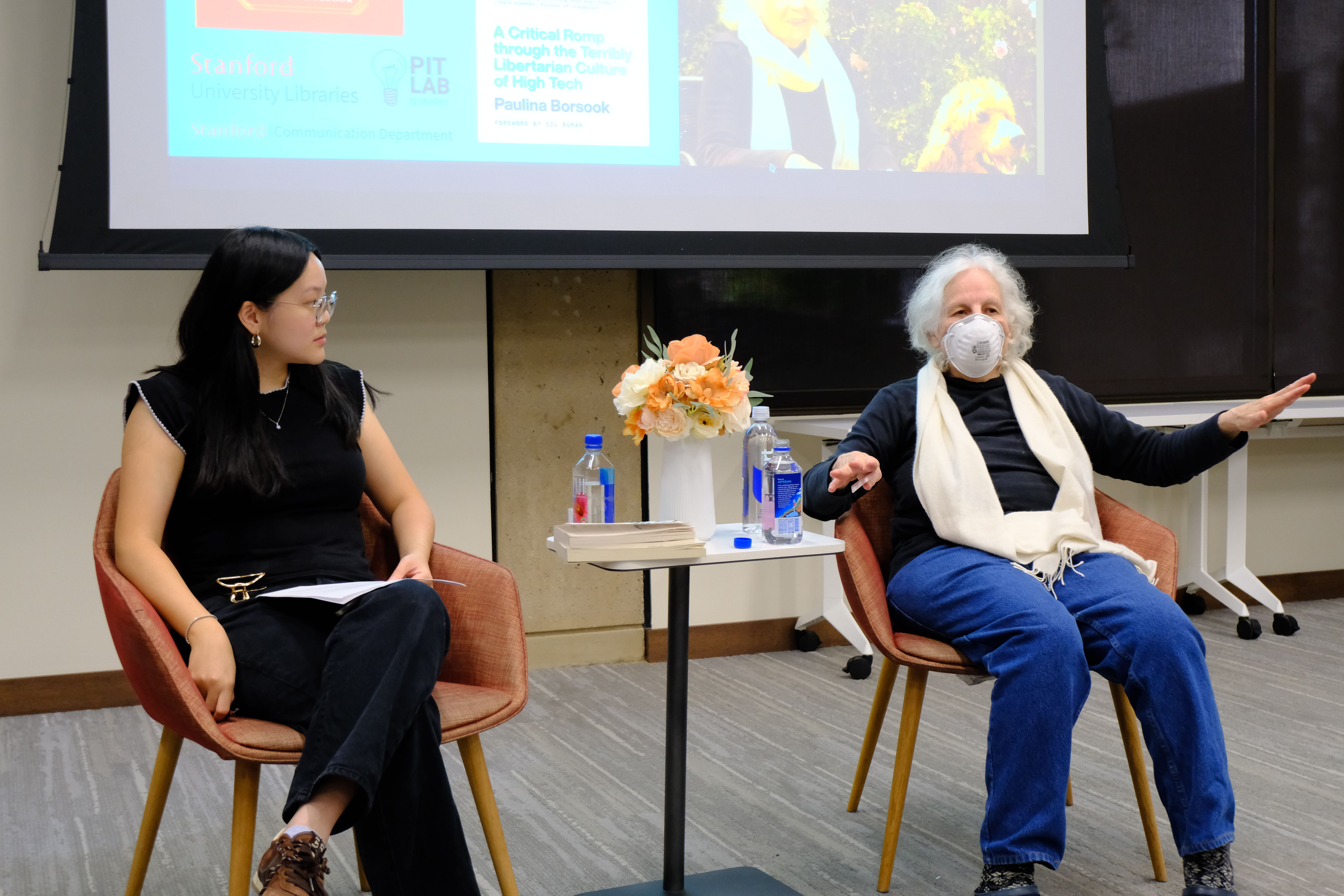
On Thursday, 26 years after the book’s initial publication, Borsook returned to Stanford to speak about “Cyberselfish,” at a fireside chat hosted by the Stanford Public Interest Technology (PIT) Lab. She urged Stanford students to do something Silicon Valley never did: learn the tech industry’s past before trusting its promises. Previously, Borsook worked as an artist-in-resident Stanford Research Residency program, where she explored her traumatic brain injury (TBI) through her multimedia project “My Life as a Ghost” (Borsook was shot in the head at age 14).
Only 7,000 copies of “Selfish” were sold during its initial release in 2000, just as the dot-com bubble burst. Borsook said the crash left the public disillusioned with the tech industry, and after the Sept. 11 attacks, the national conversation moved away from tech. Eventually, the book went out of print. “It crashed my entire career. I was never able to be published again,” Borsook said.
Then, last year, interest in the book surged. Borsook said that after a New York Times profile was published in Nov. 2025, used copies that once sold for about $3 jumped to more than $1,000. The book has since been reissued in the U.S., U.K. and France.
Borsook said the book’s return has been “thrilling and wonderful,” but also strange. “It is very weird to have written a book which is truer now than when it was written,” Borsook said.
Communications professor Fred Turner, who introduced Borsook, said most 1990s journalists were “writing about the rise of something they called the electronic frontier: wide open, ostensibly empty space.” He said Borsook’s book, by contrast, “opened the door to the critical study of the tech world.”
Borsook said that Wired Magazine, for instance, preached that regulation was bad and government was useless. “That was the religion being promoted,” she said.
Borsook never accepted that view. She noted that the internet began as a government-funded project, and tech’s wealthiest rely on public regulation and subsidies for their comfortable lives.
The ideas survived, she argued, because tech leaders ignore where their industry came from. In her view, tech companies still describe themselves with the language of an earlier Silicon Valley — one that prioritized innovation and creativity — even as their business models underneath have shifted to surveillance and extraction.
Now, she said she sees the pattern repeating in AI, where companies are pouring money into one another. “I’ve been getting real 2008 vibes,” she said, referring to the Great Recession’s catastrophic stock market collapse. “This is not sustainable.”
According to Borsook, it’s problematic that universities rarely teach the history of technology and its social implications. She recalled speaking to a group of engineering students who had never taken a class on either.
“Several of them came and said, ‘We’re so hungry for this,’” Borsook said. “And I thought, ‘This is criminal.’”
Angela Nguyen ’27, one of the event’s organizers, said the critique applies to Stanford too. Nguyen, president of PIT Lab co-founded Stanford Critical AI Group, which brings together students, researchers and faculty to study how AI affects power and governance, including the ideology behind the tech industry’s promises.
“Even though we’re here at Stanford, it’s important to be critical of either the institution or … the world,” Nguyen said.
Fellow Critical AI Group co-founder Chijioke Mgbahurike ’25 M.S. ’25, a law and AI research fellow at the Stanford Law School, said his courses on AI rarely ask how technology affects society.
“You can go through your entire degree without once ever having touched on the societal implications of your work,” he said. He now hopes to push the computer science department to teach the history of computing.
For Mgbahurike, Borsook’s story — formerly ignored and newly rediscovered — is a reminder that change takes time.
“It’s probably going to get worse before it gets better…but it’s a marathon, not a sprint,” he said.