
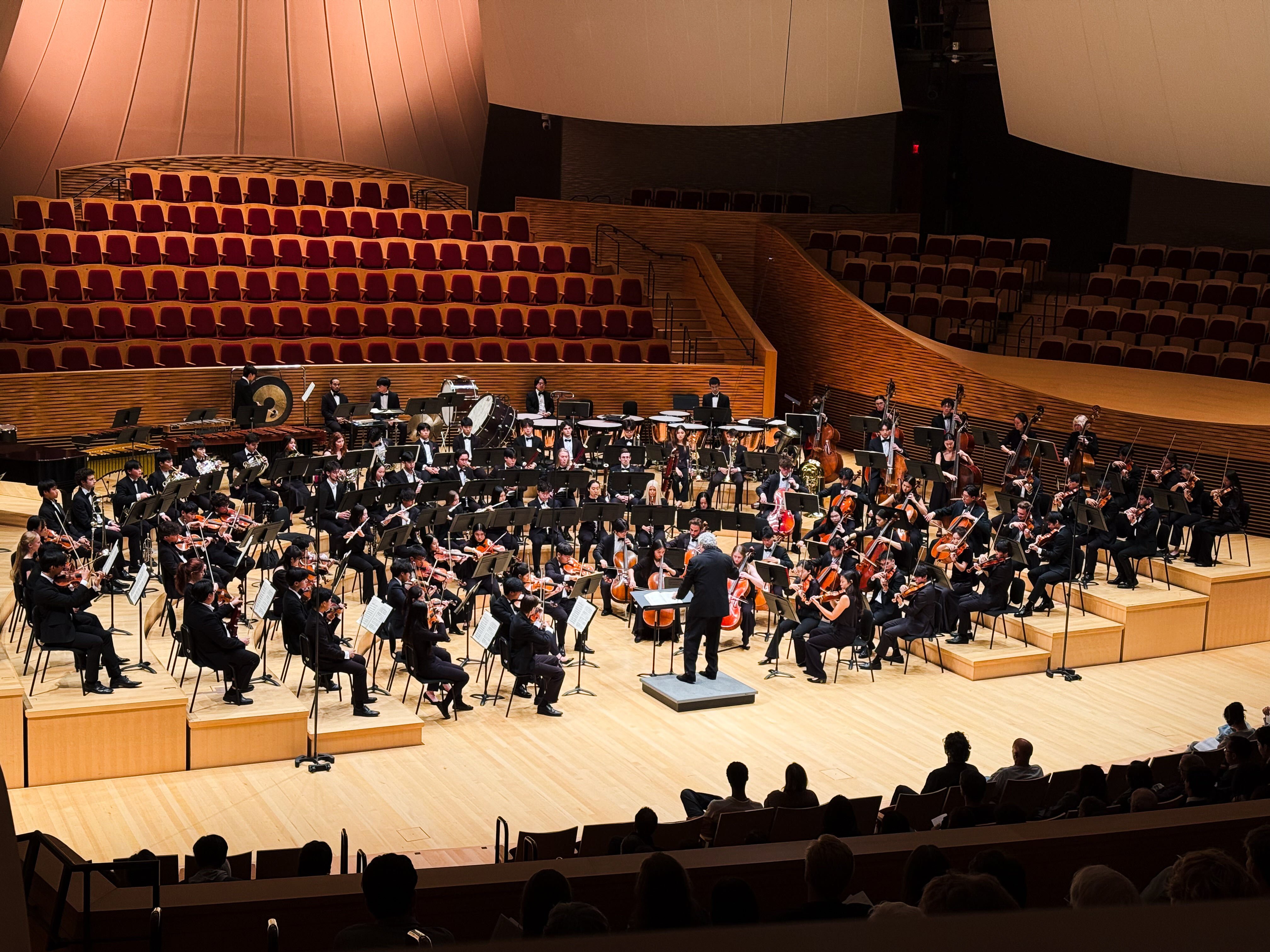
Editor’s Note: This article is a review and includes subjective thoughts, opinions and critiques.
In 1900, Eduard Hanslick wrote a short review of Mahler’s First Symphony that characterized the work as “not music.” This was not unusual for the critic: Today he is remembered largely for derisive comments aimed at what would become stalwarts of the repertoire. Nevertheless, his discussion of Mahler was surprisingly restrained, as he humbly suggested that his negative opinion stemmed not from the music, but rather from his personal lack of understanding and familiarity with it.
Would that I could do the same for Wang Lu’s “Surge,” a 2022 piece performed by the Stanford Symphony Orchestra to open a Friday program that would culminate in Mahler’s symphony. Unfortunately, the short work had few redeeming qualities. Opening with repetitions of a rising chordal figure, it immediately resembled the credits music of a second-rate movie score — and the second half gave the impression of a composer desperately trying to extend their ideas through an endless scroll of assistant cinematographers and special effects coordinators. The central motives were too short to be interesting, and their development was neither enlightening nor minimalistic.
The piece may have evoked the “endless, vivacious energy” of college life that Wang Lu described in a pre-concert talk. But rather than portraying the joie de vivre of youth, Lu’s piece was an encapsulation of tacky parties and hollow social media feeds.
Conductor Paul Phillips’ “Concordia Mundi,” an orchestral adaptation of a work for 12 pianos and the only world premiere of the evening, was better. At the very least, the formal structure, which involved the presentation of three motives and an intensifying exploration of their contrapuntal possibilities, was admirable. But pulling this off properly would have required, first and foremost, good themes. The finale of Mozart’s “Jupiter” Symphony and the Prelude to Wagner’s “Die Meistersinger” — two pieces that possess a similar architecture, although Phillips told The Daily that he only realized this after he finished “Concordia Mundi” — are as popular for their main melodies as for their counterpoint.
Regrettably, Phillips’ themes failed to rise to the occasion. The first, with its constant returns to the same note, was particularly pedestrian, and the other two did not resolve the work’s lyrical shortcomings. Nor was the orchestration, the very aspect of “Concordia Mundi” that was entirely new, wholly successful: Phillips could not resist keeping one piano, but it felt distinctly out of place in the symphonic texture.
Few of these issues were the fault of the orchestra itself, as demonstrated by the players’ broadly successful treatment of two older works.
Under the direction of assistant conductor Sean Tan ’27, the ensemble delivered a compelling rendition of “Orpheus,” the fourth of 12 tone poems written by Franz Liszt in the 1850s. Soloists, especially cellist Maya Benyas ’25 M.S. ’26, distinguished themselves through elegant phrasing that floated above the two shimmering harps, and Tan marshaled his forces to produce a terrific climax that managed to avoid any harshness.
Even so, the moment could have been more remarkable if the many meditative sections were performed more sensitively. But the orchestra seemed unable to quiet down when necessary: The horns’ entry in the first measure was only the most notable example of a line which failed to provide an ethereal calm.
This shortcoming was again on display in Mahler’s First Symphony. The introduction, which the composer described as the “awakening of nature,” was not sufficiently delicate: The world wasn’t being forced out of bed by an alarm, but nor was it slowly coming out of a pleasant dream.
Thankfully for this orchestra, the music soon becomes more lively: Even the funeral march of the third movement contains a folksy middle section. As can be expected from virtually any student orchestra, there were still some issues in the rest of the performance. But these were largely swept away by a general effusiveness, a mood that was only significantly threatened by Phillips’ choice of a plodding tempo for the first movement. (He tried to compensate for it by rushing through the second movement, but this only amplified the orchestra’s limitations.)
It should then come as no surprise that the expansive finale, which Mahler marked as “Energisch” in the score, was the highlight of the evening. The frenzied opening was exceptionally powerful without any sacrifice of accuracy, and Phillips continued to drive the musicians all the way to the sweet violin melody — which in turn was played exquisitely by a section that had struggled to achieve similar effects earlier in the concert.
But it is the brass that deserves the biggest praise. Starting from the off-stage fanfares in the symphony’s introduction, the trumpets’ clarity of tone and technical prowess were on full display. It was thanks to them that the final minutes of the evening were positively thrilling: It was difficult to hear the rest of the orchestra over the brass’ triumphant figures, but they played so well that one couldn’t really complain.
Mahler’s finale is a tremendous piece, and it proved particularly well-suited to highlight the strengths of the Stanford Symphony Orchestra. If only this was true for the rest of the program.