
Editor’s Note: This article is a review and contains subjective thoughts, opinions and critiques.
It’s a timeless story: We never appreciate the mundanity of our lives until it’s gone — and then it’s too late.
Such is the premise of Thornton Wilder’s 1938 play “Our Town,” which Stanford Theater and Performance Studies (TAPS) presented Nov. 12-14. Wilder’s three-act play traces three days of small-town American life at the turn of the century in fictional Grover’s Corners, New Hampshire. The show’s most distinctive element, though, is its metatheatrical narrative and bare-bones set design as Wilder envisioned it: chairs and tables but otherwise minimal props. In a character-centered play, the talented cast reminded us that theater is fundamentally about performers.
Ryder Thompson ’27 guided the story as the Stage Manager, an omniscient narrator who breaks the fourth wall and interrupts the action of the play to hurry characters offstage or offer context. Thompson imbued the role with a sanguine, wistful touch that reflects his awareness of the characters’ tragic fates.
The play blurs art and reality from the beginning. To open the first act, the characters each shout their actors’ real names, and the Stage Manager mentions that he is putting a copy of the script in the town’s time capsule.
Chlöe Jones ’29 and Iyanu Olukotun ’27 excellently portrayed lead characters Emily and George, respectively. The scene in Act II where the two fall in love was a highlight, with both actors presenting a realistic awkwardness. Olukotun’s earnest George began the scene by comforting a distraught Emily after she regretted criticizing his character. When she realized the two loved each other, however, Jones swung impeccably from tearful to hilariously giddy.
Jones and Olukotun again demonstrated their chemistry in their wedding scene, where they have last-minute hesitations but ultimately marry anyway. The wedding also features one of the many excellently-played supporting characters, Mrs. Soames — played by Jenny Ballutay ’28, an editor for The Daily — whose inappropriately loud commentary drowned out the bride and groom’s vows and elicited the most uproarious laughter of the night.
The production included too many perfectly-interpreted supporting characters to do justice in a single review, like Emily’s parents (Noah Dehli ’28 and Charlotte Kearns ’27) and George’s parents (Ben Hollingshead ’28 and Maddie Garfinkel ’28). The cast even featured a Distinguished Careers Institute (DCI) fellow, Mark Adams, as Professor Willard, an overzealous academic who introduces Grover’s Corners minutiae directly to the audience and hands out brochures before the show.
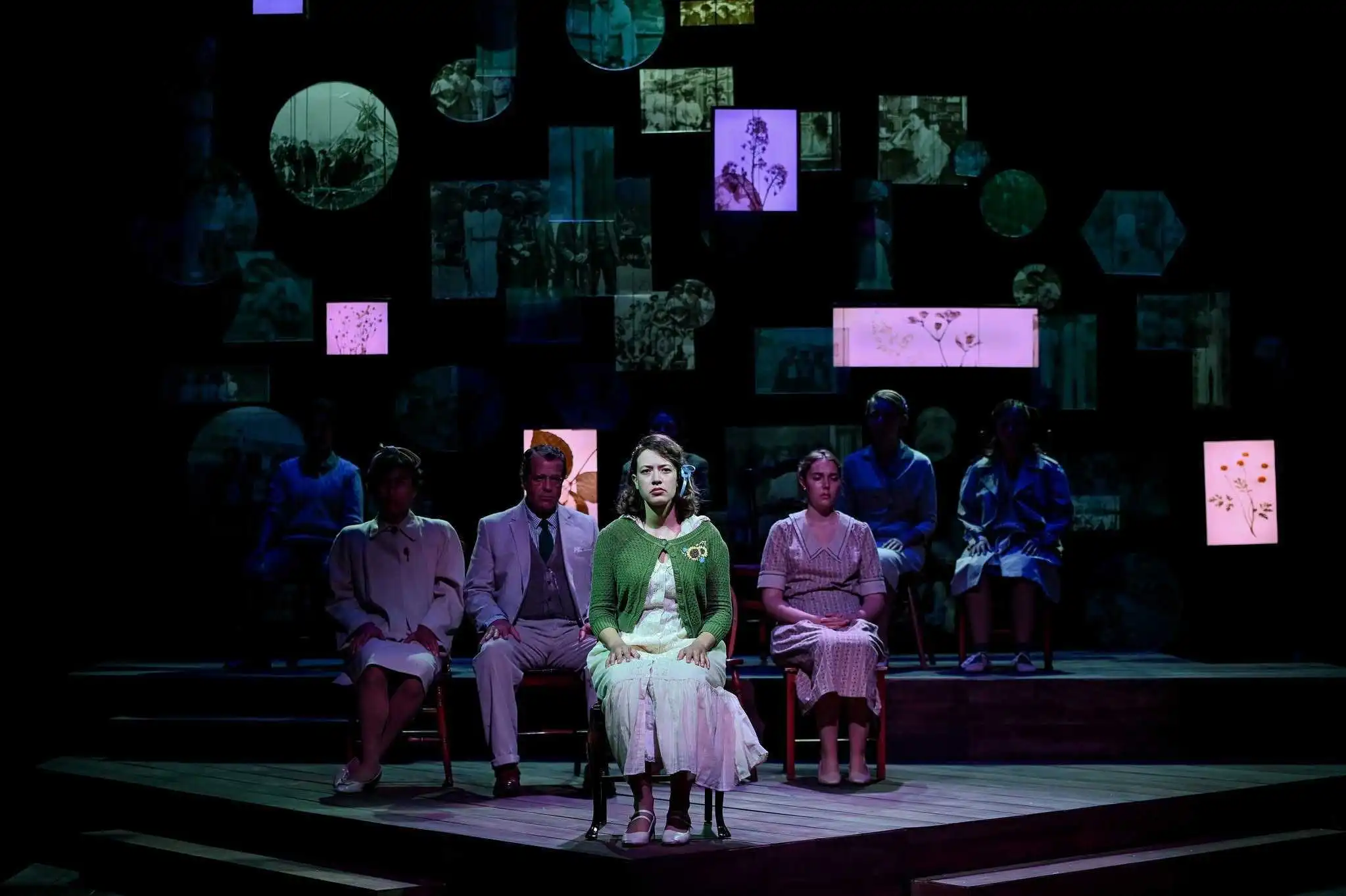
“Our Town” hinges on Act III. When the curtain comes up, a set of now-familiar characters are sitting in rows of chairs on one raised side of the stage. Soon, though, it becomes clear they are ghosts, and that Emily is joining them after she died in childbirth between acts. She now talks to the other deceased townspeople, whose fates we learn as she does. Then she chooses to relive one day of her life: her 12th birthday.
The dead discourage Emily from revisiting the past — a prescient warning, as she cannot bear rewatching herself and her loved ones act so blasé with no knowledge of the future. In the climactic moment where she decides to return to the cemetery, Jones perfectly delivered Emily’s wrenching monologue, probably the most famous from the play: “Goodbye, goodbye world, goodbye Grover’s Corners…”
Watching this drama play out from the audience, the seemingly mundane scenes and details that filled Act I no longer seemed like meaningless filler, but became the moments that give life texture. I imagined we in the audience might have watched Acts I and II quite differently had we seen Act III first.
No discussion of the play would be complete without highlighting the staging. The limited props enabled the cast to show off their considerable pantomime skill from the moment the play begins, typing on invisible typewriters or tending to invisible gardens.
The creative staging extended to the audience. Viewers sat on both sides of the stage, which was flat except for two raised areas on each end, which variously represented homes, an altar and a cemetery. Behind each raised area, floral images and black-and-white family photographs lit up throughout the course of the play.
Many great works of theater are readily adaptable across settings, and Wilder’s minimal set design ensures that the theme that no one appreciates life while living it universalizes across any setting or time. Family, love, marriage, community, death — any staging of “Our Town” ought to invite audiences to fill in the familiar sights of their homes and to see Grover’s Corners not as a window but as a mirror. The crew at TAPS clearly understood the assignment.
“Our Town” is a bit heavy-handed with its theme of life’s ephemerality, particularly towards the end, although that is a limitation of the narrative, not the actors or production team. Yet that core message — visible in this play and centuries of art — is a poignant reminder that what seems inconsequential now might be quite different as a memory. A little memento mori might inspire us to live a bit more intentionally.
Correction: This article originally misspelled Dehli’s surname. The Daily regrets this error.
Correction: This article originally misidentified the student who portrayed Emily. The Daily regrets this error.