
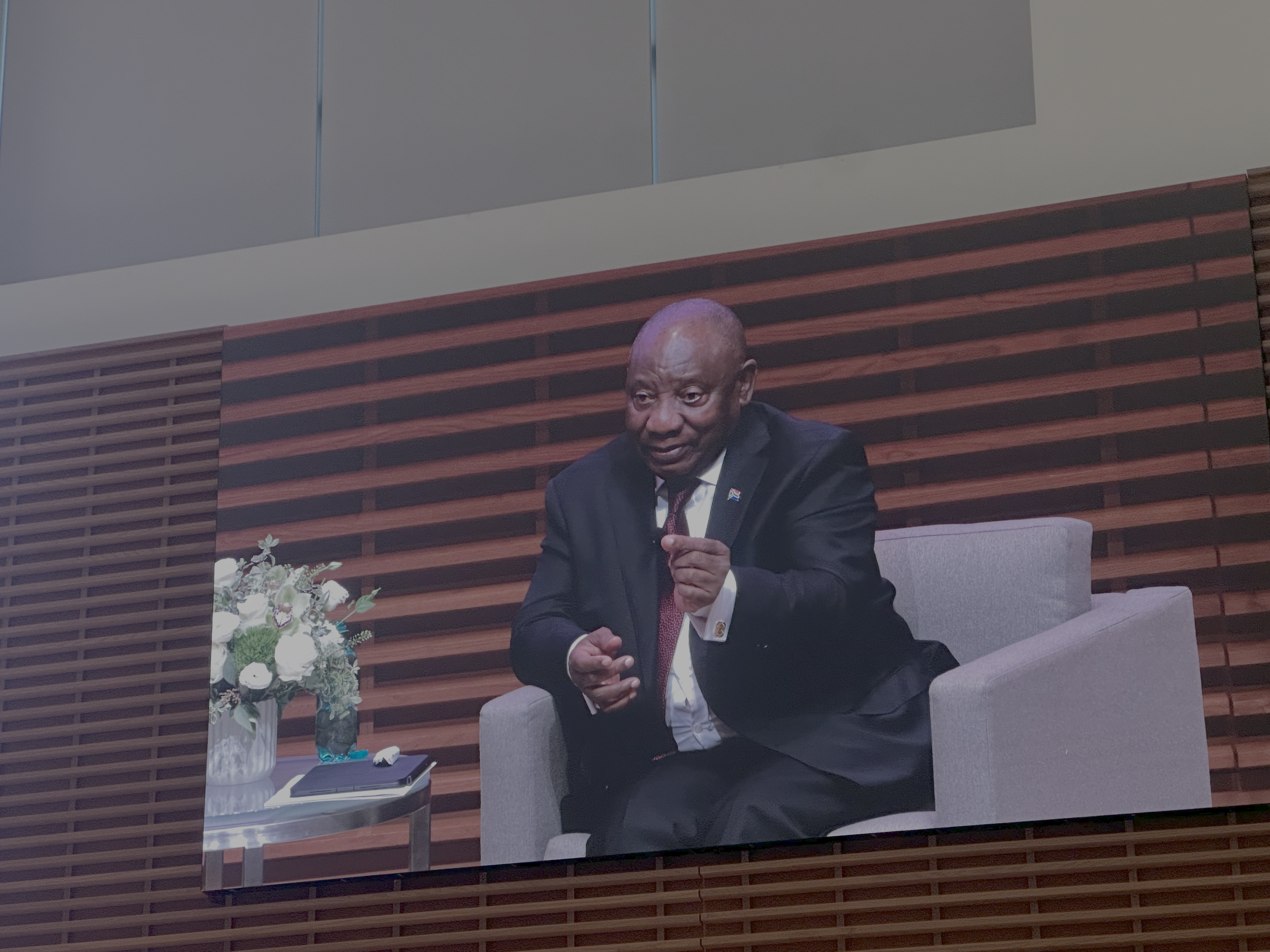
South African president Cyril Ramaphosa celebrated his 74th birthday by speaking at the Graduate School of Business on Tuesday. He called for investment in South Africa as the country looks to embrace the age of artificial intelligence (AI).
In conversation with South African-born venture capitalist Roelof Botha M.B.A. ’00, Ramaphosa shared his plans for South Africa’s future, focusing on economic growth, technological advancement and education. By 2050, Ramaphosa said that he wanted to see “a South Africa which will have rid itself of the legacies of the past … That legacy is what colonialism and apartheid did to our country.”
Ramaphosa referred to colonialism and apartheid as the “original sins” which have “held [South Africa] back from development.” He emphasized that it has been just 32 years since the country ended apartheid, a system that he said contributed to generational poverty and racial disparities in the education system.
To move away from its history, Ramaphosa said he hoped South Africa would be a country that removes inequality and poverty, achieves full employment, harnesses a well-skilled population, fosters annual economic growth of 5 to 6%, becomes a place for technological innovation and maintains strong political connections.
The audience responded to this message with claps and cheers.
Ramaphosa also outlined a vision for how the country will achieve these goals, including by making multiple calls for investment in South Africa. Historically, South Africa has lacked external investment, which has put it at a disadvantage compared to other countries, Ramaphosa said.
He cited a conversation with Ursula von der Leyen, President of the European Union, on Germany’s redevelopment following World War II as an example. According to Ramaphosa, von der Leyen, a German national, said that Germany was only able to rebuild with funding from the United States through the Marshall Plan, and without it, “Europe today would be a backwater… region of the world.”
South Africa, Ramaphosa said, “did not have that same advantage” following the end of apartheid. “Investment has been lacking. So in order for us to be catapulted to a higher level, we need investment, we need skills and we are in the process of improving the investment climate in our country.”
To help with development, Ramaphosa said that South Africa is focused on talent retention. “We in South Africa right now are creating a conducive environment for people who have left the country to come back and contribute to the further growth of the country,” Ramaphosa said. “We want you to come back. There’s no country that is as beautiful as South Africa. I promise you.”
Ramaphosa included his own daughter as an example. “I’ve got a daughter who’s overseas, she’s learning, but she knows she’s coming back…. She’s coming back to contribute to the growth of our country.”
In pursuit of economic growth, Ramaphosa said that South Africa is “hungry for partnership,” including welcoming a data center build-out, with the caveat that the country wants to be involved in “the full value chain” as opposed to simply providing land. Both Ramaphosa and Botha emphasized South Africa’s energy production and excess generation capacity as a draw to support data centers and other technologies.
Botha added that on Sunday, he and Ramaphosa discussed establishing a liaison in Silicon Valley with the goal of building a “business development bridge.”
Building on his support for data centers, Ramaphosa shared a positive outlook on artificial intelligence for development. “Our approach to AI is that this is a technology that we have to embrace, that we have to utilize and that we want our young people to be deeply immersed in, because we see a lot of good that AI has to offer,” he said. Ramaphosa also attended a lecture on Tuesday which addressed the risks of AI and how they can be mitigated.
Following his visit to Stanford, Ramaphosa said he plans to return home even more optimistic about AI. “We go back home, not fearful of AI. We go back home embracing AI and wanting to utilize AI for the development of our country and our people. So we go back home stronger, but we also go back home hopefully with a bag full of investments and the money that we’ve been smelling.”
Ramaphosa’s comments were met with laughter from the crowd.
Some students found that, with its focus on AI and investment, the talk lacked political discourse.
“I thought it was really interesting, but it was definitely a politician’s speech, for better or worse,” said Daniel Hadi ’27. “I think the angle he took was interesting to not talk about significant policy platforms or change.”
Hadi said that as a Palestinian American, he is interested in South Africa’s history of apartheid and wanted to hear more about how attracting investment “durably reverses the harms and the sins” that Ramaphosa discussed.
“He left substance on the table,” Hadi told the Daily after the event.