
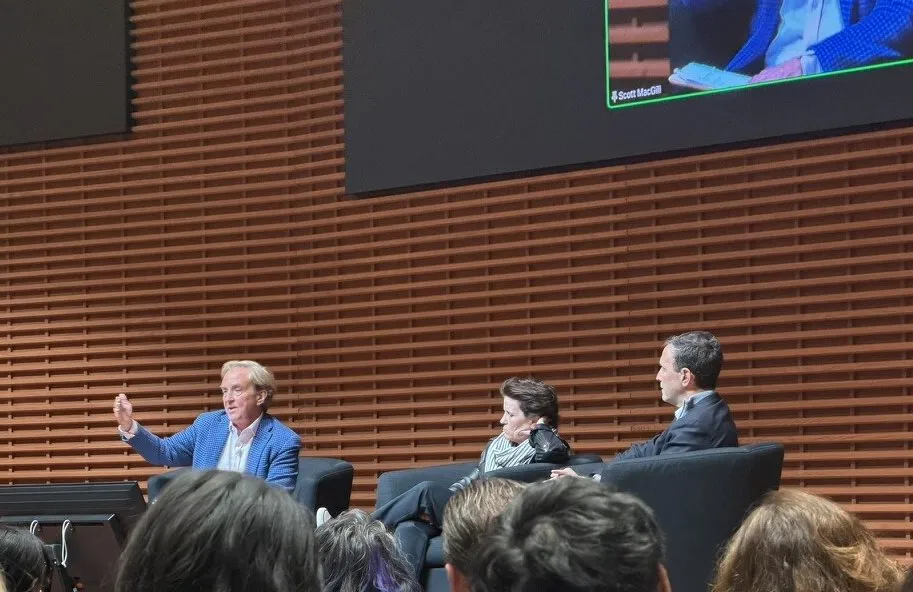
Stanford president Jonathan Levin ’94, joined a panel of industry experts and lawmakers Monday evening to probe the future of artificial intelligence (AI) in education and the lives of youth.
The conversation, moderated by Jim Steyer ’78 J.D. ’83, adjunct professor in the Graduate School of Education (GSE), was the second to last in Steyer’s speaker series titled “Will America Fail the Midterms?”
Other speakers included former Surgeon General Vivek Murthy, journalist and contributing editor of New York Magazine Kara Swisher and former European Commissioner for Competition Margrethe Vestager.
Monday’s session was the first of the class since the midterm elections, which played an important role in the night’s discussions. Steyer opened the class by noting the course’s title had changed.
“America passed the midterms,” he said. This change has been reflected on Canvas.
Swisher, who was in Canada on election night, and Vestager, who lives in Europe, offered their accounts of a “sigh of relief” felt abroad as strong results for Democrats rolled in. The results came, however, in the context of two years of American “attacks” against European regulatory viewpoints. Swisher posed the question of why Europe, Canada or American allies should lend trust to the U.S., especially as the U.S. has “kicked them in the teeth over and over again” in favor of “a small group of billionaires.”
Swisher also argued that the AI age reflects what she described as predatory historical patterns from American westward expansion. The “techno-narcissists” who build AI, she says, seek control over resources in the same manner that settlers sought railroads, gold or water.
“They think they own everything,” she said. “And we’re the cheapest dates on the planet by trading away our privacy.”
Murthy also discussed the need for additional liability and transparency provisions, adding that modern social structures “should not rely on somebody being a good person” to benefit and protect everyone. As a father, he stressed the importance of good role models leading government, business, education and other sectors, which he feels are absent today.
He connected the election results to a rebuke of this “moral failure.”
“I don’t think those are the values that most of us believe in as Americans or the folks in and around the world,” Murthy said. “Some of what you saw in the election was a reaction to a set of values that people are no longer happy with.”
Levin’s interpretation of the election results began with contrasting AI’s business model to that of social media. While social media aimed to commodify attention, AI is a “general purpose technology,” he said. When companies push out the most advanced model, he said, that allows users both to do good and inflict harm.
Those companies then have a financial incentive to leverage “disrupt[ive]” innovations to win the race for an initial public offering (IPO) on the stock market by advancing toward the “frontier” of AI development, he said.
“I’m no electoral political expert, but I think that’s some of what you see in the country’s fear of such radical change that might happen and what the implications might be,” Levin added.
Vestager, who leads efforts for social media and AI regulation in the European Union, stressed the human side of the technology’s growth. Referring back to “disast[rous]” earlier campaigns to rein in social media companies, she spoke to the unique difficulties that AI regulation carries.
“We’re talking about a technology that will decide war, cybersecurity, crime, production, how you work, if you work, learning, relationship, love, identity,” she said. “And it’s in the hands of very few men who are still optimizing their profits in a crazy race about who can be the first to produce the most dangerous technology.”
Humans, as Vestager describes, benefit from being around community, which AI threatens. She said human relationships were at stake as a result of democratic systems capitulating to control by tech companies.
“If you just want to ask the machine whenever anything becomes just a tiny bit difficult, we’ll not make it,” she said.
Much of the evening’s conversation centered on young people’s usage of AI for mental health support or companionship. Murthy referred to the statistic that 1 in 2 young people in the US are part of an ongoing loneliness crisis. He credited the “frictionless intimacy” of AI for exacerbating this phenomenon and highlighted the importance of human relationships in which people challenge one another.
The panelists recognized that several of the leaders in AI development were Stanford alumni. When asked about Stanford’s responsibility for producing the next generation of leaders, Levin expressed that students ought to graduate having heard from a range of viewpoints, from his fellow panelists to tech industrialists. Hearing those perspectives, he said, prepares students to weigh the impact of their choices.
“Everyone who graduates from Stanford, in some form or another, is going to end up in a situation where they make decisions that affect other people,” he said. “What you hope for from an education is … they think that through, and they try to make decisions that are not just about themselves, but about the people around them.”
Despite apprehension regarding the future of AI, Vestager still finds optimism in democracy.
“Power comes from the people,” Vestager said. “That’s the US. That’s Europe. Those who have that powerful lending, they can be held responsible for creating a society where you can dream and where you can have that sense of, ‘I’m part of this society and counted in.’”