
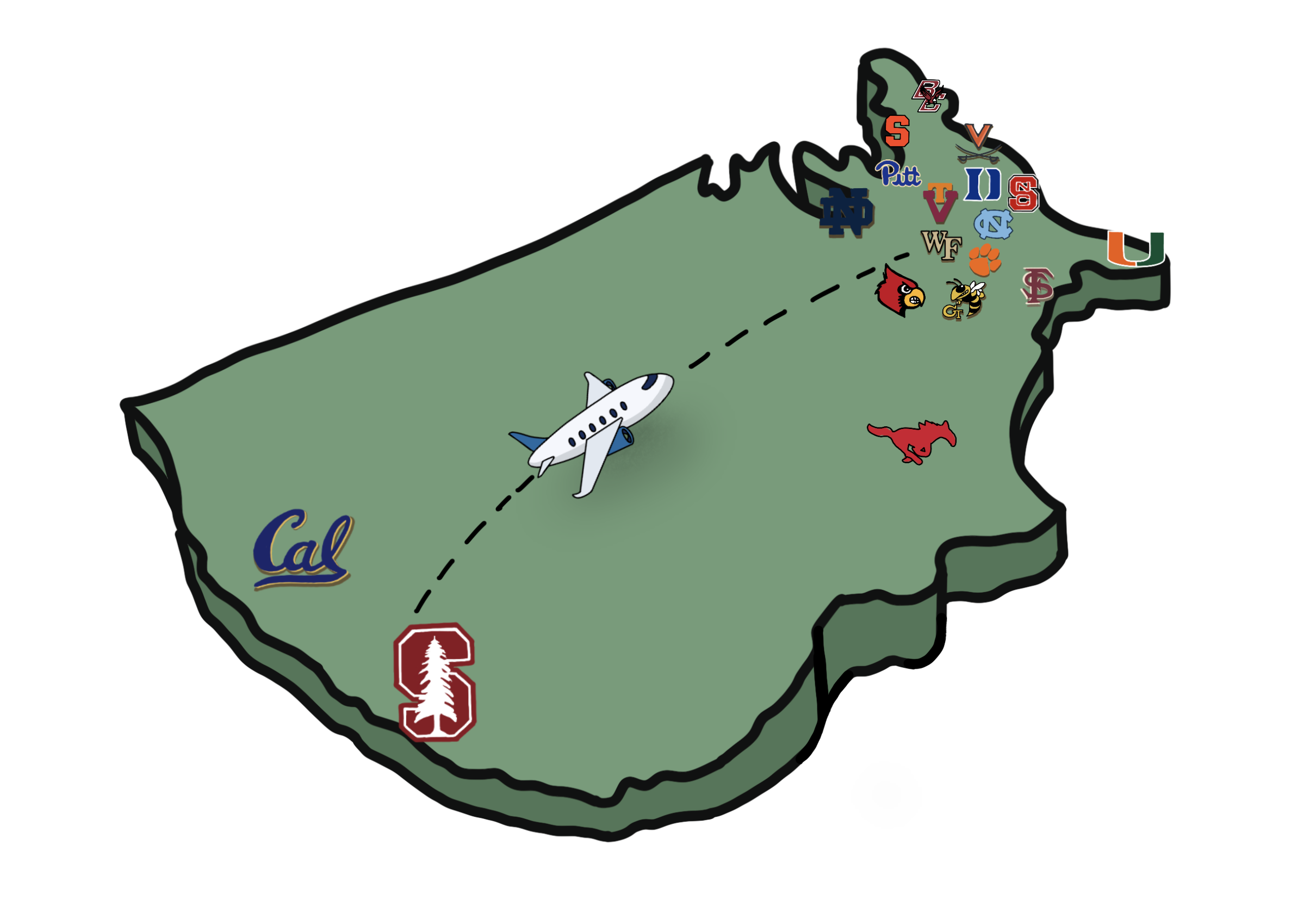
Stanford football has notably had one of the most challenging travel schedules in the country since joining the Atlantic Coast Conference (ACC) in the fall of 2024. The other West Coast ACC member, Cal, has had a similar experience – this season Stanford has the most travel miles of any FBS team in the continental U.S., and Cal has the fifth-most. (Hawaii is perennially the FBS’s road warrior, typically racking up over 18,000 miles in the air.)
With all five away games so far being in the Eastern time zone, the Cardinal have averaged just over 2,200 miles to each away opponent. Many have questioned whether Stanford’s struggles on the road, where they had lost 15 straight before last weekend, is due to their punishing travel schedule. Since this somewhat absurd arrangement of a West Coast school playing in an East Coast conference seems like it may be here to stay, I traveled to Blacksburg, Virginia, for Stanford’s game at Virginia Tech on Nov. 14 to look at what goes into these lengthy away trips.
Garrett Wolfe, Stanford’s new director of football operations, is primarily responsible for orchestrating these trips. For him, the process starts in October of the preceding season when the ACC releases the list of home and away opponents. At this point, Wolfe and his team can start scoping out hotels in the area before game dates are known.
“Once they release the game dates, then you can have them on speed dial… you want to secure your stuff ASAP,” Wolfe said. It’s only then that charter flights can be booked, buses reserved and police escorts arranged.
Playing at Virginia Tech, nestled up in the Appalachians, however, presents specific logistical challenges. Roanoke airport has a relatively short runway and surrounding terrain, which means the team’s typical Boeing 757-300 can’t get in and out nonstop to SFO. Hence, Stanford needed to take two planes. The Roanoke-Blacksburg area also only has one hotel with enough meeting room space available, the slightly eclectic Hotel Roanoke, located just over 45 minutes away from Virginia Tech’s Lane Stadium.
As opposed to this multi-day endeavor, one- or two-day trips were commonplace in the Pac-12 era. Wolfe said that for West Coast games, the formula would be a lot simpler since “you just do everything Thursday … jump on a plane at one o’clock [Friday] and be there by dinner.” He likened the scale of the new travel operation to a “mini bowl game” rather than a typical in-season away opponent.
Once the week of the game arrives, the first piece is set into motion when the equipment truck departs on Monday. Packing and dispatching the truck largely falls to the director of football equipment Greg Valenzisi and his team.
Valenzisi noted his job is very checklist-based. “We just start going through all the little things … how’s it getting to the game, where’s it going in the stadium … and how’s it coming back?” The journey that equipment takes is not necessarily symmetric either. They opted to fly the uniforms back from Blacksburg since they need the away jerseys for Cal this upcoming Saturday.
He also said that timelines were the single biggest thing that’s changed since the days of the Pac-12. What used to be a simpler timeline to unload equipment is now an elaborate dance between the truck, an advance team and the travel party itself.
He stressed that the relationships built with former Pac-12 opponents had helped handle the inevitable issues that come up. Valenzisi recounted a trip to Washington State that went sideways when his flight to Pullman, Washington was canceled. “I told my counterpart at Washington State what had happened, [and] he had his staff unload the truck for me.” From his account, those relationships are just starting to form for Stanford among ACC opponents.
By Wednesday before the game, select Stanford football staff were hitting the ground running in both Roanoke and Blacksburg. A small advance team of four typically travels on commercial flights the day prior to the team in order to check on the hotel and begin setting up equipment.
Two key advance team members – assistant director of operations India Zepeda and sports nutrition and medical nutrition therapy assistant director Peyton Vining – have the job of ensuring the hotel is up to par. Joey Gatewood, Stanford’s assistant athletics director of sports nutrition, explained the challenge that is providing players with adequate nutrition on the road: “[Peyton is] meeting with the hotel staff and the chef … he’s making sure our water is there, making sure the Gatorade is there, all of our supplements have arrived, and that all the meals are spec’d out to the way that they’re supposed to be.” Particularly at hotels they’ve never been to before, ensuring consistency is a challenge.
In addition to the hotel-provided meals, sports nutrition packs two massive “boat” coolers, an approximately 800-pound trunk of supplements, snacks and electrolytes, game day and locker room supplies and various testing equipment. These items come on the equipment truck and have to be unloaded on Wednesday or Thursday.
Simultaneously, Valenzisi and the additional equipment advance team member begin unloading items from the truck and setting up at the team hotel. They transform a conference center into what is essentially a practice facility: Each position group needs meeting rooms to watch film, sports medicine needs space for treatment and the list goes on.
After much planning and those key pieces already in motion, the team’s travel party of 180 departed on Thursday morning, arriving in Roanoke by late afternoon for a slate of meetings and a team dinner. 80 players travel, and the remaining 100 individuals include athletics administrators, sports medicine staff, select donors and team development staff, University IT, video, athletics communications and team creative staff.
Describing what it takes to orchestrate each team travel day is where Wolfe’s logistics acumen becomes clear. Among so many details to keep track of, he monitors each part of the operation in order to “tinker and tailor” with each successive trip. The time it takes to get from Stanford to SFO, the time needed to load the plane, the time from the last person boarding to wheels up, and countless other details feed into his mental model of how smoothly the charter flight operation is running.
By Friday afternoon, their routine leading up to practice was in full swing. The hotel was abuzz with activity as players and coaches ate lunch and staff members prepped for post-practice meetings.
Valenzisi and the equipment team were nowhere to be found – because they were already at Salem Stadium, the practice site, to set up. Luckily for Valenzisi’s team, Salem Stadium’s grounds manager helped prepare small things for them since it’s already a dual-use college and high school facility. This meant the equipment staff’s job was mostly unpacking a selection of items they had pulled off the truck.
Six buses with players and coaches swiftly arrived and unloaded, and the roughly one-hour practice was underway. About 30 minutes in, Wolfe walks over to associate general manager Sam Fisher and mentions the nationwide FAA ground stop. News quickly propagated about teams throughout the country that were literally stuck on the ground, profoundly illustrating the fragility of the entire operation. In an odd twist, the vast distance which Stanford has to travel and the necessity of multi-day trips was what insulated them from that Friday afternoon’s air travel chaos.
To close off Friday, the team wrapped up practice and headed home for dinner. Wolfe described the time from dinner onwards as a “flow state.” For him, it might be the closest thing to a break that he gets, even though there are still a myriad of details to manage. The post-dinner routine is something where “everybody knows what to do … other than the advance bus to the stadium, there’s really no leaving, there’s no coming, there’s no going.”
The game day advance team’s work is essentially the same as any home game: set up the sidelines, set up each player and coaches’ locker and prepare any other equipment or supplies.
By the time players arrive to warm up, the vast majority of the work put in by Wolfe, Valenzisi, Gatewood, their team members, and so many others is mostly done. Postgame, equipment staff packs everything as quickly as possible while the travel party makes an expeditious exit (last weekend, this meant a postgame press conference held in a car via Zoom). Wolfe described the beauty of charter flights as being able to “kickstart” the next day when they return.
What likely felt particularly rewarding for everyone was how, for the first time in two years, their efforts were rewarded with a resounding Stanford road victory.