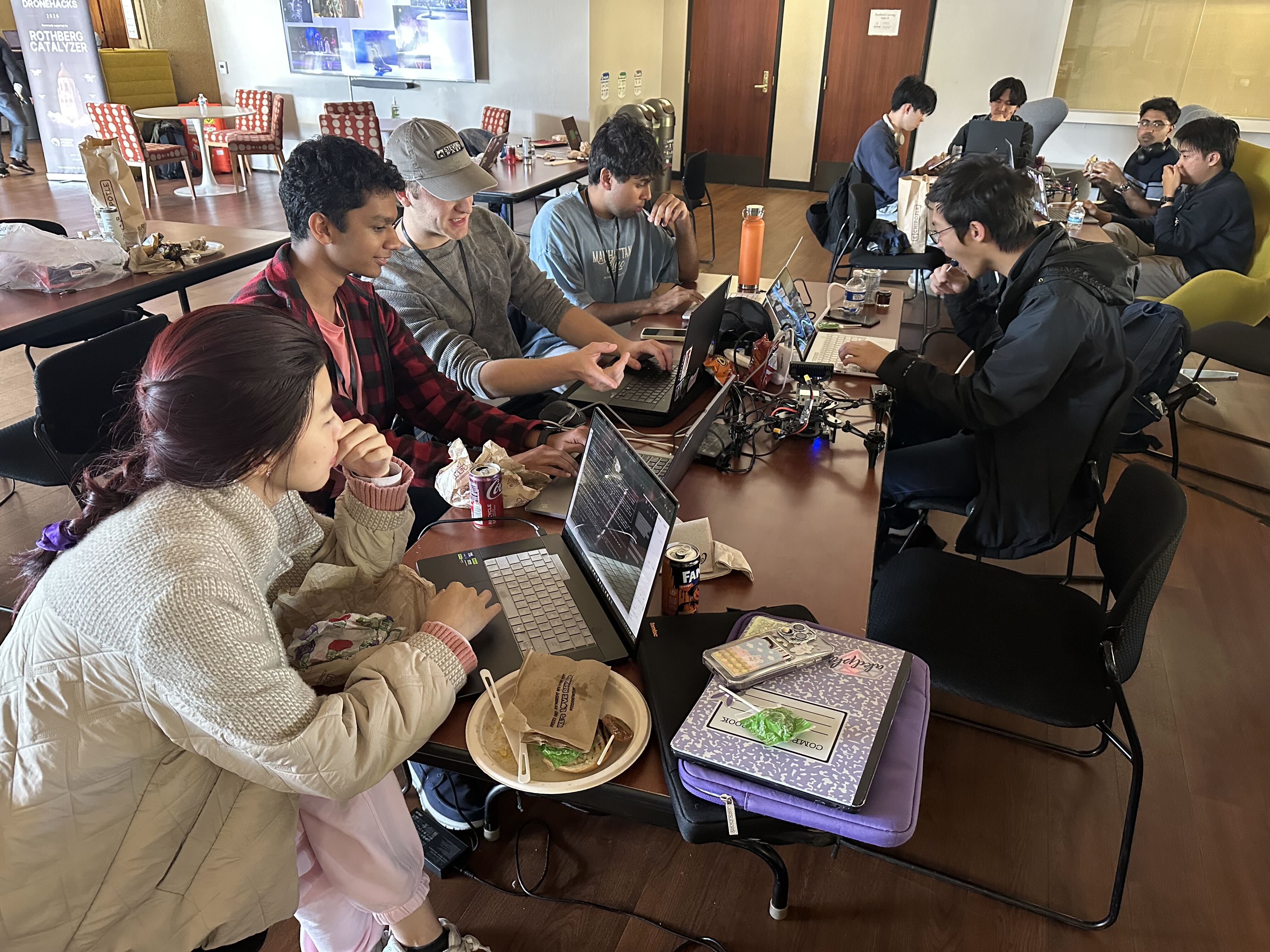
Students from 28 different universities and two countries spent last weekend in Oak Lounge, surrounded by empty energy drinks, countless lines of collective code and the constant sound of drone hums from the room next door. Meanwhile, employees from companies like Skydio, Google Wing, Dronecode and others offered advice as both judges and mentors to the rooms full of students.
From Friday afternoon to Sunday evening, Stanford hosted its first ever DroneHacks — a hackathon with over 100 students participating in teams. For 48 hours, teams attempted to code a fully autonomous GPS-denied drone that can maneuver through an obstacle course.
Organizers initially planned the event for last spring quarter, but delayed it to this fall to ensure safety. “We wanted to be as risk averse as possible,” said Artash Nath ’28, founder and director of DroneHacks.
To start, participants were given identical 7” drones with the same parts. The drones are powered by Pixhawk 6C, Luxonis depth camera and NVIDIA Orin Nanos, according to the events’ website. The team behind DroneHacks built 25 of these drones. Teams either flew them or used them for parts.
“We aren’t sure exactly what to expect, but we have high expectations,” Guilherme Bonfim ’27, a member and challenge lead of DroneHacks, said prior to its start.
The event kicked off with an opening ceremony featuring multiple speakers, including engineers, co-founders and tech directors.
Keynote speaker Noah Rothberg, a trustee for the Rothberg Foundation, the primary sponsor for the event, shared a story about a friend of his being injured on the battlefield last year. Four of Rothberg’s friend’s team members were also killed, making him wonder how differently it could have gone.
He said that “better technology could be the difference between life and death.” He also praised the event, saying, “We have done about a dozen catalyzers… but this was definitely the best organized and put together one by far.”
Later that evening, the teams received their drones, a downloadable simulation that can be used to train and calibrate their drone and other necessary information, which began the sprint to create the best (and most general) software to complete the course.
Throughout the weekend, participants faced breakthroughs, blockades, difficult problems and ingenuitive solutions. One of the largest issues teams faced was the simulation to real life gap; “There is a sim to real gap that pretty much all teams, including us, very much struggled with,” said Jeremy Hsieh ‘29, a Stanford student and member of Dronehacks team “Multi-Agentic B2B N2N DAS” — the first team to complete the course.
Event organizers faced challenges of their own, including an alteration to the course early on and managing flight training from the original flight closing time of 2:00am being pushed to 6:30am so everyone could have the opportunity to practice live and hone in on the drone’s applicable capabilities.
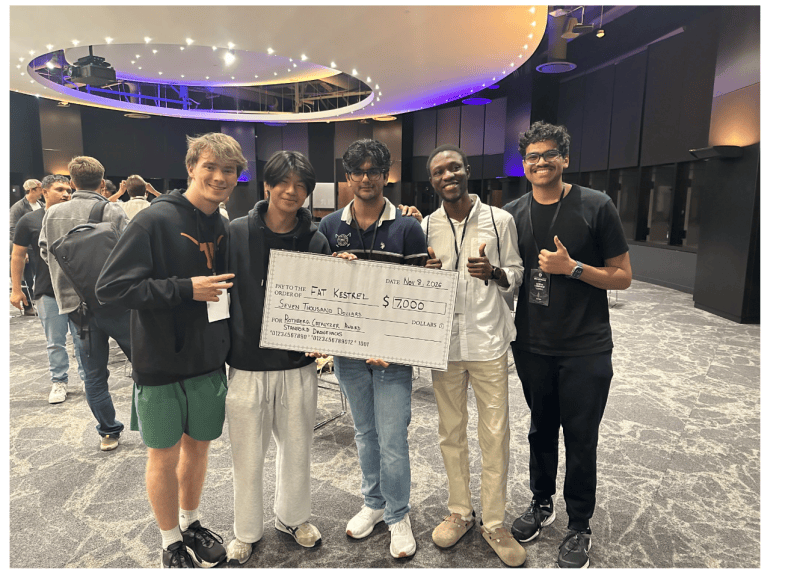
The event concluded with a ceremony, where $15,000 in rewards were handed out. First place and the Rothberg Catalyzer Award went to team “Fat Kestrel” for having the best combined technical impressiveness and course completion.
The team included four sophomores from University of Texas, Austin — Asteya Laxmanan, Matthew Zhang, Robert Schnurr and Anshul Mistry — and Stanford first-year master’s student Nathaniel Asaik, for a prize of $7,000.
They first began working to develop an effective software, which Zhang then spent all Friday night into Saturday morning running in the simulation.
Early on, they already demonstrated a strong sense of teamwork. “I’m looking forward to potentially collaborating with these guys… and it’s good to keep in touch, seeing what next things we can do,” Asaik said Saturday night, just before their first practice on the course.
Through Saturday night and Sunday morning, though, nothing was working for them until their final flight at about five in the morning, when their drone flew halfway across the course. The progress gave them motivation to keep going as they approached the last day, just after a two hour nap.
In an interview after their last flight, which made it across the entire obstacle course and back, they admitted to struggling to work as a team. After they were able to get back on their plan and work together, however, everything began to realign.
The other awards included a second place ($3,000), third place ($2,000), most technologically impressive ($2,000) and runner up for the most technologically impressive ($1,000). Competitors were scored on a point system, with 60% of the points from making their drone to five checkpoints across the course and 40% coming from judges, who gave them points based on technical merit and generality. A bonus 25% went to anyone who made it back to the start from the end.
Sponsors, judges and mentors alike expressed how well the event went, especially since it was student-led. Multiple mentors and judges intended on only being there for a couple of hours, and ended up staying nearly all weekend. Many of these supporters, as well as the student board representing DroneHacks, stressed working under a deadline as a team, gaining hands-on experience to use in future careers, and exposing the drone business to students still searching for their engineering interests.
Anduril was even showcasing one of their drones (with a fake battery), to give students a glance at the latest autonomous drones.
When asked why the company wished to sponsor the event, Farzad Rahbar, the co-founder of FlyX Technologies said, “I think just connecting to the community: giving back, monetarily or in experience. It has also been rewarding for me and also as a company, I’m always looking for talent.”
Asked about the choice of sponsors, some of which included defense companies, Nath said the event was non-recruiting. “They just have the engineers with the most technological expertise to best mentor the participants,” Nath said.
“We want Stanford to be a drone center,” he added.