
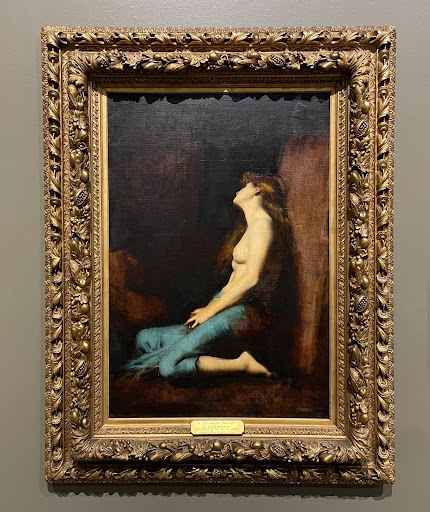
In the European art section of the Cantor, I discovered a painting that felt almost personal. In the “Penitent Magdalene” by Jean-Jacques Henner, a young girl sits on the floor, her back against the brown wall. She looks young, likely around my age, which makes me feel a connection towards her. She sits topless, with her chest bare. Her skin is very pale and bright, which juxtaposes with the dark background, creating a sense of chiaroscuro. Her light brown hair falls below her back. She wears what seems to be a bright blue long skirt that covers her hips and legs. The blue of the skirt is the only colorful aspect of the painting. It makes me question why she is bare-chested while wearing what feels like the bottom part of a dress. What happened to her? Did someone rip the top part of her dress? Did she do it to herself?
What’s striking about her is that she is not facing us; she looks away, towards the darkness of the inner parts of the room she is in. We can’t see her face, except for the left side of it. Her neck stands elongated below the face she is hiding. Why is she looking away from us? Is she embarrassed? Did she do something she hates and she can’t face us anymore? Is she about to cry and doesn’t want us to see? What is she hiding?
Her gaze must be searching for something, something that can pull her out of what feels to me like misery. Perhaps she is looking for an escape from her life. Maybe she wants a new one. Maybe she wants to leave her reality. Something about this pose makes her appear like a normal young girl: a girl who feels ashamed, a girl who feels hopeless, a girl who wants to change things, a girl who wants to escape from her mind. She is pushing herself so close to the wall, as if she wants to become one with it and disappear. In a sense, despite being painted in 1881, she feels eternal. Modern. Looking at her reminds me of myself and the angst that comes with being a girl. I find myself asking, who is she?
With these questions in my mind, I read the description. The woman depicted in the painting, Mary Magdalene, was wrongly identified as a sinner who regretted her past, becoming “a symbol of penance” in Christianity. The painting captures her in this state of regret and contemplation: she regrets that she sold her body. The way she made mistakes in the past yet grew from them through salvation makes her a relatable figure, as she is an embodiment of the idea that we are not perfect. Perhaps that’s why, looking at her painting, she feels so real — she is just a girl who is ashamed of who she used to be, who wants to move on, a girl who doesn’t like what she did. Isn’t this universal? Becoming a saint after penance, Mary Magdalene serves as a reminder that there is always a tomorrow, and there is always a way to change things in life.
Mary Magdalene is usually depicted as looking up to heaven. In George de la Tour’s depiction of Mary Magdalene, she looks at the candlelight, a symbol of illumination and divine light. However, in Henner’s depiction, she stares into darkness; her gaze is lost amongst the dark shadows. Here, she is “turned away from us.” In de la Tour’s Baroque depiction, Mary’s spiritual purification is emphasized through her stare to a source of light, but Henner’s depiction is almost more real – in the real world, we can’t easily find such pure divinity, and we might need to search for salvation through more earthly and darker means.
What I hadn’t noticed in my initial look was her isolation. She is secretive in a sense. We don’t know what’s on her mind. She is almost left alone with her problems, expected to solve the confusions of her mind by herself. Perhaps this loneliness is also common: Henner is able to bring the viewers to relate to her, understand her and find a source of empathy for ourselves.
As I leave the gallery, I take one last look at her, and I smile. Here in this gallery, Henner’s “Penitent Magdalene” will forever stand as a reminder that we can move through our past and find a new self, however difficult the journey might feel.