
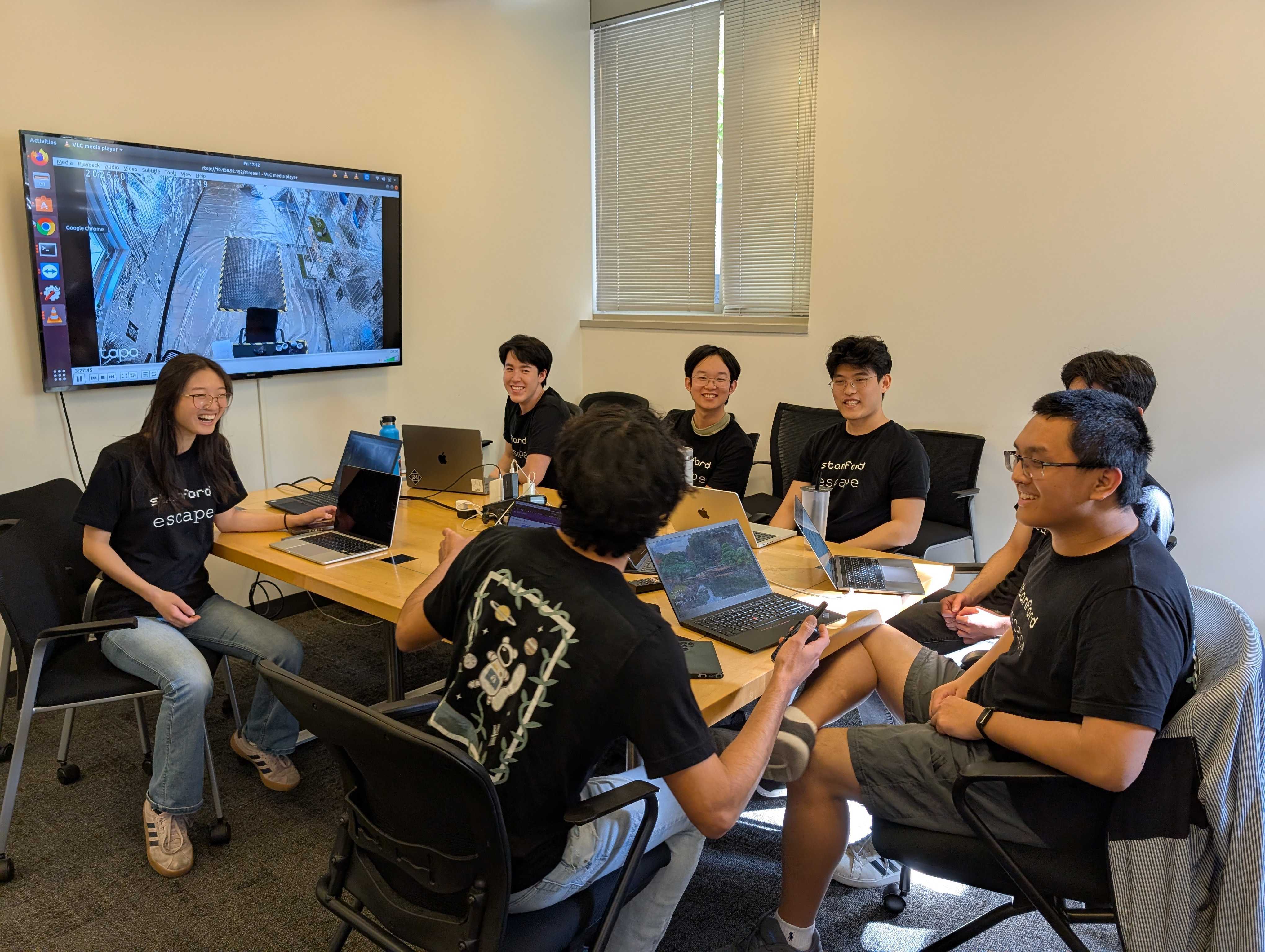
In the “mission control room” at Packard 124, Stanford Escape — the team of computer science, electrical engineering and math majors behind Stanford’s first in-house escape room — huddles around a large screen, watching participants in the room next door navigate a series of interactive, multimedia puzzles.
Stanford Escape is an ad hoc team organized primarily to design and build the escape room, which is free and open for booking by Stanford students and faculty from May 1 to 17. The room welcomes players from all backgrounds and experience levels and is also open to tours for booking. The organizing and engineering team predominantly consists of Stanford Association of Computer Machinery (ACM) and Stanford Robotics club members.
“Most of the team is our friends we’ve made through engineering clubs for the past four years, or [problem] sets or robotics projects. We thought it’d be really cool to put these skills to use for a really fun community wide escape room,” said Sydney Yan ’25, co-lead of Stanford Escape and president of ACM.
Yan then recruited Samuel Do ’24 M.S. ’25, who shared her hobby for escape rooms, to co-lead Stanford Escape. Do and Yan met through the CS198 section leading program, and Do had designed escape rooms for his CS106B students in the past.
The conceptualization of a community escape room started in the summer of 2024. The team began planning the logistics in the fall and meeting regularly in the winter.
“Last quarter was a lot of planning and brainstorming. This quarter we’ve built the stuff, and then we’ve also had a lot of tests done before opening the room,” Do said. Building the room proved more complex than expected, as the team’s initial estimation of a one week and a half turned to five weeks.
The inspiration for the mechanics and optics of the room came from media, video games and past class projects. A few members of the team had interned at SpaceX and some were interested in space, which influenced the theme of the room.
The project is funded by both the ACM, which provided for the decorations, and Stanford Robotics, which supplied much of the hardware. Throughout the building process, the team also made use of materials from Lab 64, an electrical engineering maker lab in Packard open to the Stanford community to work on electronic systems projects.
Archer Date ’26, president of the Robotics club and mechanical engineering major, joined the project after being approached by Yan. Date was involved in crafting printed figurines, manufacturing and 3D printing for the escape room. He said he enjoyed the shared community that emerged from the close work that the team completed.
Despite entering the team not knowing everyone, “we quickly became friends,” Date said. “And so a lot of work sessions were less work sessions and more like a bunch of us coming together and having a good time.”
Sam Chen ’26, an electrical engineering major who joined the project after checking what Date was up to one day, said that he loves escape rooms and that building one was a “dream come true,” enhanced by the positive community and “good vibes” fostered by Yan and Do.
The escape room has been in high demand, with the first batch of tickets selling out within the first 15 minutes of the email announcing the room’s opening to campus mailing lists.
For the Stanford Escape team, seeing the players’ reactions to their months of work is a fun and rewarding time.
“I just love to hear the reactions from the room as the walls are pretty thin. They’re always super surprised when something happens and it’s so cool. I’m just very proud of that,” Do said.
“There was one team we had this morning that was just always yelling at each other. It was so much fun. It’s just great to see the energy everyone has,” said Yan.
Adrian Pan ’28, a player who completed the room with five friends, noted the nice decorations and said that the escape room “exceeded his expectations in every way.”
“The Stanford talent that went into making this an immersive experience really shined through like a laser, and Sam Do’s contributions were especially remarkable,” said Eddy Jiang ’28, another student who completed the escape room.
One of the biggest challenges that the Stanford Escape team faced was malfunctions that required creative solutions under the time pressure of the project.
“Things would just break for no reason and because everyone was doing their own thing, we had to have a week just full of integration. There was a lot of debugging that we had to do there, and then that debugging inevitably led to more things breaking,” Date said.
“I was working on a custom made controller, and that thing just broke, even though I’d been working on it for weeks. A lot of our puzzles, in order to meet this time constraint of needing it the next day, required working very hard to redesign it in some sort of way,” Do said.
The organizers’ vision for the escape room extends beyond their graduation from Stanford.
“I hope, in the future, once this becomes more of a permanent project… there’ll be more people to staff, more people to build. It’ll be a bigger thing overall,” Do said.
Anna Yang contributed reporting.
Correction: This article was updated to accurately reflect that Do designed escape rooms for his CS106B students and a corrected spelling of Eddy Jiang’s name.