
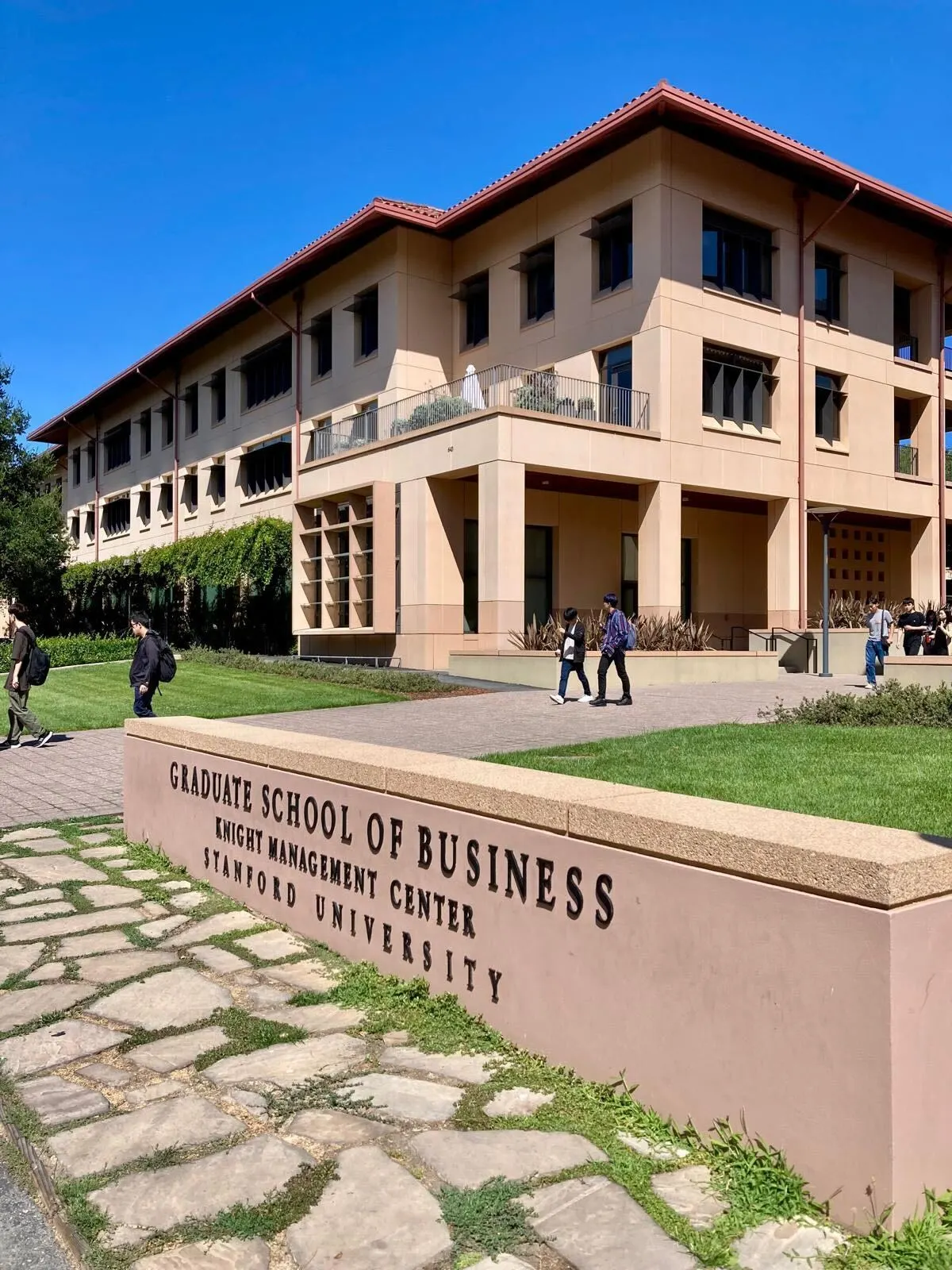
I recently graduated from the Stanford Graduate School of Business (GSB). Coming in with a background in public policy and international affairs, I pursued an MBA to gain fluency in business fundamentals — financial statements, business models, leadership and the like. What I didn’t expect was that I gained not only such skillsets but also shifts in mindset. Today, I’d like to share three such shifts that may be insightful regardless of whether you’re considering an MBA:
1) Embracing the entrepreneurial spirit
Walk onto Stanford’s campus and the first thing you’ll feel is an atmosphere of possibility. Young people are here building multi-billion-dollar enterprises and innovative solutions, driven as much by expertise on what’s possible as by naivete on what’s not possible. Even I, a public policy major, became possessed by this entrepreneurial spirit — especially as I saw how it’s not confined to one profession, but is a way of being. It’s the lens that sees real-world problems as innovation opportunities. It’s the vision untethered by the status quo, not fixed to “what is,” but transfixed by “what could be.” It’s a zeal undaunted by what you don’t know, but willing to figure it out as you go. It’s in equal measure humility and hubris: humility to fail, learn and pivot. And hubris enough to believe that you — yes, you — might be able to make a dent in the universe.
I got a taste of this approach when my startup team was one of eight admitted into Steve Blank’s spring quarter experiential entrepreneurship course, Lean Launchpad. The traditional business method involves spending months on a business plan and millions on product development, only to find out after launch if there’s no customer demand. Steve Blank pioneered a new method, the “Lean Startup,” which emphasizes developing a minimum viable product (MVP) quickly and cheaply, and iterating it alongside customer feedback. For example, to gauge demand for our product, my team and I launched a landing page with a waitlist before we even had a product. Steve Blank encouraged us to “get out of the building” to test our business hypotheses, so over the 10-week course, we conducted 100+ customer interviews. Before, I would have been too uncomfortable to share anything less than polished plans or perfected products. But here, every week we were revising dimensions of our draft business model, and developing new prototypes, from Figma wireframes to mockups using cardboard and 3D printers. By the end, we had a stronger business model and final product than any amount of isolated desktop research could provide. Indeed, many successful entrepreneurs rarely start with a winning business plan. Rather, they start with imperfect ideas that they refine — again and again. Netflix began by mailing DVDs. Shopify started by selling snowboards online.
This experimentation mindset is especially relevant today. We live in unprecedented times, from the accelerating advancement of AI to changing cultural norms. Answers to our questions lie not only in past data, but also in real-time trials. Luckily, in the age of AI, it’s also easier than ever to take action and iterate.
2) Thinking across disciplines
Business school teaches you about the various puzzle pieces to operating an organization — e.g., finance, marketing, human resources, strategy, IT — and how they come together. When aligned, they create leverage. When disconnected, they create friction. Speaking only one professional language (e.g., finance, engineering, marketing) isn’t enough. An effective leader is able to translate and integrate between them and adopt systems thinking.
Further, innovation today often exists at the intersection of disciplines. Some of today’s most transformative fields — fintech, behavioral economics, neural networks — exist because people built bridges across disciplinary boundaries.
Coming from a background in public and international policy, I was used to thinking in an interdisciplinary way. But the GSB pushed me to take that instinct further. As an Investment Director at the GSB Impact Fund, I led a team evaluating early-stage startups. Our best deal analyses didn’t stop at unit economics or market size. We considered policy tailwinds, demographic shifts and regulatory trends.
Now when I’m stuck, I zoom out. I consider what inspiration or tools I can draw from other fields. The breakthrough or out-of-the-box solution just may come from looking sideways.
3) Investing in relationships
Over lunch one afternoon, a professor shared a valuable insight: the most important investment we can make is in the relationships around us. There’s some truth to the saying that “your network is your net worth,” as relationships shape everything from your professional opportunities, to your personal well-being.
Further, behind every great idea and successful execution is a team. The best strategies fall apart without the right people to carry them forward, or adapt them when the environment inevitably shifts. No matter how smart or hardworking you are, you can’t scale or prevail alone.
While I understood this, what surprised me was the extent to which the GSB emphasized interpersonal skills. We have classes like Interpersonal Dynamics (a.k.a. “Touchy Feely”) and Conversations in Management, where we roleplay difficult managerial conversations. Initially, I viewed these classes as a luxury rather than a necessity. Now I realize these skills are a necessity that we at the GSB have the luxury of practicing. At the end of the day, the world runs on people, and people run on emotions. Understanding them is key to a life that is both more influential, and more fulfilling.
The most important relationship, however, is the one we have with ourselves. People will come and go in your life. The one person constantly with you, from birth to death, is yourself. So, audit your inner voice. Do you speak to yourself with compassion? Do you treat your body with care?
At Stanford, we’re surrounded by highly accomplished and ambitious peers, from finance phenoms to celebrities to successful startup founders. It’s easy to compare. However, each person is following their own path and priorities. As one of my professors insightfully commented, “My success is defined by how I feel about my actions and choices every day.”
At the end of the day, knowing yourself and why you do what you do is perhaps one of the most important leadership lessons I learned. The best leaders aren’t just connected to others. They’re also anchored in themselves.