
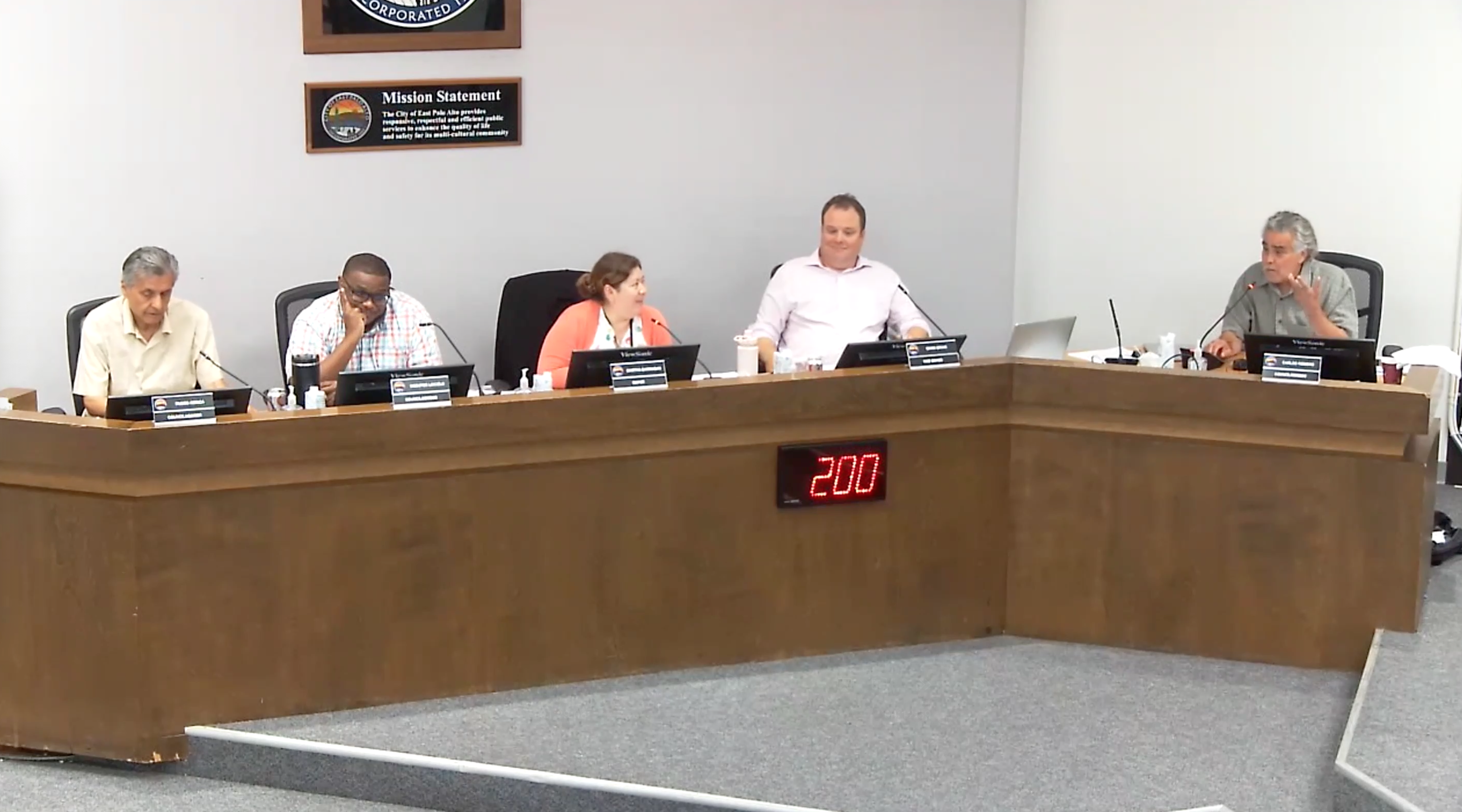
East Palo Alto resident Ravneel Chaudhary submitted a complaint to the City Council on Sept. 16, alleging that council members made the decision to remove council member Carlos Romero prior to the Sept. 10 council meeting and failed to give adequate time for public comment.
Chaudhary’s complaint alleged that the circumstances of Romero’s removal violated the Brown Act, which mandates that the public be notified of open government meetings and allowed to comment on official matters. The act also states that councils are not permitted to make decisions in advance of a public meeting.
This sequence of events stems from a Sept. 2 city council meeting where Romero said that fellow council member Webster Lincoln “may be deaf and dumb,” a violation of the city’s code of conduct. In a public meeting on Sept. 10, the council voted 3-2 to censure and strip Romero of his regional board positions.
Chaudhary, who is also a commissioner for East Palo Alto’s Public Works and Transportation Commission, claims the council failed to adhere to the Brown Act during the Sept. 10 meeting by limiting public comment.
“I firmly believe that if you’re going to have any form of censure or any big item like this, there needs to be a public engagement, and the public needs opportunity to speak,” he said in an interview with The Daily.
“The meeting was scheduled immediately prior to a rent board meeting, creating a hard stop at 7:00 PM and severely limiting public comment on this significant agenda item,” wrote Chaudhary in the complaint. “Many residents who submitted slips according to procedure or tried to raise their hands on Zoom were unable to speak.”
City Attorney John Le responded to Chaudhary’s letter, writing that “the City Attorney’s office does not believe a violation of the Brown Act has occurred.”
The letter states that the Mayor has the authority to set “reasonable and equitable time-place–manner restrictions.”
“The City does not view the proceedings in question (or its remedy) as censoring the speech of Councilmember Romero,” Le wrote to The Daily.
In response to Le’s statement, Chaudhary said he still believes Lincoln’s statement and the council’s deliberation at the Sept. 10 meeting constituted a Brown Act violation.
“It seems more like this meeting was a formality versus an actual hearing with due process about what the accusations were and what the proposed sanctions should have been,” he said in an interview with The Daily.
Chaudhary also claims the council violated the Brown Act by making decisions in advance of the Sept. 10 meeting, evidenced by a statement Lincoln wrote beforehand that was included in the meeting agenda.
Chaudhary’s complaint requested the city council correct this potential violation by “rescinding or readdressing the council action regarding the censure and removal of Council Member Romero from regional boards, with adequate public comment opportunity.”
According to Lincoln, the claims that Lincoln’s statement violated council policy would implicate Romero of the same violation, as he also submitted a statement prior to the Sept. 10 meeting.
“The fact that only certain council members are being targeted suggests to me this complaint is politically motivated retaliation,” he wrote to The Daily.
“We bent over backwards to make sure that we didn’t violate the Brown Act,” Vice Mayor Mark Dinan said in an interview with The Daily. “This is stuff that city staff are very well versed in and there was nothing done. I did not talk to Webster Lincoln or Carlos Romero or [council member] Ruben Abrica about this item before the meeting.”
Lincoln wrote in the impact statement that Romero’s comments used “outdated, derogatory language that has historically been used to marginalize and demean people with disabilities.”
Romero, who also wrote a statement in the Sept. 10 agenda packet, apologized for his comment, writing, “I recognize that this outdated phrase carries painful history and is now considered a pejorative term.” Romero wrote that his comment was a result of frustration.
“Councilmember Lincoln interrupted me, without holding the floor, to end debate on a controversial Inclusionary Housing Ordinance (IHO) agenda item no less than three separate times,” Romero wrote in the statement.
Romero also acknowledged that shortly after he made the comment, he apologized three times, explaining that “no personal offense was intended” towards Lincoln and “the use of the phrase referred to [Lincoln’s] lack of listening and not his intelligence or mental acuity.”
The Daily has reached out to Carlos Romero for comment.
According to the city, Romero’s behavior isn’t an isolated incident. On June 3, Romero made inappropriate comments about Vice Mayor Dinan’s child and received a warning that future violations would result in formal sanctions.
“Carlos was very, very clearly warned that speaking like he has was breaking the code of conduct, and that there would be consequences if he did the same thing again,” Dinan said. “For the second time, in three months… he shot his mouth off, and that’s not how you’re supposed to do business as a city.”
Romero additionally wrote an email in 2017 that included the phrase “let the bastards sue us” in reference to a water company board that included Lincoln’s grandmother, Lincoln’s mother and other elderly Black women.
“This establishes what I see as an eight-year pattern of using derogatory language toward Black community members in positions of service,” Lincoln wrote to The Daily. “In my opinion, the censure addressed a documented pattern of conduct unbefitting an elected official.”
While Romero is still able to speak at City Council meetings as a resident, he is unable to continue serving on any of the city’s regional boards.
“Folks may disagree with what we did at that meeting, but there was no Brown Act violation,” Dinan said. “A lot of the allegations are just a misreading of what the Brown Act actually is and isn’t… and I encourage everybody who does local government in the state of California to actually study the Brown Act if they think there was a Brown Act violation.”