
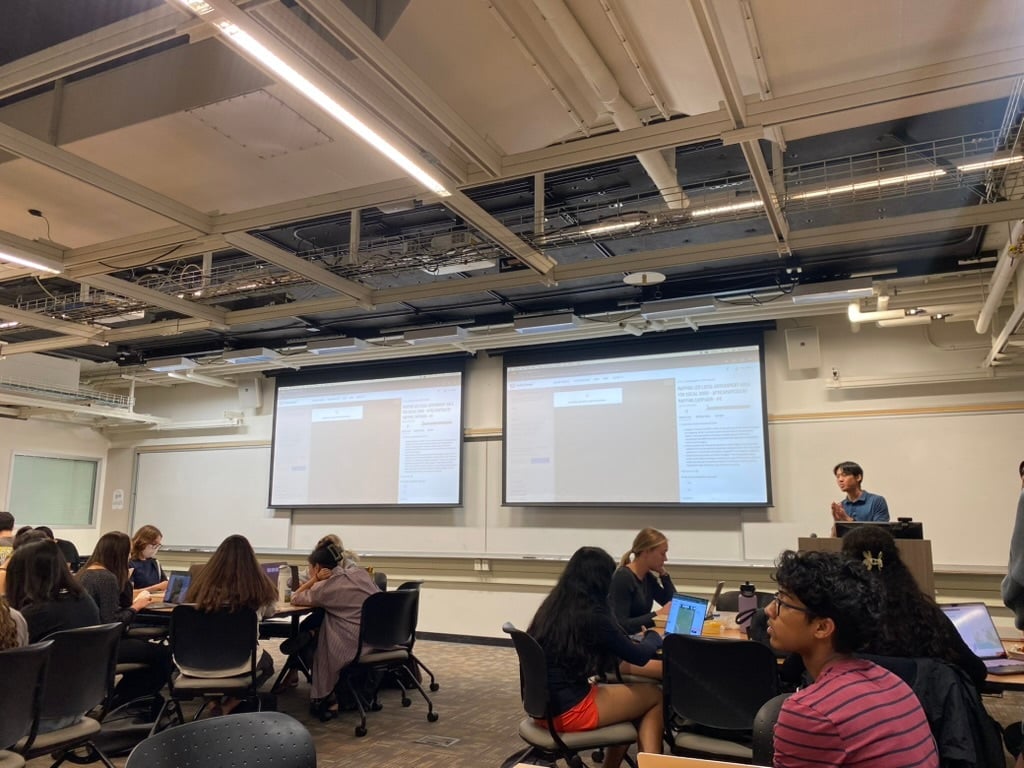
Light music, keyboard clicking and the smell of catered Zareen’s emanated from a small room in the Stanford Medical School as three dozen students huddled around tables digitally tracing roads and houses on their computers. On Monday, the Global Health Club hosted a “Mapathon” event to help provide disaster and health aid to underserved communities by improving mapping in those regions.
The Global Health Club aims to create a global health community, connect people to related opportunities and create mentorship for students interested in the field. During this year’s annual Mapathon, students carefully annotated satellite images from Izzi, Nigeria, marking new routes in the hopes of improving relief in the event of disaster or disease.
The work is part of a larger organization called Humanitarian OpenStreetMap Team (HOT), a team engaging in humanitarian efforts through open mapping. HOT uses OpenStreetMap (OSM), an open-source world map, to improve coverage of under-mapped communities, and these maps are then used by charitable organizations like Doctors Without Borders to deliver aid to underserved communities.
William Harrison ’29 attended the event through casual interest. He came to appreciate the cooperative nature of global health work and the importance of filling the mapping gap.
“I had not really thought about how GIS and NGO governmental work would intersect, but it seems like it’s definitely more important than I would have previously realized,” he said. “I hadn’t realized how critical and incomplete this data is. It makes the mapping feel even more important.”
Open-source maps were the building block of the Mapathon event. “OSM is the Wikipedia of maps,” Max Yang ’27, president of the Global Health Club, said. HOT not only involves volunteers, but also connects with a larger disaster response network.
“HOT is part of Missing Maps, a coalition that includes disaster response groups like the American and British Red Cross,” Mapathon guest speaker Anne Sorensen, Director of Philanthropy for HOT, said. “We all need timely, accurate geospatial data.”
Anne Sorensen has been with HOT since 2022, and at the Mapathon she explained that Google Maps is “not always accurate and other data is not widely accessible,” which makes the mapping project especially important.
“In these more rural communities it is harder to encourage these ‘Apples’ and ‘Googles’ to map there,” Yang said. HOT then comes in to fill this gap.
Some of the mapping is used immediately to help communities struck by disaster.
“We’ve done a couple of projects recently mapping in Gaza and mapping in Lebanon that again are places where it’s not safe to be on the ground … people want to do something and this is a way to channel that desire to support and to be involved in something that is needed and really impactful,” Anne Sorensen said.
The mapping is also useful for community resilience after a catastrophe. Humanitarian organizations use this information to help inform future responses and prevent future damage. Some disasters HOT has provided aid for include the recent 2025 Ebola outbreak in the Democratic Republic of the Congo, the 2023 Turkey-Syria Earthquake and the 2010 Haiti Earthquake.
Other mapping is more preemptive. The Mapathon’s work on Izzi, Nigeria, a community at risk for disease outbreak, enables appropriate services to better locate people in need should an emergency arise. “Mapping helps medical services and NGOs know where the people they need to serve actually are,” Hailey Ramzan ’27, co-vice president of the Global Health Club, said.
A little bit can go a long way, too. According to Anne Sorensen, “Mapping can feel empowering when global crises make people feel helpless. It’s a way to contribute meaningfully from afar.”
The attendees, many first-timers to the club, enjoyed the opportunity to learn something new. “I’m not super techy, so this was a cool way to do something different and still related to global health,” Annika Nehrig ’28 said. “It was surprisingly easy to learn and really rewarding. I’d definitely do it again.”
Others enjoyed the calming nature of the task. “It was oddly meditative. I might end up doing it on my own,” Harrison said.
To Priyanka Kudallur ’29, the event provided greater insight into global health work. “I’ve always cared about healthcare inequities, and this gave a tangible view of how NGOs and crowdsourcing connect … It was simple, but powerful — we were literally adding data to a live map of underserved areas.”
In all, over 1,080 buildings were mapped in just a couple hours.
The Mapathon is just one of many events the Global Health Club is hosting this year. “I hope people leave knowing they can make a difference. Global health doesn’t have to feel distant,” Yang said.
Other upcoming events include a SASH Scholar Spotlight and a Global Health Opportunities Fair. The Global Health Club also meets every Tuesday, where they host guest speakers and discussions.
“Giving an hour of your time to a cause like this is really meaningful,” Ramzan said. “I really hope that attendees can leave with a more empathetic heart.”
Correction: This article has been updated to reflect the correct designation of Hailey Ramzan, the correct full name of Anne Sorensen and the correct organization name of OpenStreetMap. The Daily regrets this error.