
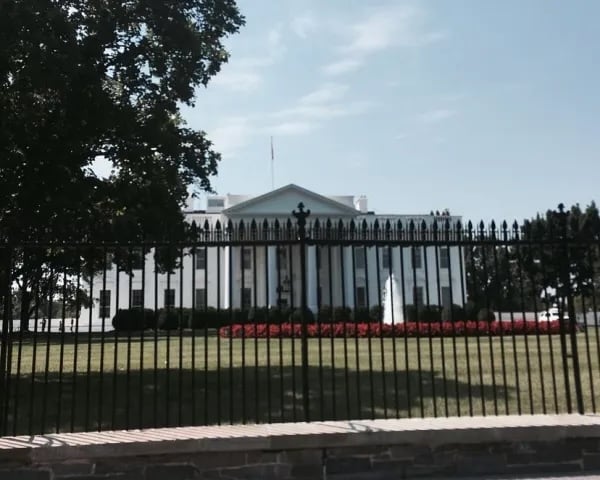
Since the federal government shut down on Oct. 1 after the Senate’s failure to pass a budget for the new fiscal year, hundreds of thousands of federal employees have gone on unpaid leave or work without pay. Though the shutdown is unlikely to impact existing government-funded activities on campus, students, faculty and staff are likely to feel some effects of suspended federal services in the coming weeks.
In a Sept. 30 announcement, Vice Provost and Dean of Research David Studdert wrote that “federal research activities on campus can largely continue during a federal shutdown,” although “evaluations of new proposals will stop.”
Additionally, University media relations director Luisa Rapport wrote in an email to The Daily that the University does not “expect disruptions to the delivery of federal student financial aid.”
The shutdown will also not affect research at the SLAC National Accelerator Laboratory, according to a spokesperson for the Department of Energy (DOE).
“DOE’s Office of Science laboratories are not currently experiencing a lapse in funding and continue to operate in a normal capacity,” wrote Emery Washington, deputy press secretary for the department’s Office of Public Affairs.
The DOE’s website further states that many of its activities draw from funds not tied to a specific fiscal year, allowing some employees to avoid furlough, or unpaid leave.
However, the government shutdown has affected the Stanford in Washington (SIW) off-campus program, where some students have been furloughed from their internships.
Jill Vizas ’97, the SIW on-campus program manager, said that “more than half” of the fall 2025 cohort is unaffected. However, some students working for the federal government have been furloughed, depending on “how offices categorize workers.” For example, House of Representatives interns have been furloughed — but not Senate interns.
Vizas added that SIW students are still learning during the shutdown: the program’s classes have been unaffected and students still have opportunities to learn beyond the office.
“One of our instructors… was testifying before the Senate Foreign Relations Committee about China and cybersecurity, and [students] got to go to the hearing. They might not have had time if they had to go to work,” Vizas said.
Beyond Stanford, the shutdown’s effects will nevertheless become increasingly noticeable, according to Bruce Cain, a professor of political science.
“Until Americans see that whatever happens in D.C. affects their lives, it’s all abstract,” Cain said. “But when it affects their lives personally [and] they can’t get the government services they need, then they begin to see that it matters.”
Cain noted that during a shutdown, no federal workers are processing research grant applications and student athletes could experience travel delays due to air traffic controller shortages. According to Cain, as the shutdown continues, more essential employees may protest. Some employees may begin taking sick days instead of working without pay, Cain said.
Cain added that growing political polarization and obstruction in Congress have caused longer and more frequent government shutdowns, which are “neither popular nor effective.”
Republicans, Cain said, are relying on rescissions, a process whereby Congress can cancel previously appropriated funding. He said that rescissions allow the Trump administration to “slowly achieve what they want to achieve, which is to reduce the federal government substantially.” Democrats hope a vote on the government shutdown will force Republicans to take responsibility for funding cuts, he said.
Cain is pessimistic that the problem of government shutdowns will be resolved in the future. As a potential solution, he cited a successful 2010 ballot measure in California.
“We stopped paying the elected officials during the shutdown,” Cain said. “I’ll bet… that if you stopped paying members of Congress when they don’t pass a budget, you would end the process like that,” he said, snapping his fingers.
With no resolution to the shutdown in sight, Cain said Americans will soon “discover why you have government.”
Correction: This article was updated to reflect that the full formal name of SLAC is SLAC National Accelerator Laboratory, and SLAC is no longer an acronym. The Daily regrets this error.