
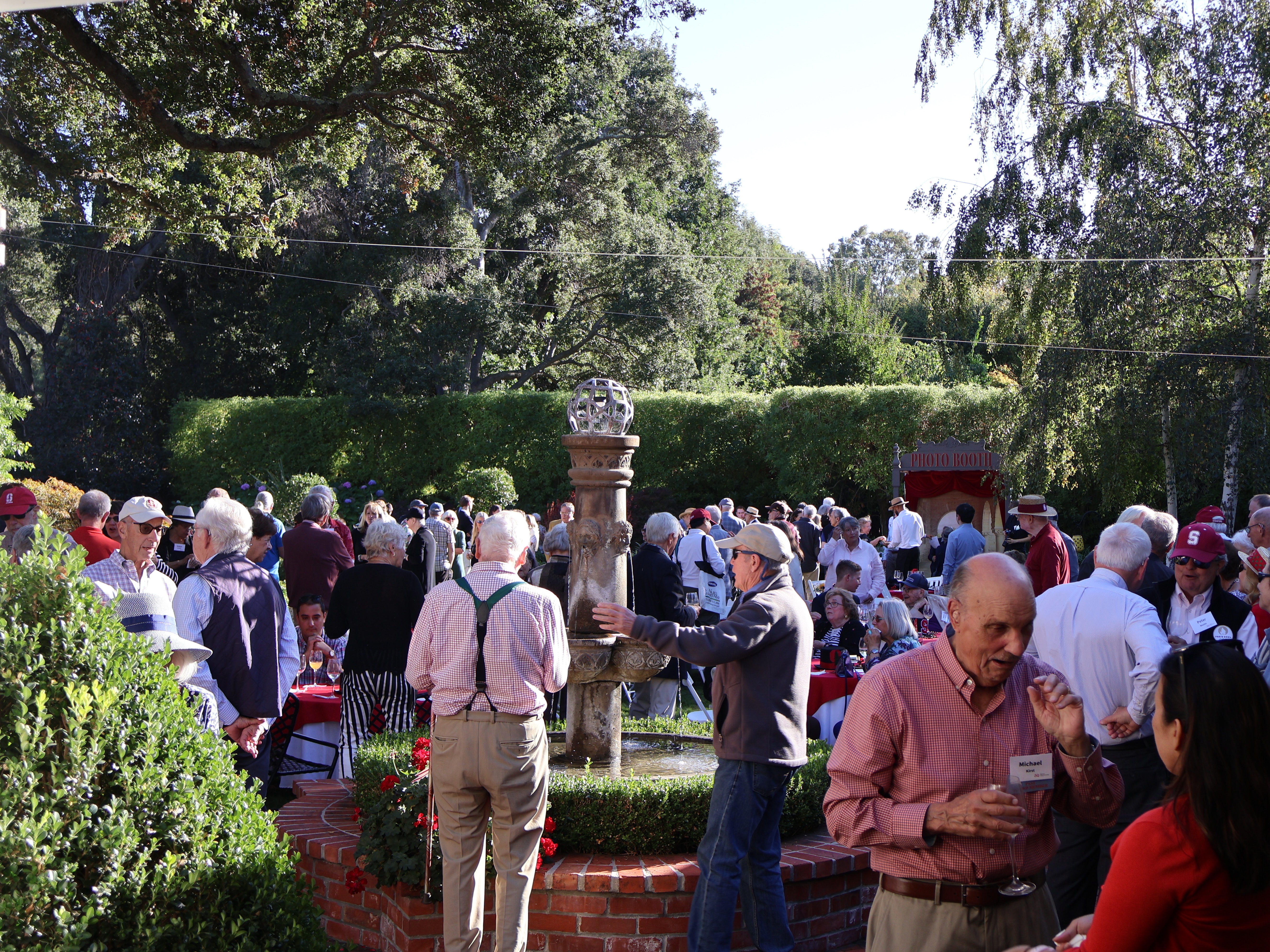
On Sunday, the Stanford Historical Society (SHS) kicked off their 50th anniversary year with a backyard celebration of the past, as well as a glance toward the future.
The event, which was held at a historic campus house designed by architect William Wurster, featured exhibits of Stanford artifacts, displays of historic memorabilia, a speech by emeritus professor and Pulitzer Prize-winner David Kennedy ’63 and more.
“We today, here on this campus, in our lifetimes, we are digging in the wells that some future generations will drink from,” Kennedy said in his speech. “We are kindling the fires from which they will warm themselves. We’re planting the orchards from which they will harvest.”
With over 800 members, SHS supports the preservation and examination of Stanford’s history. From publishing books to organizing guest lectures and conducting oral history interviews, SHS provides opportunities to engage with the University’s history.
“The objective of the society is to try to be accurate,” SHS president Larry Horton ’62 said. “We study any parts of Stanford history, including things that might not be favorable. If you’re going to study history, you have to study the good and the bad.”
The organization brings to light many of the more obscure parts of Stanford’s history, both on and off campus.
“The history presented at the Historical Society is more intimate and personal than a class,” said Henry Segal ’26, the only student member on the SHS board.
The 50th anniversary celebration included several tributes to Stanford’s history, giving the already historic house a museum-like quality. One room displayed an exhibit of photographs from Leo Holub, the founder of Stanford’s photography program. Another room presented a “Plug Ugly” hat straight from the days of the now-ancient Stanford tradition of a satirical performance involving hand-painted hats that ended in 1915.
“I love throwing parties. I love opening up an old home like this, and I really love having both faculty and students enjoy a home like this,” said SHS board member Sunny Scott, who hosted the event at her home. “I have lots of memorabilia to share and people are generally delighted. This was one of the best events.”
As the members reflected on 50 years of the organization’s history, they also looked to the future of the organization.
“Part of the mission of the Historical Society, I’m very happy to affirm, is that not only is it expert at recollecting what happened before us, but preserving what we’re doing right now for the benefit of future generations,” Kennedy said in his speech.
Andy Pflaum MBA ’99, a member of SHS, said he was looking forward to documenting Stanford’s role in an evolving higher education system in the next 50 years.
“Stanford came in at kind of an inflection point, or created an inflection by being co-ed, one of the most prominent universities of the time to be co-ed,” he said. “So it was sort of at the cusp then and now, as the role of the university continues to evolve, hopefully Stanford will be something of a leader and we’ll be able to document that and look back on that 50 years from now.”
Many members said they hope more students will get involved with SHS in the future.
“Before I was in this, I would say, ‘I know the school,’ meaning I know what it looks like, I know that it’s beautiful, I know how to get places. But it’s really the personality that makes you feel, not just belonging but that you have a responsibility to this,” Segal said. “It’s a bit like patriotism, in the way that I may have felt patriotic after reading about the revolution. The same way people think it’s important to understand basic things about civics, I think you should give a little bit of attention to Stanford. When you come here, you’re a citizen of Stanford first.”